























How to Build a Fitness App for Women: Key Features and UX Considerations


- Market & Audience Insight: Why Women-Fitness Apps Matter
- Strategic Foundation: What Enterprises and Startups Should Define Before Development
- Key Steps for Women's Fitness App Development: Roadmap & Process
- UX & Design Considerations: How Poor Design Increases Churn and Compliance Risk
- Key Features of a Women-Centric Fitness App
- UX & Features Checklist (Quick Guide for Teams)
- Common Challenges of Women's Fitness App Development and How to Avoid Them
- Measuring Success: KPIs & Metrics for Enterprises and Startups
- Why Partner with Appinventiv for Female-focused Fitness Mobile App Development
- Frequently Asked Questions

Key takeaways:
- The women’s fitness app market is growing fast. But it still lacks solutions designed around women’s real health and lifestyle needs.
- Successful fitness app development for women should not focus on one-size-fits-all workouts. It also needs to offer personalization, safety, and motivation.
- UX plays a major role. From easy onboarding to confidence-boosting visuals, every screen must connect emotionally with users.
- It’s essential to partner with an experienced tech team. They should understand women’s health, compliance needs, and scalable architecture ensures faster delivery and better outcomes.
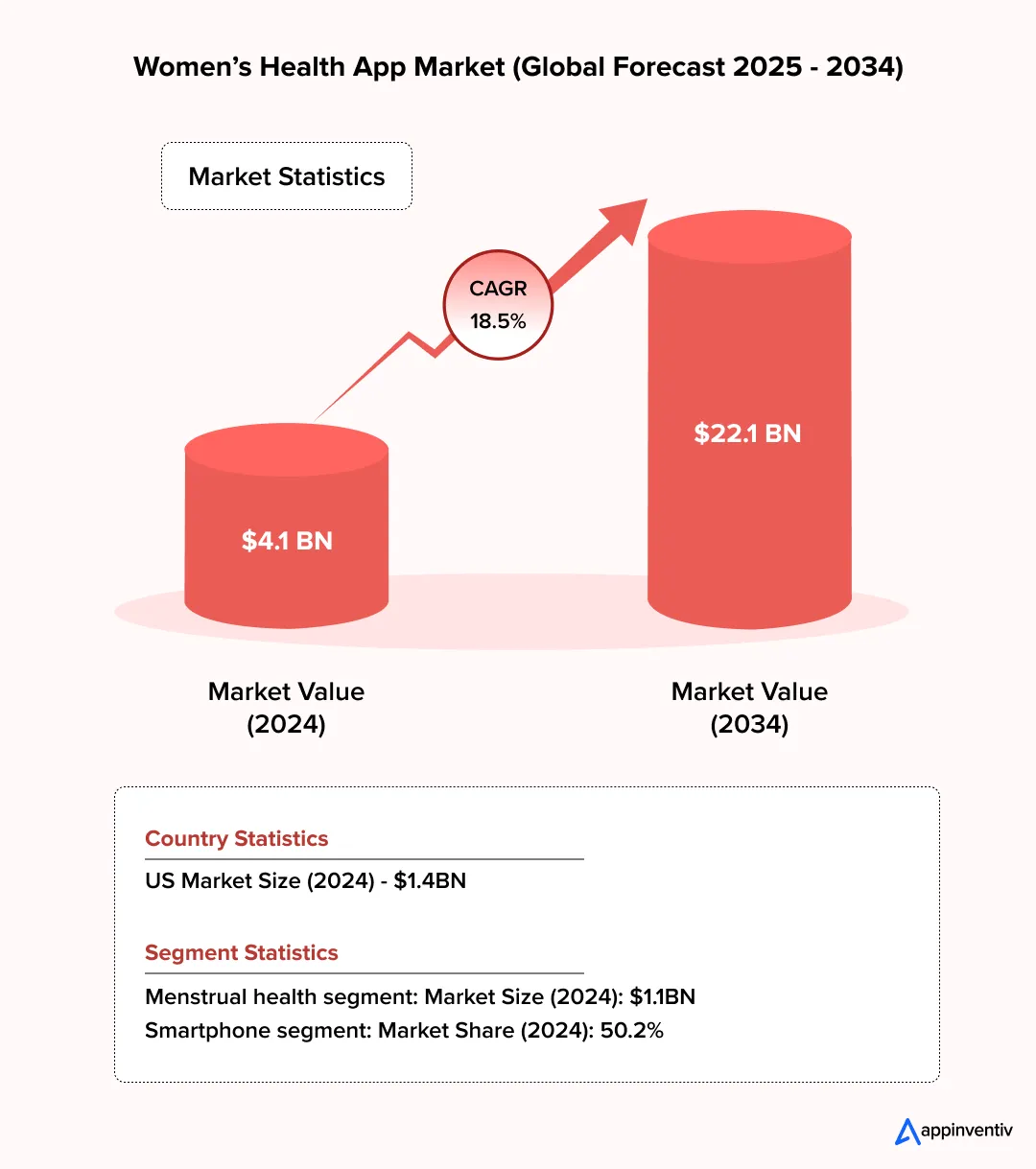
Women’s fitness apps are reshaping digital wellness and creating a clear business opportunity for gyms, insurers, corporate wellness teams, and travel and hospitality brands. The global market for women’s health apps is projected to reach $22.1 billion by 2034 (GMI).
A well-built women’s fitness app does more than log workouts: it drives brand engagement, sustains customer relationships, creates new revenue channels, and yields actionable data. Success requires product design that reflects women’s life stages, goals, constraints and privacy expectations. UX, feature selection, data handling, community controls and enterprise integrations must all align with those needs.
This guide explains how to build a women’s fitness app at enterprise scale. By the end, you’ll have a concise blueprint to build or upgrade a women’s fitness app that meets both user needs and enterprise goals.
Because women dominate wellness use, your next fitness app must be designed for them.
Market & Audience Insight: Why Women-Fitness Apps Matter
Demand for women-focused fitness apps is rising rapidly, presenting a clear opportunity for gyms, insurers, corporate wellness teams, and travel brands. The global women’s health app market is projected to reach $22.1 billion by 2034 (GMI).
Women seek products that reflect life stages, from postpartum recovery to menopause, plus personalization, safe community spaces, and routines that fit busy schedules.
Existing apps (for example, Sweat and Women Workout) succeed at simple programs and short home routines but rarely cover the full lifecycle or enterprise needs, such as advanced tracking, compliance, and white-label capabilities.
For enterprises, a well-designed women’s fitness app can drive long-term engagement, generate recurring revenue, and surface consented behavioral insights that improve content and partnerships. That combination is the real differentiator for user relevance plus enterprise readiness.
Enterprise Architecture Principle
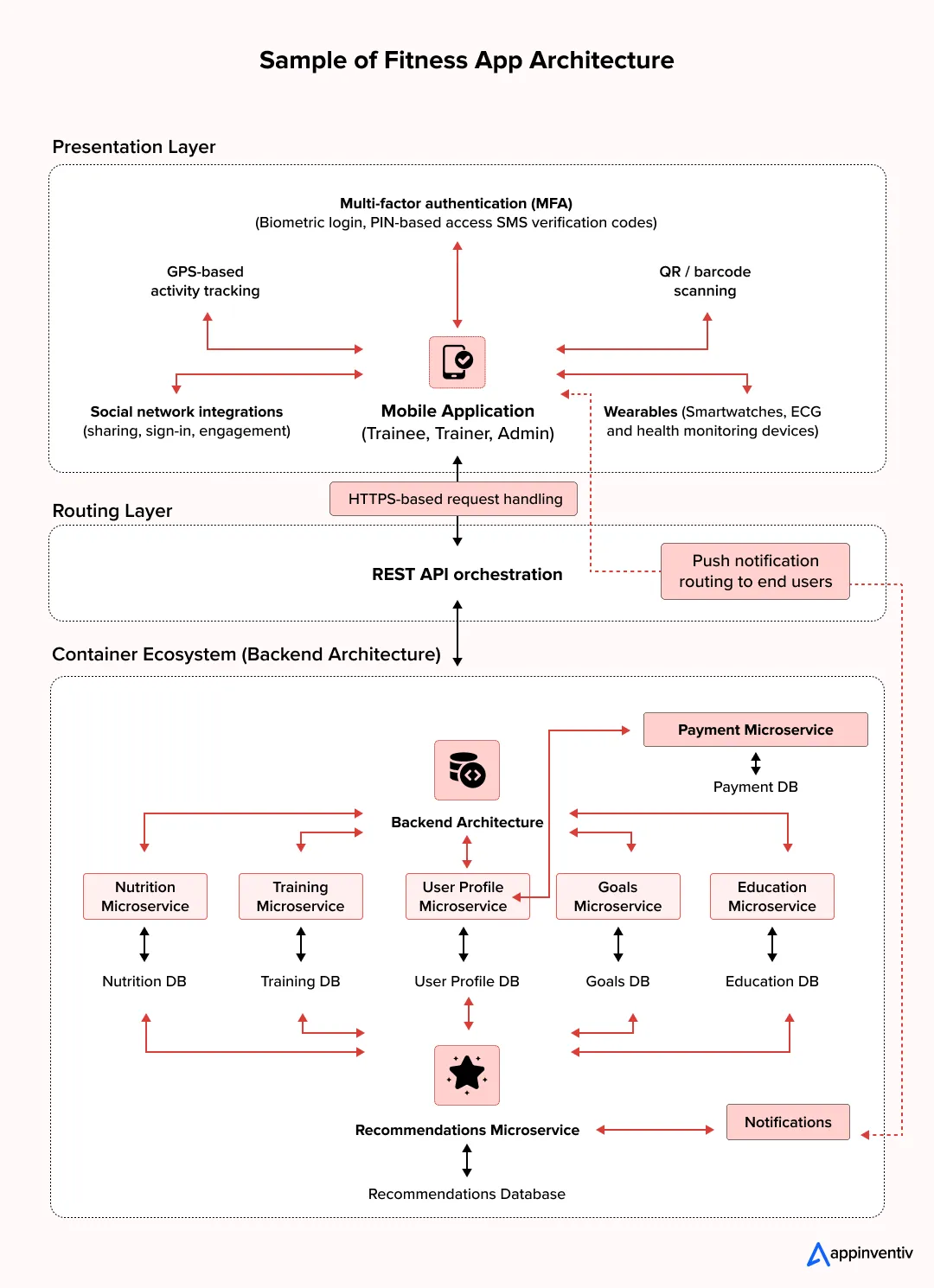
Monolithic fitness platforms fail under seasonal load spikes and feature expansion. A containerized microservices architecture allows independent scaling of high-traffic modules, such as live streaming, nutrition tracking, or wearable sync, without system-wide downtime.
Strategic Foundation: What Enterprises and Startups Should Define Before Development
Before you begin building a fitness app for women, set a compact strategy that balances user relevance with enterprise discipline. A focused plan prevents rework, speeds decision-making, and ensures the product serves real users while meeting business objectives.
1. Business Objectives and Success Criteria
Define what features you want in your fitness app and what success looks like for you in business terms: revenue streams (subscriptions, corporate contracts, partnerships), target retention rates, and strategic aims (brand extension, membership growth, or improved client outcomes).
Attach one measurable goal to each objective so product decisions map directly to outcomes. For example, a target free-to-paid conversion rate or enterprise adoption percentage.
2. Primary User Segments and Use Cases
Identify two to four target personas (e.g., busy professional, postpartum returner, peri-/menopausal user, enterprise employee enrolled via corporate wellness).
For each persona, document key constraints (time, privacy), primary goals, and the single most valuable feature that addresses them. This prevents one-size-fits-all designs and prioritises content that matters.
3. Strong Value Proposition
State, in one sentence, what makes your app different for women and why they should choose it over general fitness tools.
Examples: “clinical-grade postpartum recovery paired with short daily strength sessions” or “cycle-aware strength plans for busy professionals.” A crisp proposition guides product scope and marketing.
4. MVP Scope and Prioritisation
Define a narrow MVP that proves product-market fit without overbuilding. Recommended must-have items for an enterprise-ready MVP:
- Simple onboarding with goals and life-stage selection (must-have) → KPI: onboarding completion rate
- Core workout library (short + structured plans) (must-have) → KPI: workouts-per-week
- Progress tracking and basic analytics (must-have) → KPI: Day-7 retention
- Basic privacy/consent controls and secure sign-in (must-have) → KPI: support tickets on privacy
Next-release features: menstrual-cycle suggestions, pregnancy/postpartum modules, wearable sync, white-label support and admin dashboards.
5. Governance, stakeholders, and review cycles
Appoint owners: product (roadmap), clinical (content), security/compliance (data handling), and commercial (monetization).
Define weekly and monthly review gates to evaluate metrics, content safety, and regional compliance. This is critical for enterprise procurement.
6. Data, Privacy, and Compliance Baseline
Design the app with a consent-first model. Key architectural decisions should include encryption in transit and at rest, role-based access controls, centralized consent logs, and tokenized identifiers for analytics. Identify regulatory checkpoints per market (e.g., GDPR, HIPAA). For enterprise customers, expect SOC 2 or ISO 27001 evidence.
7. Technology and Integration Choices
Decide the integration surface early: SSO (SAML/OAuth) for corporate clients, wearable APIs (Apple Health, Google Fit), payment processors for subscriptions, and optional telehealth hooks.
Prefer modular microservices for independent scaling of high-traffic features (live streams, recommendations, payments).
8. Operational Readiness and SRE Considerations
Plan monitoring and incident response before launch. Define acceptable performance targets (e.g., p95 API latency objective, acceptable crash rate), logging and alerting thresholds, and an escalation path for enterprise incidents. Include a retention and backup policy for health records.
9. Monetization Model and Commercial Terms
Map revenue channels to product features: subscriptions for ongoing access, pay-per-class for live sessions, corporate bulk licensing, and partnerships for co-branded programs.
Draft pricing tiers that align with usage (individual vs corporate) and consider trial flows that convert efficiently.
10. Content Strategy and Clinical Oversight
Define who produces content and how it’s validated. For life-stage content (pregnancy, postpartum, menopause), require clinical review and version control. Specify a cadence for content refresh and personalization rules to keep recommendations relevant.
11. Metrics That Prove Value (executive-level KPIs)
Track a concise dashboard for leadership:
- Acquisition: New sign-ups, CPA
- Activation: Onboarding completion rate, Day-1 retention
- Engagement: DAU/MAU, workouts completed per active user
- Retention: Day-7 and Day-30 retention, churn rate
- Monetization: Free→paid conversion, ARPU, subscription renewal rate
- Enterprise: Corporate adoption rate, admin-dashboard usage
- Quality & reliability: Crash rate, average API latency, support response time
- Privacy: Number of consent revocations, privacy-related incidents
Key Steps for Women’s Fitness App Development: Roadmap & Process
A disciplined, outcome-driven roadmap reduces risk, shortens time-to-value, and aligns product choices with business goals. Below is a phased fitness app development process tailored for women, with clear deliverables, enterprise checkpoints, and measurable KPIs for each stage.
Phase 1: Discovery & Research
Purpose: validate demand, identify high-value personas, and define success metrics.
Deliverables: user interviews, competitive audit, persona profiles, hypothesis-driven feature list, target KPIs.
Enterprise considerations: include legal, clinical, and commercial stakeholders in discovery to capture compliance and partnership requirements early.
KPIs: validated personas (≥3), prioritized feature list, target Day-7 retention benchmark.
Phase 2: Strategy & Scope (MVP Planning)
Purpose: convert research into a concise product scope that proves product-market fit without overbuilding.
Deliverables: MVP backlog (must-have vs. next release), monetization model, go-to-market hypothesis, success criteria.
Enterprise considerations: determine corporate licensing needs (SSO, admin dashboards) and procurement evidence (SOC 2 / ISO readiness).
KPIs: defined MVP success metrics (onboarding completion, conversion target), estimated TTM (time-to-market).
Phase 3: UX, Content & Compliance Design
Purpose: design user journeys that respect life stages, privacy, and accessibility while optimizing activation.
Deliverables: onboarding flows, persona-specific home screens, content taxonomy, moderation policy, accessibility checklist (WCAG), consent flows.
Enterprise considerations: clinical content review cycles, privacy-by-design documentation, brand/white-label variants.
KPIs: onboarding completion rate, accessibility compliance score, consent opt-in rate.
Phase 4: Architecture & Tech Planning
Purpose: define a secure, modular architecture that supports scale and integrations.
Deliverables: high-level architecture (microservices vs monolith), data model, API contract, integration map (wearables, Apple Health/Google Fit, payment gateways, SSO), security baseline.
Enterprise considerations: plan for data segregation, encryption (in transit & at rest), centralized consent logs, and compliance evidence (GDPR, HIPAA, where applicable).
KPIs: p95 API latency targets, data residency plan completed, integration readiness.
Phase 5: Incremental Development (Sprints)
Purpose: build features in short cycles with continuous validation.
Deliverables: working releases per sprint, automated tests, feature flags, CI/CD pipelines.
Enterprise considerations: enforce security scans in CI, require release gating by product, security, and clinical owners. Use feature flags for controlled enterprise rollouts.
KPIs: sprint velocity, automated test pass rate, defect escape rate.
Phase 6: Quality Assurance & Pre-Launch Validation
Purpose: ensure stability, safety, and performance across target devices and regions.
Deliverables: functional QA, security penetration testing, performance/stress tests, accessibility validation, and compliance checklist sign-off.
Enterprise considerations: third-party audit (SOC 2 Type I/II) where required; create incident response runbooks for enterprise customers.
KPIs: crash rate < target, load test throughput, remediation SLA for critical issues.
Phase 7: Launch & Controlled Rollout
Purpose: release the app with mechanisms to monitor adoption and mitigate risk.
Deliverables: phased rollout plan (beta → soft launch → full launch), onboarding campaign, analytics instrumentation, support playbook.
Enterprise considerations: pilot programs with key partners, contractual SLAs, white-label configuration for early enterprise customers.
KPIs: Day-1/Day-7 retention, activation rate, conversion (free→paid) for pilot cohorts.
Phase 8: Measurement, Feedback & Iteration
Purpose: use behavioral data and qualitative feedback to refine features and prioritise roadmap items.
Deliverables: analytics dashboards, user feedback reports, A/B test results, prioritized backlog.
Enterprise considerations: maintain consented analytics, anonymize enterprise datasets as required, surface enterprise-specific KPIs to partners.
KPIs: DAU/MAU, workouts-per-active-user, churn rate, NPS.
Phase 9: Scale, Advanced Capabilities & Operations
Purpose: move from product-market fit to scale and enterprise-grade operations.
Deliverables: advanced modules (cycle-aware coaching, pregnancy/postpartum tracks, live classes, corporate wellness dashboards), multi-region deployment, SRE playbook, cost-optimization plan.
Enterprise considerations: SLA reporting, multi-tenant or white-label support, contractual security attestations, dedicated support tiers.
KPIs: corporate adoption rate, ARPU, subscription renewal rate, operational uptime.
Governance & Cross-Cutting Controls (applies to all phases)
- Stakeholder model: assign product, clinical, legal/compliance, security, and commercial owners.
- Gates & sign-offs: require explicit approvals for clinical content, privacy model, and launch readiness.
- Security & privacy: integrate threat modeling during architecture, enforce encryption, and log consent actions.
- Accessibility & localization: plan translations and WCAG compliance from the start, not as post-hoc fixes.
Practical Notes: Startups vs Enterprises
Startups should prioritise speed and validation: compress Phases 1–5 into a 3–6 month MVP cycle and focus on core retention KPIs.
Enterprises must prioritise governance, compliance, and operational readiness: expect longer planning and validation windows, formal audits, and partner pilot agreements.
Quick KPI Checklist (lead metrics for executive dashboards)
- Activation: onboarding completion rate, Day-1 retention
- Engagement: DAU/MAU, workouts completed per user per week
- Retention: Day-7, Day-30 retention, churn rate
- Revenue: free→paid conversion, ARPU, renewal rate
- Reliability & Security: crash rate, p95 latency, number of privacy incidents
- Enterprise: corporate adoption, admin-dashboard usage, SLA compliance
We deliver enterprise‑grade mobile app development, tailored to women’s wellness journeys.
UX & Design Considerations: How Poor Design Increases Churn and Compliance Risk
At enterprise scale, UX is not a design concern but a retention, liability, and revenue lever. Poor onboarding and generic personalization directly increase churn, while weak privacy UX exposes brands to regulatory and reputational risk.
Designing a fitness app for women must do two things simultaneously: meet personal needs (life stage, time, privacy) and meet enterprise requirements (scale, compliance, partner workflows).
Below are practical design principles, implementation examples, and the metrics you should track.
1. Supportive Onboarding
Make onboarding short, context-rich, and decision-aware. Ask only what you need to personalize the first experience: goals, typical workout window, fitness level, life stage (e.g., postpartum, menopausal), known health constraints, and privacy preferences (what data they consent to share).
Use progressive disclosure and collect non-essential details later.
Enterprise implication: onboarding completion links directly to Day-1 retention and lowers early churn for pilot cohorts.
Measure: onboarding completion rate; Day-1 and Day-7 retention.
| Practical pattern: show a 3-step onboarding progress bar, with a “skip for now” option and a clear explanation of why each question helps personalize the experience. |
2. Real, Human-centred Personalization
Personalization should reflect real behaviour and life stages, not surface-level tags. Prioritise simple, transparent rules first (time-of-day preferences, session length), then add model-driven suggestions (e.g., reduce intensity after two missed weeks).
Offer explicit toggles for cycle-aware suggestions, pregnancy/postpartum modes, and activity goals. Always surface why a recommendation appears.
Enterprise implication: better personalization drives weekly active use and improves conversion from free to paid.
Measure: workouts-per-active-user; personalized plan adoption rate; free→paid conversion.
3. Visual Language That Empowers, Not Stereotypes
Use inclusive imagery, diverse body types, and neutral but confident palettes. Avoid token colour schemes or gender clichés. Typography, spacing, and imagery should communicate competence and calm. Microcopy should be concise, encouraging, and specific (e.g., “Short strength routine — 12 min” vs. “Quick workout”).
Enterprise implication: stronger brand perception increases NPS and reduces uninstall rates among target cohorts.
Measure: NPS; uninstall rate in first 30 days.
4. Accessibility and Inclusive Interaction
Design to WCAG AA standards: sufficient contrast, scalable fonts, clear touch targets, and keyboard navigation. Provide captions, voice instructions, and alternative workout versions (low-impact, seated, short). Include locale support and culturally appropriate imagery and content.
Enterprise implication: accessible products increase the total addressable market and reduce legal/compliance risk in some regions.
Measure: accessibility compliance score; support-ticket volume related to usability.
5. Safe and Moderated Community Spaces
Offer private cohorts, opt-in visibility, and moderation controls. Allow anonymous posting or pseudonyms in sensitive groups (postpartum, clinical recovery).
Implement reporting, community guidelines, and a moderation SLA for enterprise customers. Consider automated filters plus human review for escalation.
Enterprise implication: moderated communities drive engagement without exposing the brand to reputational risk. They are often a key selling point in corporate wellness deals.
Measure: active group participation; moderation response time; sentiment index.
6. Habit-Building That Respects Busy Lives
Focus on micro-habits: 8–12 minute sessions, gentle streaks, context-aware nudges (e.g., “15-min stretch after long flight”), and micro-goals. Use intelligent timing, not high-frequency push, and provide an easy “snooze” option. Reward consistency with meaningful milestones, not superficial badges.
Enterprise implication: small, repeatable wins improve Day-30 retention and lifetime value.
Measure: streak persistence, workouts-per-week, Day-30 retention.
7. Privacy-First UX and Transparent Data Controls
Make privacy settings visible and simple to change. Explicitly label sensitive features (cycle tracking, pregnancy mode) and require a separate opt-in. Use plain-language explanations of data use. Show a user-accessible consent log and easy deletion/export options.
Enterprise implication: privacy clarity reduces churn driven by trust concerns and simplifies procurement conversations with enterprise clients.
Measure: consent opt-in rate, number of consent revocations, privacy-related support tickets.
8. Consistent Multi-Device Experience
Ensure core flows (start session, log progress, view plan) work across phone, tablet, and wearable. For wearables, provide summary views and the option to sync or not. Prioritise quick interactions on wearables and richer experiences on mobile/tablet.
Enterprise implication: multi-device parity improves engagement and increases data fidelity for analytics.
Measure: wearable sync rate, cross-device session completion.
9. Enterprise-Aware UX Patterns
Include admin views, white-label theming, bulk user onboarding (SCIM), role-based access, and configurable privacy levels for corporate programs. Provide simple exportable reports and dashboards for HR partners.
Enterprise implication: these features shorten enterprise sales cycles and reduce integration friction.
Measure: time-to-onboard enterprise client; admin-dashboard usage.
Key Features of a Women-Centric Fitness App
Building a women’s fitness app requires more than a library of content modules. The feature set must support the full user journey, offering clear guidance, meaningful personalization, and motivation without cognitive overload.
From a business perspective, these features must also scale. Security, performance, and flexibility are not optional. The strongest products balance everyday usability with enterprise-grade readiness, allowing startups to launch focused MVPs while enabling enterprises to build platforms designed for long-term growth.
Core Features Every Women-Fitness App Should Have
These are the women’s fitness app features that form the base of the product. They matter to both startups launching their first version and enterprises expanding their digital fitness ecosystem.
Profile and Goal Setting
Users should be able to set simple goals during onboarding. This includes:
- Fitness level
- Workout goals (weight loss, toning, strength, flexibility)
- Life-stage needs (pregnancy, postpartum, menopause, or none)
- Time availability
A clear profile helps the app offer the right plans and track the right metrics.
Workout Library Built for Women
Women often prefer routines made for real-life needs. It could be short home workouts, strength routines, postpartum care, and low-impact days. Your library can include:
- Goal-based workout plans
- Trainer-led videos
- Short “busy day” workouts
- Prenatal and postpartum routines
- Strength training sessions designed for women
This makes the app relevant to a wider range of fitness goals and life stages. It can be beneficial for a wider range of users.
Progress Tracking
Tracking progress gives users a sense of growth. Important tracking options include:
- Body measurements
- Weight changes
- Workout frequency
- Mood insights
- Menstrual cycle (optional)
Pattern-based insights can help users see trends over time and adjust routines based on consistency, recovery, or cycle phase.
Nutrition and Meal Planning
Women often seek guidance on food along with workout. Your app can offer:
- Daily meal plans
- Recipes
- Calorie goals
- Nutrient tips (iron, calcium and bone health are especially important for women)
- Easy meal logging
Nutrition support helps create a complete wellness journey.
Community and Social Spaces
A safe and positive space can boost long-term engagement. Important community features include:
- Moderated groups
- Women-only discussion spaces
- Daily challenges
- Private or anonymous sharing options
A well-designed community feature helps users stay motivated without added pressure.
Gamification Elements
Simple motivational tools keep users active. Some examples include:
- Badges
- Streak counters
- Challenge completions
- Rewards for consistency
These features help users form habits over time.
Reminders and Notifications
Notifications should be gentle and meaningful. Examples:
- Daily workout nudges
- Hydration reminders
- Cycle-based suggestions
- Rest-day alerts
Good timing and tone matter more than frequency.
Analytics Dashboard for Business Teams (Important for enterprises)
An internal dashboard helps brands track:
- User activity
- Retention
- Sign-ups
- Workout trends
- Plan performance
This allows enterprises to optimize content investment, reduce churn, and improve lifetime value using behavioral data.
Advanced Features for Scaling (Ideal for Enterprises, Optional for Startups)
These features help the app grow. They support large user bases and deliver greater value to enterprises.
Wearable and IoT Integration
Women often use smartwatches and fitness bands. Your app should connect with devices like:
- Apple Watch
- Fitbit
- Samsung Watch
- Garmin
- women-health trackers
These IoT and wearable app integrations for fitness allow real-time heart rate, step, and activity sync.
Smart Personalization (AI-backed suggestions without jargon)
AI in women’s fitness app development can offer greater personalization. Apps can offer better plans when they notice patterns. Examples:
- Suggest short workouts if the user often skips long ones
- Adjust intensity after long breaks
- Highlight routines during a user’s cycle phase
- Send special alerts if activity suddenly drops
This creates a “coach-like” experience without feeling robotic.
Women’s Health Lifecycle Modules
These modules help the app stand out. They include:
- Pregnancy-safe workout mode
- Postpartum recovery care
- Pelvic-floor training
- Menopause support
Such features make the app useful through different stages of life.
Corporate Wellness Mode (Enterprise-exclusive)
Great for employers and wellness brands. These features include:
- White-label branding
- Bulk user enrollment
- Group challenges for teams
- HR dashboards
- Wellness score reports
This creates new revenue channels for enterprises.
Third-Party Integrations
A modern app should connect smoothly with:
- Payment gateways
- Wearable APIs
- Gym software
- Telehealth services
- Nutrition apps
- eCommerce stores for fitness products
Integrations give users more value without switching apps.
Live and On-Demand Content
Many women enjoy trainer-led sessions. Your app can support:
- Live workout classes
- Live yoga or pilates sessions
- On-demand video library
- Guest trainer sessions
These features create a strong community feel.
Monetization Options
Both startups and enterprises can earn through:
- Subscription plans
- Premium modules (e.g., pregnancy workouts)
- Live class passes
- Brand partnerships
- In-app product sales
Simple payment flows help users subscribe with ease.
Security and Data Protection
Women’s health data is sensitive. Your app must include:
- Strong encryption
- Secure sign-in
- Transparent data settings
- Compliance with local rules
- Privacy-first design
Trust is a key factor in long-term engagement.
Scalability for High Volume (enterprise-critical)
As user numbers grow, the system should stay fast and stable. This means:
- Cloud support
- Load balancing
- Stable content delivery
- Strong backend architecture
This prepares the app for national or global rollouts.
UX & Features Checklist (Quick Guide for Teams)
This checklist helps both startups and enterprises understand which features matter most for fitness app development solutions for women.
| Feature | Why It Matters for Women | Enterprise Impact | Priority |
|---|---|---|---|
| Simple Onboarding | Reduces early drop-offs | Improves sign-up rates | MVP |
| Goal-Based Workouts | Matches real fitness needs | Higher retention | MVP |
| Short Workout Options | Fits busy schedules | Better daily activity | MVP |
| Progress Tracking | Builds confidence | Strong usage insights | MVP |
| Cycle-Friendly Suggestions | Supports hormonal changes | Deeper engagement | Next Release Feature |
| Pregnancy & Postpartum Mode | Helps major life stages | New user segments | Next Release Feature |
| Safe Community Spaces | Encourages support | Strong brand connection | MVP |
| Nutrition Guidance | Helps complete wellness plan | Upsell potential | MVP |
| Wearable Integration | Real-time data | Better analytics | Next Release Feature |
| Live + On-Demand Classes | Builds motivation | New revenue streams | Next Release Feature |
| Admin Dashboard | N/A | Needed for corporate wellness | MVP for enterprises |
| White-Label Support | N/A | Helps large partners | Next Release Feature |
| Strong Privacy Controls | Protects health data | Builds trust, reduces risk | MVP |
| Multi-Device Access | Easy for home, gym, travel | Wider usage | MVP |
Common Challenges of Women’s Fitness App Development and How to Avoid Them
Building a fitness app for women comes with its challenges. Many brands repeat the same mistakes, which leads to low engagement, poor retention, or slow growth. A clear understanding of these challenges of women’s fitness app development helps build a stronger product from the start.
1. Using a Generic Fitness Approach
Many apps treat all users the same. This is one of the biggest operational risks. Women have different fitness needs, life stages, and motivations. A generic workout list or standard tracking flow often feels unhelpful.
Successful platforms address this by using women-only fitness app design best practices. It shapes your content and features around real user groups. This includes options for beginners, busy professionals, and postpartum users. A focused approach makes the app feel more personal and increases daily usage.
At scale, generic experiences typically translate into lower engagement and higher churn across priority user segments.
2. Weak Onboarding Experience
A long or confusing onboarding process can cause users to quit before they even try the app. Simple onboarding is essential. It should ask only a few important questions and guide the user gently.
A short and warm introduction builds trust. It also helps the app collect the right details to offer meaningful suggestions later.
3. Ignoring Life-Stage Needs
Women go through major physical and hormonal changes at different times in their lives. Many apps forget this important factor. As a result, users cannot find the right routines or guidance.
Adding special modes for pregnancy, postpartum recovery and menopause solves this problem. These features make the app useful to a wider audience and keep users for a longer time.
4. Lack of Safe Community Spaces
Women often want support and encouragement, but not pressure. Some apps create open or unmoderated groups, which can feel unsafe or discouraging.
The better approach is to design controlled community features. These include private groups, positive discussions, and the option to hide personal details. When users feel safe, they stay active and return more often.
5. Poor Data Privacy Practices
Women’s health data is sensitive. Privacy missteps also increase regulatory risk and slow enterprise procurement. Some platforms also hide how data is stored or shared, which creates fear and confusion.
Clear privacy settings and secure storage are essential. Your app should explain how data is used in simple words. This builds confidence and protects both the user and the business.
6. Overcomplicated Features in the First Version
Some teams try to add too many features at once. This slows development and leads to a messy user experience. A crowded interface can overwhelm new users.
To realize long-term value, teams should prioritize core features first, and then add advanced options after studying real user behavior. This keeps the app clean and easy to use.
7. Not Planning for Growth Early
An app may work well for a small number of users but struggle when the audience grows. Slow loading, crashes, and poor performance hurt the user experience.
Enterprises should think about scale from day one, and startups should choose systems that can expand later. A stable foundation avoids problems when the app becomes popular.
8. No Clear Revenue Plan
Some apps go live without a solid plan for how they will earn money. This makes long-term growth difficult.
A fitness app for women can earn through subscriptions, premium classes, brand partnerships, or corporate wellness plans. Planning this early helps the app grow in a stable and healthy way.
9. Not Testing Enough Before Launch
Skipping proper testing leads to bugs, broken features, and unhappy users. Even small issues can harm app ratings.
Comprehensive testing across iOS and Android devices, screen sizes, and network conditions is essential. This ensures the app is smooth for all users, not just a few.
A clear understanding of these risks helps build a stronger, user-friendly fitness app. It also protects the brand and increases the chances of long-term success.
Measuring Success: KPIs & Metrics for Enterprises and Startups
At enterprise scale, KPIs must justify continued investment. Tracking engagement alone is insufficient; leadership teams need metrics that demonstrate revenue impact, platform reliability, and partner confidence.
Here’s what to measure:
1. User Acquisition Metrics
These metrics show how many users are joining your app and how fast the community is growing.
New Sign-Ups:
Counts how many people join the platform daily, weekly, or monthly. A steady rise shows that your marketing and product messaging are working.
Cost Per Acquisition (CPA):
Measures how much you spend to get each new user. Lower CPA means more efficient marketing.
Download to Sign-Up Rate:
Shows how many app downloaders actually create an account. A smooth onboarding process usually improves this number.
2. Engagement Metrics
Engagement sits at the core of successful women’s fitness platforms. If users are active, the app stays healthy.
Daily Active Users (DAU) and Monthly Active Users (MAU):
These track how many people use the app daily and monthly. A growing DAU/MAU ratio means users find the app helpful.
Session Length:
Measures how long users stay in the app. Short sessions may indicate simple workouts, while very long sessions may show strong involvement.
Workouts Completed:
Shows how many workouts users finish each day or week. A drop may mean content is too hard, too long or not engaging.
3. Retention Metrics
Retention shows who comes back after one day, one week, and one month; making it the most critical indicator of long-term growth.
Day 1, Day 7, and Day 30 Retention:
Track how many users return after signing up. Strong Day 30 numbers? Your app is habit-forming. It’s part of their daily life.
Churn Rate:
The opposite of retention. How many users quit? High churn means something’s wrong. Maybe the content doesn’t fit. Maybe the experience feels off.
4. Women-Specific Behavior Metrics
Since this app is designed for women, you must track usage patterns linked to real-life needs.
Life-Stage Module Usage:
Shows how many users engage with pregnancy, postpartum or menopause modes. A rise in usage means these modules are serving real needs.
Cycle-Based Activity Trends:
Tracks changes in workout behavior across menstrual phases. This helps the app improve suggestions and reminders.
Feature Preference by Age Group:
Helps teams understand what different user groups prefer, such as strength workouts for younger users or low-impact routines for older groups.
5. Conversion and Revenue Metrics
A fitness app must support business growth. These metrics show how well the app is performing.
Free to Paid Conversion Rate:
Shows how many free users move to paid subscriptions. A strong conversion rate means users trust the app.
Average Revenue Per User (ARPU):
Tells how much money the app earns from each user on average.
Subscription Renewal Rate:
Shows how many users continue paying after the first cycle. High renewal means strong value and good retention.
Revenue Breakdown:
Helps you understand where earnings come from—subscriptions, classes, partner offers or corporate plans.
6. Enterprise Metrics
Enterprises need deeper insights to measure the impact of the app across large groups.
Corporate Wellness Engagement:
Shows how many employees or partner users are active. Higher engagement means stronger program success.
Partner Adoption Rate:
Tracks how many enterprise partners use white-label modules or group plans.
Admin Dashboard Usage:
Shows how often partner teams view reports. Higher usage means the analytics tools are helpful and easy to understand.
7. Technical Performance Metrics
A stable product is essential for trust and long-term use.
App Load Time:
A quick load time keeps users engaged.
Crash Rate:
Shows how often the app stops working. A lower crash rate is always better.
Server Response Time:
Important for enterprises with large user volumes. A strong backend keeps the app smooth during peak hours.
8. Community and Social Metrics
Community engagement plays a strong role in women’s fitness motivation.
Active Group Participation:
Tracks how many users join challenges or comment in groups.
Content Sharing Rate:
Shows how many users share progress, workout streaks or recipes.
Sentiment Quality:
Measures how positive or negative community conversations are. A positive space builds trust and long-term usage.
9. Customer Support Metrics
These metrics help teams understand user pain points and improve the overall experience.
Support Ticket Volume:
A high number indicates issues or confusion.
Response Time:
Fast responses improve user trust.
User Satisfaction Ratings:
Shows how happy users are with the help they receive.
Taken together, these metrics help teams prioritize roadmap decisions, identify friction early, and justify investment with measurable outcomes. For enterprises, they also provide the reporting transparency required for stakeholder and partner alignment.
Partner with Appinventiv. Trusted by global brands to build scalable, women‑centric fitness platforms.
Why Partner with Appinventiv for Female-focused Fitness Mobile App Development
Building a women’s fitness app requires more than strong design and reliable technology. It demands a clear understanding of women’s health journeys and the ability to translate that insight into a scalable, commercially viable product.
Appinventiv is a fitness mobile app development company that works at the intersection of product strategy, engineering, and domain understanding. We support startups bringing focused MVPs to market and enterprises scaling fitness platforms across regions and user segments.
Enterprise-Grade Experience & Scale
With a team of 1,600+ specialists and 3,000+ solutions delivered, we build platforms designed for growth. Our fitness apps support high user volumes, integrate with wearables and health ecosystems, and remain stable as usage scales. Whether launching an MVP or managing millions of users, our architecture is built to last.
Deep Understanding of Women’s Health Contexts
Women’s fitness needs vary across life stages, from pregnancy and postpartum recovery to menopause and long-term strength and mobility. We design products that reflect these differences through personalized journeys, privacy-first data handling, and inclusive UX.
The result is an app experience that feels relevant, respectful, and sustainable over time.
End-to-End Ownership
We take responsibility across the full lifecycle, from discovery and UX to development, compliance, and post-launch optimization. This ensures the product aligns with business objectives while delivering meaningful value to users.
Proven Outcomes in Digital Health and Wellness
Our experience includes building platforms like DiabeticU, a digital health app focused on long-term condition management. The solution combined personalized tracking, expert guidance, and community support, driving higher engagement and retention. Similar principles guide our fitness app work.
Certifications & Compliance Readiness
Our ISO 9001, ISO 27001, and ISO 27018 certifications reflect mature quality and information security practices. Recognition such as Deloitte Fast 50 India further reinforces our ability to deliver reliable, enterprise-grade solutions.
If you’re planning to build or scale a women-centric fitness platform, Appinventiv brings the strategic, technical, and domain expertise to do it right, without compromising on performance, security, or user trust.
Frequently Asked Questions
Q. What is a women fitness app?
A. It’s a fitness app built specifically for women. Not just generic workouts with a pink theme.
These apps offer personalized workouts, health tracking, meal plans, and community support. They’re designed around women’s actual needs—whether you’re dealing with pregnancy, menopause, or just trying to stay healthy.
Q. How to develop a free fitness app for women?
A. Start simple. Offer basic workouts, daily reminders, and progress tracking. Make it easy to navigate, build a supportive community and keep the core features free. Then add premium options later—subscriptions or one-time purchases for advanced features.
Q. Why should you invest in women’s fitness app development?
A. Investing in the women’s fitness app development is right as the market is growing fast. More women are using apps for fitness, wellness, and health tracking. Build something right, and you’ll attract loyal users. That means long-term engagement and real business opportunities.
Q. Are women’s fitness apps profitable?
A. Yes. Most apps make money through subscriptions, premium features, or brand partnerships. Get the features right. Keep users engaged. Market it well. You’ll see steady revenue.
Q. How much does it cost to develop a women fitness app?
A. The cost to build a workout app for women depends on what you’re building. A basic app with workouts and tracking can be built for around $30,000 to $50,000.
More personalized features, wearable integration, and enterprise-level scale can cost somewhere around $100,000 to $400,000 or more.
Q. How does Appinventiv build fitness apps personalized for female users older than 40?
A. We start by understanding what matters at that age. It could include joint health, strength training, flexibility, menopause symptoms, or weight management. We design workouts around these needs. The application could include safe exercises and personalized plans. These offer real support for the challenges that women over 40 actually face.
Q. How to add personalized workouts, menstrual tracking, and community features in a women’s fitness app?
A. Here’s the breakdown:
- Personalized workouts: Pull data from user profiles. Fitness level. Goals. Health conditions. Then suggest routines that actually fit.
- Menstrual tracking: Let users log their cycle dates. The app adjusts workout intensity based on where they are in their cycle.
- Community features: Create safe spaces where women can share progress, join challenges, and support each other. Make it feel like a real community, not just a comment section.

- In just 2 mins you will get a response
- Your idea is 100% protected by our Non Disclosure Agreement.

How To Develop a Sustainable Healthcare System?
Key Takeaways Rising costs and climate pressure make building a sustainable healthcare system a core business and risk strategy decision. Learn the key principles of sustainable healthcare system development, including prevention, efficiency, equity, and social sustainability. See how AI, data platforms, and a sustainable digital system in healthcare cut waste, improve outcomes, and stabilize workforce…
EHR Implementation for Healthcare Providers: Process, Features, and Total Cost Analysis
Key takeaways: A clear EHR implementation guide keeps teams on track and prevents delays. The full EHR implementation process includes planning, setup, moving data, training staff, and regular updates. The right features handle clinical work, billing, reports, and compliance for large healthcare organizations. EHR implementation costs vary based on design, integrations, data migration, training hours,…
Medical Device Software Integration: A Strategic Buyer’s Guide for Healthcare Enterprises
Key takeaways: Medical device software integration is a governance decision first. Define data ownership, clinical workflows, and regulatory scope before writing a single API. Build on recognized standards from the outset. FHIR, DICOM, and IEEE 11073 reduce ambiguity and simplify long-term scaling. Expect validation and security to drive real cost. Documentation, testing, and firmware controls…









