






























Which Software Development Methodology Is the Best Fit for Your Project in Australia?


- What Counts as a Software Development Methodology?
- Top Software Development Methodologies in Australia
- Australian Market Context: Trends and Influencing Factors
- Comparative Overview: Strengths and Trade-Offs
- Selecting the Right Methodology: Executive Decision Framework
- Pros and Cons of Popular Methodologies in the Australian Context
- Emerging Trends in Australian Software Development Methodologies
- How Appinventiv Helps Enterprises Choose and Implement the Right Methodology?
- Frequently Asked Questions

Key takeaways:
- Understand what software development methodologies are and how they shape project delivery, governance, and collaboration.
- Explore the most widely used methodologies in Australia, including Agile, DevOps, Waterfall, and Hybrid models.
- Learn how Australian compliance standards and remote work trends influence methodology selection across enterprises.
- Discover a practical decision framework to choose the right methodology based on project scope and organisational maturity.
How your teams build software is one of the most defining decisions you’ll make as a business leader. It sets the rhythm for delivery, controls how change is managed, and shapes how people across departments work together. Quite simply, the right methodology doesn’t just support your project; it drives your business outcomes.
Across Australia, this decision has even more weight. Most enterprises today have to balance being agile with rigorous compliance, while startups are chasing speed and scalability. Whether your teams follow Agile sprints, DevOps pipelines, or structured delivery models, each path has its own expectations, controls, and responsibilities.
To bring in consistency, the Australian training framework even formalises the use of methodologies through national units such as ICTICT403 and ICTICT613. These standards recognise that the selection of methodology isn’t just a project management concern – it’s a capability that defines how an organisation delivers software at scale.
In this article, we will outline what constitutes software development methodologies in Australia, which ones are most in use, and how you can select the right mix for your business context. The aim is simple: to support you in making a methodical, informed choice when selecting the right software development methodology for Australian business needs.
Agile, DevOps, and hybrid models are shaping how Australian enterprises deliver faster and scale smarter. See how our experts help implement the right fit for your business.

What Counts as a Software Development Methodology?
A software development methodology defines how teams plan, build, and deliver software in a controlled and repeatable way. For Australian enterprises, it ensures software development processes stay predictable, compliant, and measurable across large-scale programmes.
Rather than informal team practices, software development methodologies standardise:
- Requirement gathering and approval
- Task planning and team collaboration
- Documentation and audit trail creation
- Governance checkpoints and risk management
- Quality assurance and release control
The 17th State of Agile Report shows 71% of teams use Agile software development methodology within software development life cycle methodologies, confirming iterative delivery as the enterprise standard.
| Training Unit | Purpose |
|---|---|
| ICTICT403: Apply Software Development Methodologies | Covers both traditional and non-traditional models, helping professionals understand when to apply each. |
| ICTICT613: Manage the Use of Development Methodologies | Focuses on evaluating, selecting, and overseeing the right methodology for an organisation or project. |
These standards reinforce that choosing a software development methodology for Australian business is a delivery governance and risk decision, not only a technical one.
Software Development Process for Australian Businesses
Australian enterprises follow a structured software development process to balance delivery speed with governance and compliance requirements.
Typical Enterprise SDLC Flow in Australia
- Discovery and Business Case Approval
- Compliance Mapping (Privacy Act, CPS 230, AESCSF)
- Architecture and Toolchain Selection
- Software Development Methodology Selection
- Controlled Development Execution
- Security and Audit Sign-off
- Deployment and Operational Monitoring
This ensures every software development process for Australian businesses aligns with regulatory obligations and enterprise risk frameworks.
If you’re looking for more insights on software development, here’s a detailed guide to explore next. Read More
Software Development Methodology Features
Enterprise-grade software development methodologies in Australia differ not only in delivery style but in governance depth, risk control, and scalability. Australian enterprises evaluate methodologies based on features that directly impact compliance readiness, operational resilience, and delivery predictability.
Core methodology features assessed by Australian businesses include:
- Documentation and audit trail depth
- Iteration cadence and release frequency
- Compliance gating and approval checkpoints
- Stakeholder visibility and reporting dashboards
- Toolchain integration across Jira, Azure DevOps, and Atlassian ecosystems
- Embedded security and privacy controls within the SDLC
- Scalability across multi-team and multi-vendor delivery environments
These features determine whether a methodology reduces delivery risk and technical debt or accelerates them.
The next section explores the types of software development methodologies used across Australian companies and how each fits different project and compliance needs.
Top Software Development Methodologies in Australia
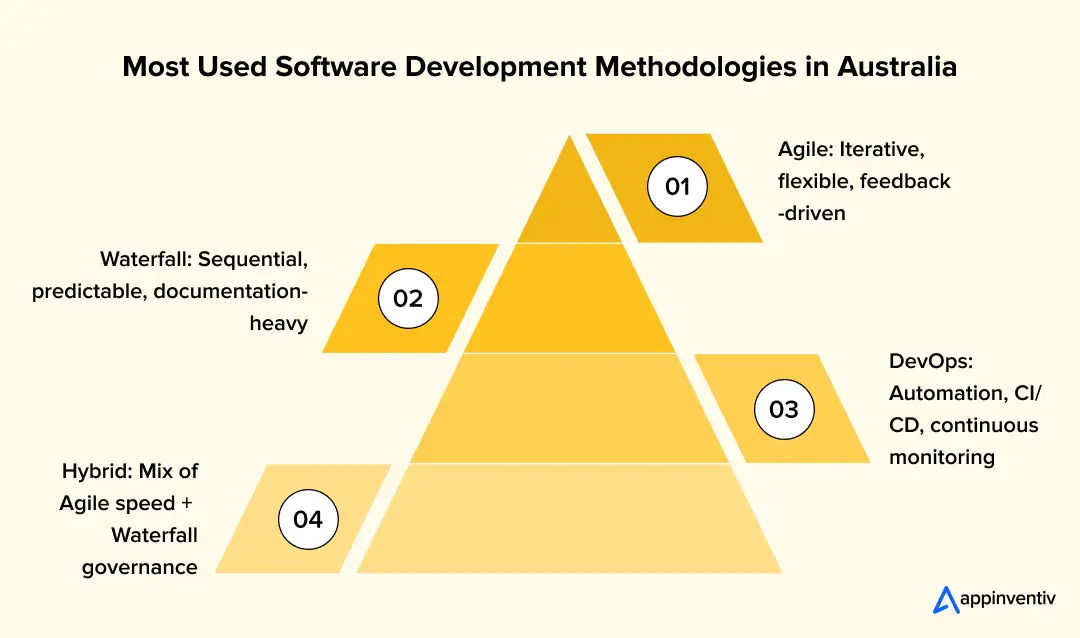
Australian teams use different software development methodologies in their operations, including traditional, agile, and blended. Each suits a different kind of project, depending on how stable the requirements are, how distributed teams work, and how much compliance or documentation is demanded by the project.
The following are the most common software development methodologies for Australian companies, widely adopted across enterprises and service providers.
Agile and Its Variants
Agile is the most dominant approach among software development methodologies in Australia, widely adopted across enterprises and startups alike. It embraces change, encourages collaboration, and delivers results in small pieces that can easily be tested. Job postings and industry reports note Agile, Scrum, and DevOps as all part of standard practice in development teams.
According to the same report, 63% of team-level Agile users follow the Scrum methodology, making it the most widely adopted Agile framework among software development teams.
Some of the common Agile variants include:
| Variant | Key Focus | Used By |
|---|---|---|
| Scrum | Sprint-based delivery with defined roles such as Product Owner, Scrum Master, and Developers | Product-based enterprises and mid-size teams |
| Kanban | Continuous flow of tasks, visualised through boards with work-in-progress limits | Remote and distributed teams |
| Extreme Programming (XP) | Test-driven development, code reviews, and pair programming for higher code quality | Engineering-led projects and startups |
For Australian enterprises, the major advantage of Agile is its adaptability. Projects characterised by frequent client feedback, shifting goals, or iterative releases fit the bill perfectly. Scaling Agile across large organisations, however, becomes complex with structured governance and additional documentation.
In Australian teams, Agile is not just a framework—it’s a rhythm of delivery. Most follow Scrum ceremonies such as Sprint Planning, Daily Stand-Ups, Sprint Reviews, and Retrospectives to maintain focus and transparency.
Remote or hybrid teams often conduct these sessions through tools like Jira, Azure DevOps, or Microsoft Teams, ensuring visibility even across time zones.
Meanwhile, Kanban boards help teams visualise ongoing tasks and limit work in progress to prevent overload. In engineering-driven projects, Extreme Programming (XP) practices such as pair programming and test-driven development (TDD) are used to maintain consistent code quality throughout each sprint.
Traditional or Plan-Driven Models
In many fields where stability and compliance take priority, plan-driven models such as the Waterfall or V-Model are still common. Each of the stages, from requirement gathering to design, build, testing, and deployment, happens one after another. Hence, the outcome is predictable and easily auditable.
Within software development methodologies in Australia, these traditional models remain vital for sectors prioritising compliance and traceability. These models work well for:
- Government or defence contracts
- Projects with fixed budgets and timelines
- Environments where documentation and version control are not debatable
Their power is in traceability, whereas the disadvantage is rigidity. Once a stage is complete, making changes further on can delay the project or increase the software development cost. Nowadays, many enterprises combine plan-driven governance with agile delivery for a better balance.
This approach still represents a widely accepted system development methodology in Australia, especially in sectors where compliance and auditability are critical.
DevOps and Continuous Integration / Delivery
DevOps is a cultural and technical shift in how an organisation approaches development and operations. Automation, faster release cycles, and continuous feedback are core values.
Australian companies increasingly merge Agile and DevOps to deliver faster and with fewer deployment issues. Typical practices include:
- Automated builds and tests
- Continuous Integration (CI) pipelines
- Containerisation and versioned deployments
- Real-time monitoring and rollback options
It certainly helps C-level leadership because they benefit from faster release cycles, reduced downtime, and visibility into production performance. That, in fact, helps distributed teams maintain consistency, especially when multiple squads work on different modules of the same product.
Hybrid or Tailored Approaches
More than half of Australian organisations now operate hybrid frameworks that blend Agile flexibility with Waterfall-style governance. Industry data shows 42% of enterprises use hybrid models combining Agile, DevOps, or other frameworks to balance innovation speed with regulatory control.
In practice, regulated Australian enterprises often follow a Water-Scrum-Fall model.
- Waterfall governs budgeting, procurement, and discovery.
- Scrum drives active software development through sprint cycles.
- Waterfall governs security certification and deployment sign-off.
This structure allows fast delivery without compromising audit traceability or compliance readiness.
This blend is ideal for organisations balancing regulatory oversight with the need for quicker iteration. The key is in clear accountability; without it, hybrids can create ownership and decision-making gaps.
Other Methodologies That You Might Come Across
Although Agile, Waterfall, DevOps, and Hybrid structures prevail in Australia, there are a few more popular software development methodologies applied by specialised teams or in specific project scenarios. They may not be mainstream, but learning them can help you choose the appropriate fit when your needs are niche or time-intensive.
| Methodology | Core Focus | Best Fit For |
|---|---|---|
| Lean | It is all about cutting waste, maximising efficiency, and not wasting time on anything that is not valuable. | New businesses and low-expense ventures. |
| RAD (Rapid Application Development) | Creates software in haste by prototyping and providing initial user feedback rather than conducting lengthy planning. | Projects that require a short turnaround or proof-of-concept verification. |
| FDD (Feature-Driven Development) | Builds software feature by feature, providing visibility of progress and an early testing opportunity. | Extensive projects have building blocks. |
| DSDM (Dynamic Systems Development Method) | DSDM (Dynamic Systems Development Method) is an Agile model with a set of guidelines and documents. | Businesses that need governance agility, e.g., government programmes. |
| Prototype-Based / JAD (Joint Application Development) | Constructs early prototypes in partnership with end-users through workshops and reviews. | Front office applications or user-intensive initiatives. |
All these methodologies share the same premise: clear communication, iterative progress, and user involvement, but vary in the level of process structure or flexibility.
Software Development Methodology Use Cases in Australia
Australian enterprises choose software development methodologies based on industry compliance, risk exposure, and delivery scale, making selection a strategic business decision.
| Industry Sector | Common Challenge | Preferred Methodology | Reason |
|---|---|---|---|
| Big Four Banks & FinTech | APRA, CPS 230 compliance, auditability | Hybrid (Water-Scrum-Fall) | Agile speed with regulatory traceability |
| Government & Defence | Procurement governance, fixed scope | Waterfall / V-Model | Predictable milestones and documentation |
| Healthcare & NDIS Providers | Privacy Act 1988, AHPRA compliance | Gated-Agile Hybrid | Iterative delivery with clinical audit trails |
| ASX-Listed Enterprises | Multi-team coordination, risk control | SAFe / Hybrid-DevOps | Portfolio governance with CI/CD automation |
| SaaS & Digital Startups | Speed to market | Agile / DevOps | Rapid iteration and release velocity |
Next, let’s look at the key drivers of these choices in the Australian market and the trends that influence how enterprises will design their delivery models.
Australian Market Context: Trends and Influencing Factors
The adoption of software development methodologies in Australia is driven by both business priorities and regulatory expectations.
The local market reflects a mix of enterprise discipline, startup agility, and increasing automation—each shaping the software development process for Australian businesses today.
Understanding these influences helps the leader decide how their delivery models should evolve.
1. Regulation and Compliance
In Australia, software delivery models do more than guide development. They help enterprises manage risk.
Sectors like government, defence, finance, and healthcare require predictable milestones, strong documentation, and clear version control. Even teams using Agile or DevOps add governance layers such as gated reviews and formal sign-offs to stay compliant.
This is why Hybrid and Gated-Agile models are now common across Australian enterprises. They enable fast sprint-based delivery while maintaining audit traceability and supporting requirements such as CPS 230, AESCSF, the Privacy Act, and ISO 27001.
2. Distributed and Remote Teams
From 2020, more Australian development teams operate in mixed or remote settings. This has forced companies to adopt more visual and asynchronous coordination tools such as Jira, Trello, and Azure DevOps.
Frameworks such as Kanban and Scrum do work effectively here since they can maintain structure without necessarily involving continuous physical collaboration. The result is a more transparent workflow with fewer communication gaps.
3. Cloud, Automation, and Continuous Delivery
Enterprises expect software to move from build to deployment faster. DevOps and CI/CD pipelines have become standard across cloud environments, enabling teams to automate repetitive tasks and monitor production health continuously.
For executives, this means fewer manual dependencies, better release frequency, and improved consistency across distributed teams.
4. Governance and Methodology Training
Australia adopts a structured approach to methodology governance. Formal qualification units, like ICTICT613, train managers to assess and choose between frameworks regarding the project size, risk, and compliance. Many large enterprises incorporate methodology control into their PMO functions.
Several have gone a step further, creating Methodology Framework Offices (MFOs) that provide standardized processes and review delivery performance across all business units.
The next section provides a side-by-side comparison of major methodologies based on how each fares on the criteria that matter most to enterprises: flexibility, speed, risk control, and compliance.
Comparative Overview: Strengths and Trade-Offs
Each of the software development life cycle methodologies delivers value differently. For enterprise projects, choosing one often comes down to balancing flexibility with governance. The table below highlights how leading methodologies perform against key decision factors.
| Methodology | Flexibility | Speed | Governance & Compliance | Risk Control | Best Fit For |
|---|---|---|---|---|---|
| Agile | High | Fast | Moderate | Medium | Startups and digital-first enterprises |
| Scrum | Moderate | Moderate | Moderate | Medium | Product-based teams working in short cycles |
| Kanban | High | Continuous | Low | Medium | Remote and distributed teams need steady delivery |
| Waterfall | Low | Slow | High | High | Regulated projects with fixed scope |
| DevOps | High | Fast | High | Medium | Enterprises aiming for automation and faster releases |
| Hybrid | Balanced | Moderate | High | High | Large organisations managing compliance and speed |
Appinventiv’s Note for Executives
Agile and DevOps are best for responsiveness and delivery speed, which are optimal for projects that need to receive feedback and improve over time. These reflect some of the key benefits of software development methodologies in Australia, especially for enterprises balancing speed with governance.
Waterfall can still be useful when accuracy and responsibility are more important than rapid delivery – especially in defence, healthcare, and government.
Hybrid models can provide a compromise between iterative agility and formalised governance. This system can be implemented more quickly and enables the regulation, control, and maintenance of an audit trail that regulated industries demand.
Before making that decision, it’s worth reviewing the challenges with different methodologies in software development, especially where compliance and distributed teams add complexity.
It also outlines key tips for choosing a software development methodology suited to your organisation’s structure and goals.
Read Next: How to Hire Software Developers in Australia in 2025? Process, Skills, and Costs
Selecting the Right Methodology: Executive Decision Framework
No single methodology best fits all. Each of these methodologies brings different strengths and challenges. The right choice depends on how complex your systems are, how often requirements change, and how strictly compliance must be managed.
A well-chosen framework provides the following: shortened delivery cycles, reduced risk, and more predictable communication between teams.
Below is a decision framework designed for enterprises evaluating the right software development methodology for Australian business operations within the local delivery environment.
Key Decision Factors
| Factor | If This Applies | Recommended Approach | Scale of Project |
|---|---|---|---|
| Requirement Stability | Fixed upfront | Waterfall / V-Model | Large, regulated programmes |
| Change Frequency | Evolving needs | Agile / Scrum | Medium digital products |
| Regulatory Demands | Full audit trail required | Hybrid (Agile + Governance) | Enterprise portfolios |
| Team Structure | Distributed teams | Kanban / DevOps | Multi-location delivery |
| Technology Stack | Cloud-native | DevOps | Continuous release environments |
| Organisational Maturity | Agile-trained teams | SAFe / LeSS | 200+ team scaling |
Practical Application Example
A national enterprise employing 400 people wants to reconstruct an internal flight order system.
- Customer interface and booking modules are built in Agile sprints to allow fast testing and feedback.
- Integration with finance and compliance systems follows the Waterfall model for controlled sign-offs.
- Deployment Pipelines through automation in DevOps run to manage versioning and continuous delivery.
This shows how choosing the best software development methodology for your business can strike the right balance between governance, agility, and speed.
Our team helps enterprises implement result-driven software development methodologies that align with compliance, scale, and innovation goals.

Next, we shall discuss the advantages and disadvantages of these methodologies in the Australian context, focusing on how local factors like regulation, remote teams, and automation influence the practical outcomes.
Pros and Cons of Popular Methodologies in the Australian Context
Each of these methodologies brings different strengths and challenges. These variations become clearer when examining software development methodology use cases that demonstrate how each performs under real Australian conditions.
Here’s how they compare in real-world Australian environments.
1. Agile and DevOps
Before weighing the pros and cons, it’s worth noting that the agile software development methodology and DevOps often go hand in hand. Complementing each other, they help teams shorten delivery cycles while being able to adapt.
Pros
- Deal with changing requirements.
- Deliver updates faster through frequent feedback loops.
- Encourage stronger collaboration across technical and business teams.
- Improve release stability through automation and continuous testing.
Cons
- Require additional documentation to meet compliance standards.
- It can be difficult to scale across many departments.
- Need cultural readiness and consistent team maturity to sustain long-term adoption.
Agile and DevOps, if implemented with adequate governance and seasoned leadership, can help Australian enterprises compete at speed and at scale.
2. Traditional or Plan-Driven Models
Traditional models remain part of many enterprise delivery strategies. They are best applied where control and traceability matter more than speed.
Pros
- Provide clear timelines and structured approval cycles.
- Provide extensive documentation, perfect for regulated projects.
- Ambiguity is reduced when requirements are fully defined at the outset.
Cons
- Slow to adapt once the development phase is underway.
- Limited flexibility for mid-project changes.
- Feedback often arrives too late, increasing rework risk.
Despite their rigidity, these models still hold value for sectors like defence, banking, and government, whereby compliance takes precedence over iteration.
3. Hybrid Approaches
Hybrid approaches merge the predictability of Waterfall with the flexibility of Agile and are fast becoming the preferred choice for most large Australian enterprises.
Pros
- Combine agility with structured governance.
- Maintain faster iterations while keeping the documentation intact.
- Work well across distributed teams and multi-phase programmes.
Cons
- This can cause confusion if responsibilities are not clearly defined.
- Require strong project governance due to process overlaps.
Appinventiv’s Insight
Australian companies are increasingly adopting hybrid models as a bridge between innovation speed and compliance discipline.
We at Appinventiv see this happening in enterprises that need fast delivery with no compromise on regulatory expectations. The hybrid model creates a steady rhythm of release and review, therefore supporting both growth and accountability.
The next section shows the emerging trends in Australian software development methodologies.
Emerging Trends in Australian Software Development Methodologies
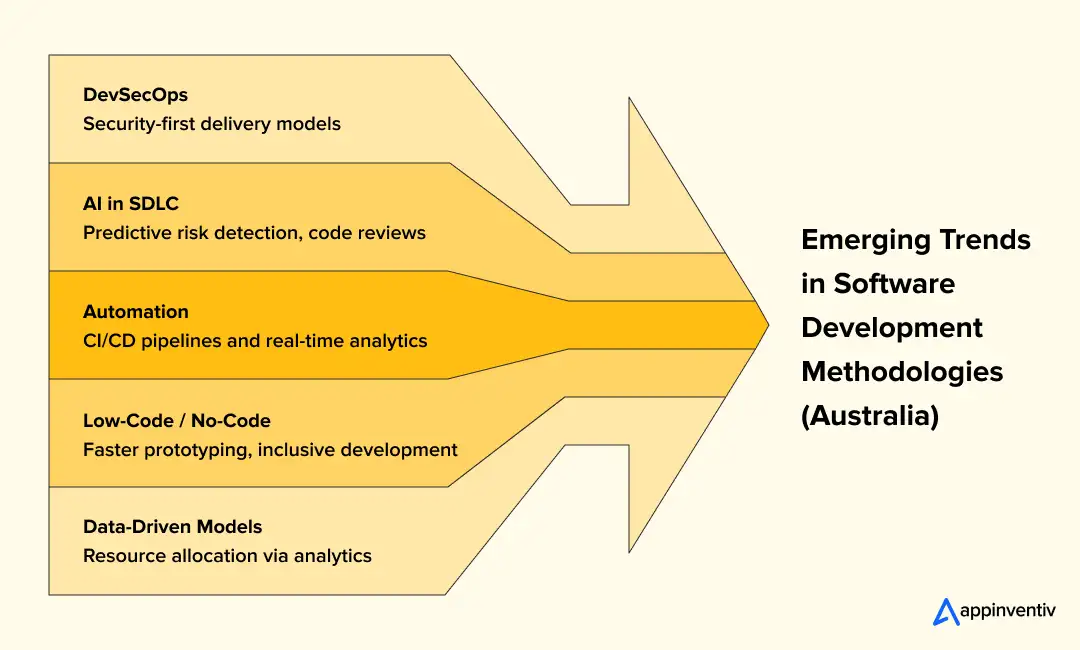
The software industry in Australia has been transitioning to smarter, integrated models of delivery very fast, where the agile software development methodology continues to form the foundation for iterative progress.
To achieve a balance between responsibility and speed, businesses are weaving automation, security, and AI into their development models.
The following are some of the best trends influencing this development:
- DevSecOps Implementation: Adopting security at all stages of SDLC and making sure that all stages are compliant and protective.
- Agentic DevOps: Using AI agents to monitor software development life cycle methodologies in real time, predicting delivery bottlenecks and workflow friction before release delays occur.
- FinOps Integration: Including real-time cloud cost monitoring within sprint and release cycles, helping enterprises manage spend and align the software development process for Australian businesses with financial governance.
- GreenOps / Sustainable Coding: Measuring the carbon footprint of software workloads and adopting energy-efficient coding practices to support ESG and sustainability reporting in Australian enterprises.
- AI-assisted Development: Predictive backlog management, machine learning-based automated code reviews, and prediction of delivery risk.
Taken together, these changes are all pointing to one way: that is, Australian organisations are moving towards intelligent and outcome-focused methodologies that are both agile and stable in the long run.
From Agile to Hybrid, we design, implement, and manage methodologies that accelerate delivery while maintaining strong governance.

The next section shows how Appinventiv helps the enterprise pick and apply the best methodology, from evaluation to delivery governance, with measurable outcomes.
How Appinventiv Helps Enterprises Choose and Implement the Right Methodology?
As a leading custom software development company in Melbourne, Appinventiv helps enterprises implement the right software development methodology for Australian businesses across teams, tools, and governance. Whether it’s Agile for speed, Waterfall for compliance, or hybrid models for balance, we tailor software development methodologies in Australia to match delivery maturity and risk needs.
With 10+ years of APAC experience, five Agile delivery centres across Australia, and 250+ digital assets deployed locally, we manage enterprise-scale programmes with precision. Our 96% client retention rate reflects long-term trust and delivery reliability. Recognised among APAC’s High-Growth Companies by Statista and the Financial Times for two consecutive years, we’ve transformed 35+ industries by combining faster iteration with structured governance.
Using a Hybrid-DevOps model, we reduced deployment time by 40% for a leading Australian logistics enterprise while achieving ISO 27001 audit readiness. Appinventiv ensures every software development process for Australian businesses delivers speed, compliance, and measurable outcomes at scale. Request a methodology maturity assessment.
Frequently Asked Questions
Q. What is a software development methodology?
A. A software development methodology is a structured delivery framework that governs planning, execution, compliance, and release control across software projects, ensuring predictable outcomes and reduced operational risk for Australian enterprises.
Q. What is Agile methodology in software development?
A. Agile is a type of iterative method of software development that releases the programme in small, manageable, and short sprints. It encourages teamwork, flexibility, and feedback that can be provided regularly, which enables the team to adapt to changing demands promptly and produce better results each time the project is launched.
Q. Why is it important to choose the right software methodology for your business?
A. The appropriate methodology will make sure that the implementation of the project corresponds to your business objectives, risk-taking capacity, and regulatory requirements. It has a direct impact on cost, speed of delivery, and team coordination to prevent rework, ensure compliance, and offer improved customer results.
Q. What are the most common software development methodologies used in Australia?
A. These software development methodologies—Agile, Scrum, Kanban, DevOps, Waterfall, and hybrid—are commonly used across Australian development teams. Agile and DevOps are the new technologies in startups and digital-first companies, whereas bigger or regulated organisations tend to resort to combining styles to strike a balance between innovation and governance and compliance.
Q. How do I choose the right methodology for my Australian business?
A. Take into consideration such factors as project size, team structure, requirement stability, and compliance needs. Agile or DevOps can be a good fit if your business needs to be flexible and frequently updated. In highly regulated industries, a plan-driven or hybrid approach is more needed since it offers increased control and documentation.
Q. How does methodology choice impact the cost and timeline?
A. The methodologies, such as Agile and DevOps, can also be used flexibly to save costs in the long run by avoiding rework and accelerating the release rate. formalised approaches, such as Waterfall, can be quite expensive to start but offer predictability. The correct fit will provide the efficiency of resources and realistic deadlines.
Q. Do Australian compliance requirements affect methodology selection?
A. Yes. Audit trails and documentation are needed in many fields, including finance, defence, and healthcare. Such compliance pressures tend to push organisations to hybrid solutions that accelerate Agile delivery speed with either Waterfall-like governance and formal sign-off.

- In just 2 mins you will get a response
- Your idea is 100% protected by our Non Disclosure Agreement.

Maritime Insurance Claim Software Development for UAE Ports, Insurers, and Logistics Networks
Key takeaways: Manual claims management is too slow for the UAE’s high-volume ports; digital solutions streamline processes and reduce errors. Maritime insurance claim software centralizes data, automates workflows, and ensures compliance with UAE regulations and Takaful principles. Real-time integration with port and vessel systems enables faster claim registration, validation, and settlement. Advanced analytics and risk…

How to Build a Student Management System in Australia?
Key takeaways: Australia’s tightening regulatory landscape (TEQSA, ASQA, CRICOS) makes student management system development in Australia a compliance-driven necessity, not just a digital upgrade. Monetisation models such as SaaS subscriptions, institutional licensing, white-label partnerships, and hybrid pricing offer scalable commercial opportunities in Australia’s expanding EdTech market. Addressing challenges early - data privacy, legacy migration, multilingual…

Guide to Software Risk Management: Identifying and Mitigating Key Risks in Software Development
Key takeaways: Risk management is no longer a peripheral activity; it is a core component of Enterprise Risk Governance (ERG) that ensures software ROI. Successful projects define their risk appetite—the level of risk an organization is willing to accept—before the first line of code is written. By integrating risk assessment into the early discovery phase,…