





















Mobile Ears- A Mobile App for People with Hearing Impairments!



Mobile Ears- A Mobile App for People with Hearing Impairments!
Hearing Loss is an increasingly growing problem these days. There was a time when it was associated with seniors only, but now people of all ages are vulnerable to this health issue. This is due to many reasons like heavy traffic noise, loud music in bars, nightclubs, events, etc. In fact, the habit of listening music at high volume via earphones while traveling is also contributing to the hearing impairments.
According to the statistics, over one billion young people throughout the world are at a risk of hearing loss, mainly because of unsafe listening practices.
Many people do not admit that they are suffering from hearing loss while others are concerned with the embarrassment of wearing hearing aids in the public. However, there are many who are unable to afford the hearing aids and so, continue to suffer. To serve the people with a better and affordable solution, the Norwegian company Listen AS has developed a hearing aid app, called Mobile Ears.
Mobile Ears- An App for Those with Hearing Impairments
Mobile Ears is a free and easy-to-use app that is helpful to people of all ages and suitable for both indoor and outdoor sound environments. It is a simple plug and play mobile application which does not demand a lengthy and annoying setup. All you have to do is to open the app, enter your age and gender and here it goes! The app has presets configured based on the statistics. That means you need not manually do the setting to use the app.
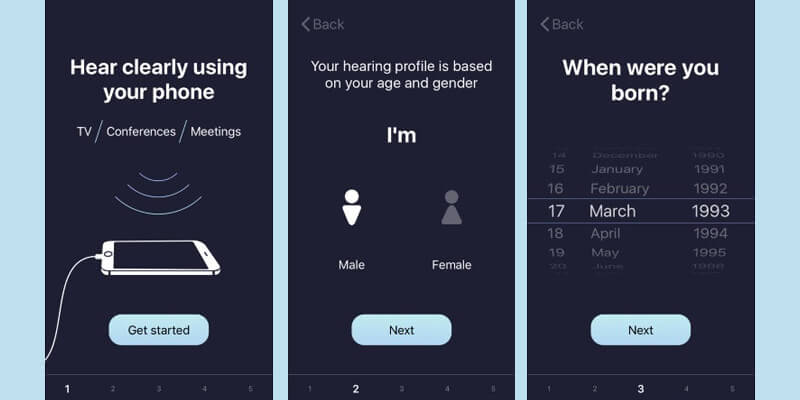
This mobile app uses the smartphone’s microphone to capture voices from the surroundings, amplify it and deliver enhanced listening experience to the users. The app algorithms are designed to filter out unnecessary background noise without affecting speech quality. In other words, with a unique speech amplification technology, this app helps the users to hear things clearly even when at a crowded place.
Mobile Ears does not require the Internet connection, which makes it more suitable to use anytime, anywhere.
Also, one can configure the app to use the earphone’s mic for better clarity. This is beneficial in meetings, conferences, group conversations as well as while watching TV.
Any Future Predictions?
Till now, this hearing aid app is accessible only for iOS users. But soon, it will be available to Android users as well. Again, the Mobile Ears app does not support Bluetooth right now due to quality and delayed amplification issues. However, the support is expected in the upcoming years.
Wrapping Up!
Mobile Apps are highly in use these days. People are preferring mobile applications over all other tools and equipment since they are easy to use, are affordable and accessible anytime, anywhere. Mobile app development has entered all the industries and sectors, including Healthcare. And the very best example of the existence of app development for healthcare industry is the above hearing impairments app.

- In just 2 mins you will get a response
- Your idea is 100% protected by our Non Disclosure Agreement.
Healthcare Kiosk Software Development – Benefits, Use Cases, Features, Costs, Process
Key takeaways: The healthcare kiosks streamline administrative processes, enhance patient flow, improve staff productivity, reduce costs, and enhance the patient experience. Healthcare kiosks enhance efficiency and personalized care through EMR/EHR-integrated kiosk software with AI, delivering real-time data updates. Scalable kiosk solutions lower operations expenses, enhance patient throughput and improve service delivery in healthcare organizations. Patient…
How To Develop a Sustainable Healthcare System?
Key Takeaways Rising costs and climate pressure make building a sustainable healthcare system a core business and risk strategy decision. Learn the key principles of sustainable healthcare system development, including prevention, efficiency, equity, and social sustainability. See how AI, data platforms, and a sustainable digital system in healthcare cut waste, improve outcomes, and stabilize workforce…
EHR Implementation for Healthcare Providers: Process, Features, and Total Cost Analysis
Key takeaways: A clear EHR implementation guide keeps teams on track and prevents delays. The full EHR implementation process includes planning, setup, moving data, training staff, and regular updates. The right features handle clinical work, billing, reports, and compliance for large healthcare organizations. EHR implementation costs vary based on design, integrations, data migration, training hours,…