
























How to Start Your Own Food Delivery Business in 2026?

 Share -


- 01Is It Worthwhile Investing in a Food Delivery Business?
- 02Food Delivery Business Models to Choose From
- 03How to Start an Online Food Delivery Business?
- 04Monetize Your Food Delivery Business Through Different Channels
- 05Challenges and Solutions for Food Delivery Business
- 06Future Trends in the Food Delivery Ecosystem
- 07How Can Appinventiv Help in Launching Your Food Delivery Business?
- 08FAQs

Key takeaways:
- Market Opportunity: The global food delivery market is projected to hit $505 billion by 2030, driven by increasing consumer demand for convenience.
- Choose the Right Model: Select from aggregator, cloud kitchen, or order-and-delivery models to match your business vision and scalability.
- Actionable Start: Research the market, select a business model, obtain the necessary licenses, build your tech infrastructure, and plan logistics to kick-start your business efficiently.
- Cost Management: Initial startup costs range from $3K to $25K, with key investments in technology, logistics, and marketing.
A few years ago, ordering food online was something people did when they didn’t feel like cooking. Now it’s just part of life. We order breakfast on the way to work, lunch from a favourite app, and dinner during a Netflix marathon. For millions, tapping “order again” has replaced the grocery list.
This shift has quietly turned food delivery into one of the most powerful industries of the decade. According to Grandview Research, the global food delivery market is expected to exceed $505 billion by 2030. That’s more than double in just a few years, and it shows how much people now depend on fast, digital dining options.
For anyone looking to build a business around this momentum, timing couldn’t be better. Starting a food-delivery venture today isn’t just about building an app. It’s about creating a system that connects restaurants, drivers, and customers in real time, with tech doing the heavy lifting in the background. In this guide, we’ll break down exactly how to do that: from shaping the right business model to building a platform that can actually scale.
Our experts can help you navigate the digital landscape, turning your vision into delicious reality.
Is It Worthwhile Investing in a Food Delivery Business?
The food delivery business is one of the fastest flourishing businesses of our time, so there’s no doubt it will be a blooming investment. According to Statista, the projected market volume of the platform delivery market is expected to reach $340.80 billion by 2028, growing at a CAGR of 4.79% from 2024 to 2028. The user penetration is expected to reach 19.1% by the same year.
More specifically, the global online food delivery market is estimated to reach $505.50 billion by 2030, continuing at a CAGR of 10.3% from 2023 to 2030. The increasing market share can be attributed to the convenience and accessibility that online food delivery platforms offer to consumers. Furthermore, the increasing smartphone usage and internet penetration have also added to the rising food delivery market size.

Looking at the demographics of the people who use food delivery apps the most, you will realize that Millennials and Gen Z make the most of them. About 80% of US diners are ordering online at the same or increased rates compared to last year. Furthermore, the US has also witnessed significant growth in orders during off-peak hours, with late-night orders up by 36% and morning orders by 23%.
Keeping all of these points in mind, it is safe to say that if you are planning to open a delivery food business, the future will likely be bright.

Food Delivery Business Models to Choose From
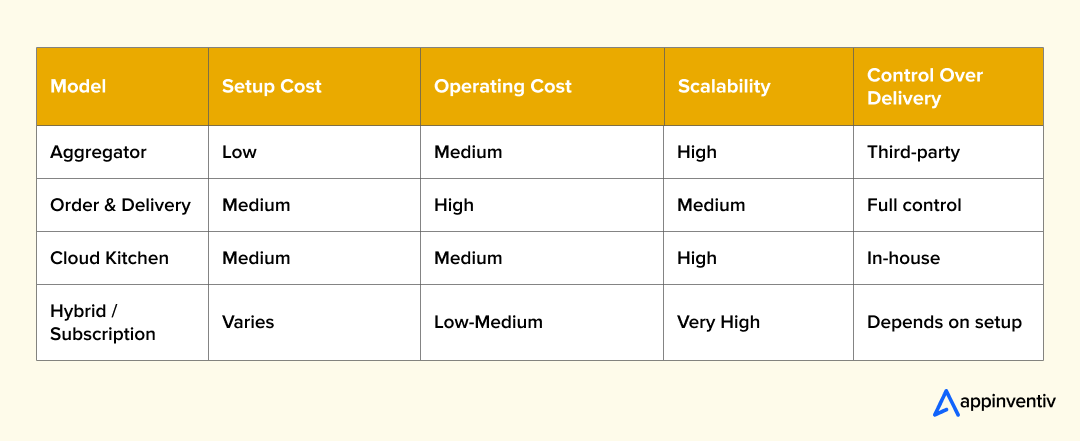
Before you begin to create a food delivery app, you must decide on a food delivery app business model that best suits your business type. Here are a few that you can take a look at:
Aggregator business model
This online food delivery business model provides a platform that acts as a bridge between restaurants and customers. It does that by associating multiple food outlets with its platform. The customers can then explore several different restaurants in one place itself.
As a food delivery startup, you can start with a subscription model to let customers and restaurants subscribe to your platform. This will be a safer option for ensuring returns from your business.
The successful applications that are built on this specific business model are JustEat, Delivery Hero, Talabat, and many more.
Order and delivery model
In this food delivery business model, the food business owners hire a delivery service provider for quick and efficient deliveries. The third-party delivery provider sets the delivery fees for food orders because they are in charge of the delivery.
This business model is suitable for you if you are a food business owner who does not want to invest in a delivery fleet but wants the food to reach your customers at home. You can collaborate with logistics providers like Swiggy, Zomato, etc., to manage the delivery. However, it is important to ensure and track the delivery partner to ensure your services are at par with the commitments made to the customers.
Full-service business model
As the name suggests, you do everything from cooking the food to delivering it. Everything will be done in-house, and so will require a huge investment. But because you will control every step of the process in this model, you are likely to earn much more. Some of the successful examples of this model are Domino’s and McDonald’s.
The Cloud Kitchen Model
A cloud kitchen skips dine-ins completely. It’s built for online orders only. You can run multiple virtual restaurant brands under one roof, test new cuisines, and operate with minimal costs. It’s a clever model for startups that want to grow quickly without spending a fortune on real estate.
The Hybrid or Subscription Model
This one focuses on loyalty and consistency. Offering memberships or premium delivery plans keeps your customers coming back. Think of it as your “steady income stream” model, smaller margins per order but stronger retention over time.
At Appinventiv, we’ve seen every model up close. Some of the biggest names in food delivery started small, just one city, one service, one goal, and scaled gradually, using tech to fill the gaps. The smartest founders don’t aim for perfection on day one. They stay flexible, keep an eye on their users, and let the data guide their evolution. That’s how real, lasting growth happens.
Let’s build your next growth-driving app.
[Bonus Read: Restaurant App Development: Benefits Of Online Food Ordering Services]
How to Start an Online Food Delivery Business?

Starting a food delivery business is not about launching an app first. It is about sequencing decisions correctly. Founders who skip steps often overspend on tech, underinvest in logistics, or launch with a model that cannot scale.
The steps below reflect how successful food delivery startups actually launch: strategy first, operations second, and technology last.
1. Research the market
Start by conducting thorough market research on the food delivery market. You can use this to construct your restaurant’s menu and combine your passion for eating with a means of making money. Build an appropriate entry strategy by concentrating on knowing market dynamics to start an online food delivery business.
2. Competitors
Platform-to-consumer and restaurant-to-consumer operators who control their own delivery logistics account for a major share of the food delivery market. Research their pricing practices, online menus, and marketing techniques to position your company favorably in comparison to these competitors’ offerings.
3. Opportunities and threats
Conduct a SWOT analysis (Strengths, Weaknesses, Opportunities, and Threats) to help you better understand your position in the market when you start your own food delivery business. You may leverage your strengths, identify your weaknesses, seize new opportunities, and spot threats with the aid of the analysis.
4. Target Audience
You need to know who your customers are. If you already own a restaurant, your existing clientele will be your target audience. But if you’re starting a business, pick a market you can influence the most.
The menu should showcase your unique cooking style and the preferences and needs of your intended clientele.
5. Understand Your Costs and Budget
According to business owners, a food delivery startup’s costs are usually between $3,000 and $25,000, with monthly overheads reaching $600 to $10,000. Here’s a breakdown of key expenses you’ll need to plan for:
- Inventory: For a brand-new restaurant, you will need a location, kitchenware, interior decor, flooring, etc. However, a cloud or virtual kitchen is a good idea if you only want to get started with a small investment. You can significantly reduce your inventory costs.
- Technology Costs: It will cost you around $30K to $150K to create a food delivery service from scratch. The price is determined by the app’s complexity, functionality, development team, location, and other factors. But you can reduce the cost by partnering with a food delivery app developer.
- Marketing & Advertising: The cost of marketing and advertising also affects the price of launching a meal delivery service. Advertising your business to millions of online users can be done through social media, banner ads, email, and other channels.
- Insurance & Licenses: Don’t forget to factor in costs for liability insurance and the licenses needed to operate legally in your region.
Also Read: How Much Does It Cost to Build a Restaurant App like Menulog?
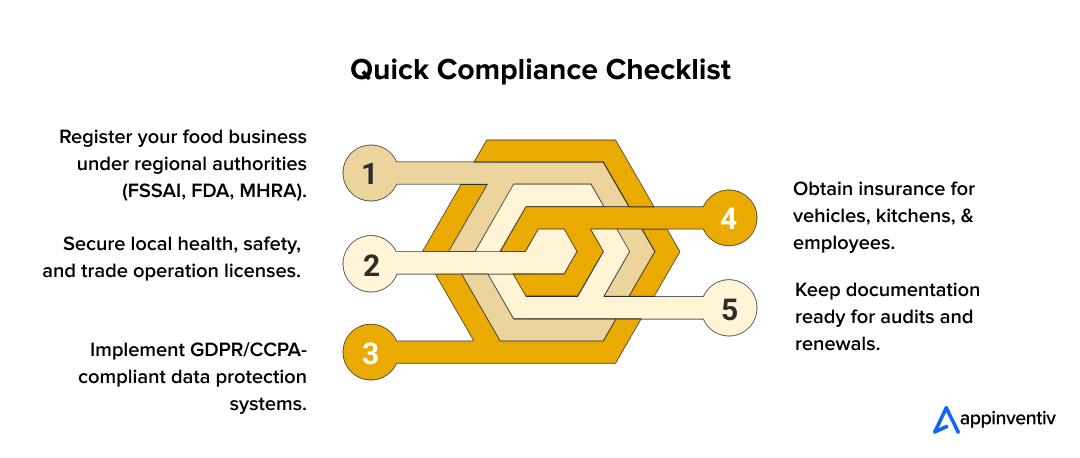
6. Set Up Your Licenses and Insurance
Securing the right business license and insurance is a key part of your startup costs. You’ll need liability insurance to cover legal claims, commercial auto insurance for your vehicles, and in many places, workers’ compensation for your employees. These costs are unavoidable, but they protect your business in the long run.
Different Countries, Different Rules
- India: FSSAI registration for food safety.
- US: FDA compliance for food storage and handling.
- UK: MHRA standards for hygiene.
Don’t forget local health permits, business registration, and vehicle licenses. Get these sorted early; inspectors won’t wait.
7. Build Your Technology Infrastructure
The heart of any successful food delivery business today is a solid tech backbone. Think of it as the glue that holds everything together:
- Customer App: For ordering, tracking, and feedback.
- Restaurant App: To manage orders and update menus.
- Delivery Agent App: For navigation, earnings, and status updates.
- Admin Dashboard: For analytics, performance tracking, and reports.
Key integrations that make it all work:
- Real-time tracking (GPS, Google Maps)
- Secure payments (Stripe, Razorpay)
- Push notifications & analytics (Firebase, Segment)
8. Customer Data Protection
Collecting addresses and payment info means you’re responsible for keeping it safe. GDPR in Europe and CCPA in California have strict rules, but even if you’re elsewhere, you should still protect customer data properly. One leak destroys trust fast.
9. Logistics
Starting a food delivery service will be more expensive due to logistics costs. You will have to invest in cars and drivers’ wages if you intend to own the fleet for your food delivery business.
If not, you can request food deliveries from third-party delivery service providers in exchange for a 20%–30% commission.
Also Read: How Much Does It Cost to Build a Food Delivery App Like HungerStation?
10. Set up order-receiving channels
There are plenty of channels where you can accept orders – over the phone, via text, WhatsApp, email, websites, apps, and even social media.
Your social media accounts can act as a multipurpose medium, assisting you in both order collection and business promotion.
Use food delivery software to build your website, take orders, and handle deliveries all in one. GPS tracking and POS integration should both be features of the software. Some applications that deliver food impose flat rates per order or a percentage of overall sales. You can also try such models.
11. Set up delivery methods
Before even considering starting a food delivery business, you must choose a shipping method. You must set up a shipping system and choose the best time to start a food delivery service. What time is ideal for food delivery? When does your food delivery service operate most effectively?
Think about the delivery area you want to cover. You must choose which regions of the city or country you wish to serve and whether you’re going to deliver food to the town or across the nation. After that, you can choose what day of the week and when to serve food. Another thing to consider is whether you want the food delivered in the middle of the night.
It’s wise to consider the weather when choosing the best time for food delivery. A party might be going on, and the weather is chilly. You don’t want to deliver food when it’s too cold outside. Additionally, it might be too hot outside. You should also consider what is going on in your neighbourhood. You must ensure the day of the week best suits your food delivery schedule for customers.
12. Promote your brand
Once everything is in place, you must inform your clients that you are starting a food delivery business. Use different media to promote your app and market your brand.
Utilize social media marketing tools to post promotional messages and analytics tools to develop appropriate engagement methods. To alert clients about the deal of the day, the chef’s special, discounts, and more, you can also execute SMS or WhatsApp campaigns.
Food delivery companies provide digital marketing strategies, including push notifications, SMS, loyalty programs, and email marketing templates, at no cost because of their effectiveness.
Communicate with your customers about your food preparation methods so they know how well you keep your place sanitised and how you care for hygiene.
Additionally, the good behaviour of the delivery staff is crucial and should be followed and monitored diligently. Their punctuality and customer-friendly demeanour can help promote your company.
Monetize Your Food Delivery Business Through Different Channels

If you want to start a food delivery business, you will want to finalize revenue channels that give you enough returns to compensate for your investment and gain profits. This is how revenue generation generally happens for delivery food businesses:
Restaurant’s fee
You will charge restaurants and outlets for featuring their ad or menus on your platform. The more they pay, the higher they will be positioned on the list. In turn, you will deliver the food for them and feature them on your app.
Commission from each order
Every meal order is normally subject to a 20–30% commission which goes to the food delivery service. This means you will transfer a set portion of every order to your business.
Delivery fee by customers
The consumer mostly covers the cost of delivery. They pay for the food that is delivered to them. The amount is determined by the location where the order has to be delivered.
Advertisements
This is a common way of earning revenue. Brands and businesses choose to show their advertisement on the app, and for showcasing that ad, they are required to pay some amount to the platform.

Challenges and Solutions for Food Delivery Business
Launching a delivery food business sounds straightforward until you actually start doing it. Here are the most common challenges teams face, along with practical ways to address them.m:
1. Logistics Bottlenecks
- The Problem: Delivery speed matters. When drivers sit in traffic or take wrong turns, customers get annoyed, and your costs go up.
- Solution: Route optimization software pays for itself quickly. It calculates the fastest paths and adjusts for traffic in real time. Your drivers stop guessing and start delivering.
2. Customer Churn
- The Problem: Orders are trickling in, but nobody’s ordering twice. Most people try you once and move on to the next app.
- Solution: Give them a reason to stick around. Set up something simple, maybe 10% off their fourth order, or knock off the delivery fee after they’ve ordered three times. But here’s what really works: reach out and ask why they left. Send a quick message or survey. Most won’t respond, but the ones who do will tell you exactly what’s broken. Fix those things, and watch your repeat rate climb.
3. Operational Inefficiencies
- The Problem: Orders pile up during lunch rush. Someone forget to update the inventory. A driver gets sent to the wrong address. Meanwhile, your team is buried in tasks that shouldn’t need human attention in the first place.
- Solution: Automate the repetitive stuff. Let the software assign orders to drivers based on location. Set up automatic alerts when stock runs low. Use tools that learn your peak hours, so you’re not guessing how many drivers to schedule on Friday night. Your staff should be handling customers and food quality, not playing catch-up with spreadsheets and delivery routes all day.
4. Security & Compliance
- The Problem: Every transaction means you’re collecting someone’s credit card details, home address, and phone number. Lose that data or let it get stolen, and you’re facing angry customers, potential lawsuits, and regulators who won’t be gentle.
- Solution: Don’t treat security like something you’ll “add later.” Build it into your platform from day one. Encrypt payment information. Lock down how data gets stored and who can access it. Ensure compliance with applicable privacy regulations, whether GDPR, CCPA, or relevant local laws. p This isn’t just about avoiding fines. One major data breach can destroy your reputation faster than any bad review ever could.
Future Trends in the Food Delivery Ecosystem
Let’s look ahead, because the real advantage comes from being ready for what’s next. As you build your delivery food business, keeping an eye on emerging trends can give you an edge.
- Automation Everywhere – Think smarter apps and faster logistics: AI‑driven chatbots answering customer questions, autonomous delivery vehicles handling last‑mile drops, and even delivery drones taking to the skies.
- Sustainability Suddenly Matters – Consumers don’t just want fast food anymore; they want greenhouse‑friendly options. Expect more reusable packaging, electric delivery fleets, and carbon‑neutral logistics becoming standard, not optional.
- Predictive Delivery Comes into Play – With enough data, you can anticipate what people will order before they tap “Buy”. AI‑powered demand forecasting helps reduce waste, improve delivery times, and boost customer loyalty.
- Market Size Growing Rapidly – According to Grandview Research, the online food‑delivery services market is projected to reach around $618.36 billion by 2030.
How Can Appinventiv Help in Launching Your Food Delivery Business?
Your on-demand food delivery business development will start by partnering with an app development company like Appinventiv that is ready to build the best solution for your business. Our aim has always been to curate custom-made solutions for every client that brings wanted outcomes and even more. Appinventiv has worked with multiple international brands to provide them with digital solutions for their apps and websites.
One such client we worked with was KFC. Their app needed an extension in the UAE for a better global presence. Their immediate requirement was to improve QR functionality, facilitate multiple order modes, and initiate advanced analytics. Appinventiv was able to curate solutions for better customer experience, which increased the conversion rate by 28%. It began by conceptualizing, designing, and deploying the right digital solutions.
Appinventiv can be the food delivery app development company you are looking for to launch your food delivery business. The experts will guide you through the entire development process and help take your business to the next level. So, get in touch with us.
FAQs
Q. How much does it cost to start a food delivery business?
A. The cost to start a food delivery business typically ranges from $30,000 to $300,000, or more depending on factors like food delivery app development, marketing, logistics, and operational setup. However, this is just a rough estimate. The actual cost may vary based on the scale and location of your business.
Q. How long does it take to develop a food delivery app?
A. While this mainly depends on the complexity of the app and the feature requirements, it usually takes about 2 to 4 weeks to complete an on-demand food delivery app development.
Q. How should I price items in my food delivery startup?
A. A straightforward formula for pricing any product is to add up your variable costs, fixed costs, and profit margin. Additionally, it’s crucial to consider who your target market is. Know how much they are willing to spend on their food, especially food ordered online. Use the average market price as a benchmark when comparing your products to those of your competitors.
Q. What features should my online food delivery app have?
A. While some features in your app will be similar to those found in any delivery app, ensure to include certain specific features. Some of these include menu options, home page customization, app feature integrations, geolocation services, customer rating and review options, multiple payment options, and more.
Q. How to start an online food delivery business?
A. Starting an online food delivery business involves several key steps: choose your business model, research the market, define your target audience, and build your tech infrastructure (like a user-friendly app). Don’t forget to secure the necessary licenses, ensure data protection, and focus on streamlining your logistics. Planning carefully and staying flexible will help you build a strong foundation.
Q. How to start a food delivery service business?
A.To start a food delivery service business, the first step is identifying your niche, whether it’s local restaurants, health-focused meals, or niche cuisines. Then, choose a business model that suits your goals (such as an aggregator, delivery-only model, or cloud kitchen). From there, create a reliable tech setup, secure your legal and operational requirements, and market your service effectively to your target audience.
Q. What do you need to start a food delivery business?
A. To start a food delivery business, you’ll need:
- A clear business model and target market.
- A reliable app platform for customers and restaurant management.
- Logistics and delivery systems (whether in-house or third-party).
- Licensing, insurance, and compliance with local regulations.
- Marketing strategies to build brand awareness.
- Sufficient capital for tech, inventory, and operations.
Q. Is Appinventiv a good partner for food delivery startup development?
A. Yes, Appinventiv is a great partner for food delivery startup development. With expertise in app design, logistics, and AI-powered automation, we can help you build a seamless, scalable, and user-friendly food delivery platform. From concept to deployment, our team specializes in creating solutions that drive business growth and improve customer experiences.


Fast 2-minute response, fully NDA-protected.
Build Your Own: A Complete Guide to Menu Engineering Software Development (2026)
Key takeaways: Menu engineering works best when treated as a decision system, not a one-time analysis exercise. Accurate menu decisions depend on real cost data, clean POS mappings, and continuous analysis. Building custom menu engineering software makes sense when complexity, scale, and control matter. Most menu engineering software built in 2026 falls between $40,000 to…
How Data Analytics in Restaurants Can Save Your Margins in a High-Inflation Era
Key takeaways: Inflation pressures restaurant margins through unstable food costs, labor inefficiencies, and supplier price drift, not pricing alone. Data analytics in restaurants brings clear cost visibility across menus, labor, and inventory, helping leaders act before losses compound. Restaurants using analytics commonly recover 3–8 margin points by reducing waste, labour optimization and workforce elasticity, and…
How to Build a Custom Restaurant Management Software? Features, Process, Costs
Key takeaways: Custom restaurant management software turns scattered tools into one operational backbone. The real ROI comes from reduced waste, better staffing, and faster decisions, not just “going digital.” Restaurants use these systems daily for menu control, inventory, workforce planning, and loyalty, not just reporting. Features only work when they match real workflows for guests,…














