



























How to Hire Data Engineers for Your Enterprise? All You Need to Know


- Why Traditional Individual Hiring Falls Short for Enterprise Data Teams
- Why Enterprises Are Moving From Individual Hiring to Organizational Partnerships
- What Should You Look For When You Hire Data Engineers for Enterprise Systems?
- The Process to Hire Data Engineers for Enterprise Teams
- Cost to Hire Data Engineers for Enterprise Teams
- The Business Impact of Hiring Data Engineers: What Enterprises Can Expect in Return
- Challenges With Hiring Data Engineers in Enterprise Environments
- Best Tips for Hiring Data Engineers for Enterprise Projects
- Why Appinventiv is Your Trusted Big Data Services Powerhouse for Next-Level Data Engineering Excellence
- FAQs

Key takeaways:
- Hiring data engineers individually slows execution and increases delivery risk at enterprise scale.
- Partnerships give faster access to senior talent without long recruitment cycles or retention issues.
- Cost depends more on capability and responsibility than salary alone.
- The right hiring model directly affects business speed, stability, and ROI.
- Partnering with experienced teams converts data from overhead into advantage.
If you run an enterprise today, data is no longer a support function in the background. It has quietly become the engine that decides how fast you scale, how well you compete, and how accurately you make decisions. From real-time dashboards to AI-driven insights, the companies leading their industries are not just collecting data, they are building systems that move business with it.
And that brings most leadership teams to the same question sooner or later: “How do we actually hire data engineers for our enterprise that are the right fit?”
The answer is not as simple as writing a job description and waiting for applications to roll in. A strong data engineer does much more than move data from one place to another. They design pipelines that do not break under pressure. They build systems that scale across teams and locations. And they quietly make sure your analytics, reporting, and AI initiatives actually work in the real world, not just on paper.
The challenge is that hiring data engineers today is harder than ever. Everyone wants them. Job titles look similar on paper. And a CV rarely tells you whether someone can truly handle enterprise-grade complexity. Making the wrong hire slows projects, burns budgets, and creates data systems that are difficult to fix later.
This is why hiring data engineers is no longer an HR task alone. It is a leadership decision. One that impacts your product roadmap, your customer experience, and your ability to compete in a data-driven market.
In this blog, we break down what actually matters when you hire data engineers for your enterprise. We will walk you through the skills to look for, the mistakes to avoid, how to evaluate candidates realistically, and how to build a team that supports growth instead of becoming a bottleneck.
Don’t start from scratch. Work with specialists who have built and managed data systems for complex businesses and understand what it takes to get results in the real world.

Why Traditional Individual Hiring Falls Short for Enterprise Data Teams
If you have tried to hire data engineer talent recently, you already know the process no longer works the way it once did. What used to take weeks now stretches into months. Roles remain open. Shortlists collapse midway. Final offers fall apart. The market has moved faster than traditional hiring models can manage.
Enterprises today compete for a very small pool of experienced professionals. Whether you are trying to hire a big data engineer to support large-scale workloads or hire a data integration engineer to connect enterprise systems, the reality is the same. Supply is limited. Demand is extreme. Timing is unpredictable.
The problem becomes bigger at the enterprise level. You are not just hiring for code output. You are hiring for reliability, system ownership, and long-term stability. A resume that looks strong does not always translate into delivery confidence in production environments.
Here is where traditional hiring breaks down:
- You interview candidates who are technically skilled but lack true enterprise exposure
- Hiring cycles run for months while data initiatives remain stalled
- Salary expectations rise faster than business impact
- Good candidates drop out late due to counteroffers
- Project timelines depend entirely on one new hire
- There is no guarantee of delivery even after onboarding
For many enterprises, the issue is not just finding a data engineer to hire. It is finding someone who can handle scale, compliance, integration complexity, and performance pressure from day one.
When you rely on individual hiring, you concentrate risk in a single role. One resignation, one mismatch, or one delay can disrupt major initiatives. The business slows down not because strategy is weak, but because execution capacity is fragile.
Traditional recruitment was designed for filling positions but businesses must understand that enterprise data engineering demands delivery, not participation.
Why Enterprises Are Moving From Individual Hiring to Organizational Partnerships
Enterprises that depend on data for growth eventually shift how they think about talent. The question stops being “Who do we hire?” and becomes “How do we guarantee execution?”
This is where organizations move away from individual recruitment and toward structured delivery partnerships. Instead of building around single roles, leaders build around capability.
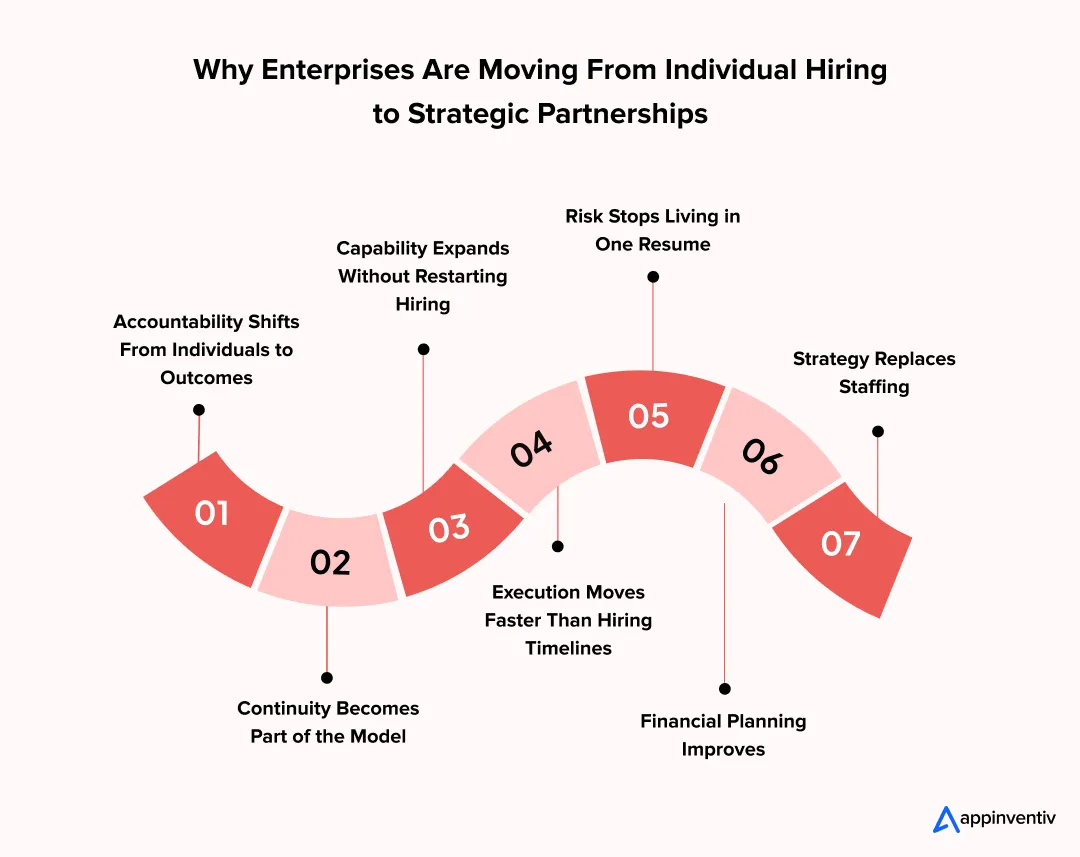
Accountability Shifts From Individuals to Outcomes
When you hire a data engineer as an individual, success depends on one person. Timelines, documentation, and stability live with that individual. In organizational partnerships, responsibility shifts from people to results. Enterprises that hire data engineers for enterprise programs through structured teams prioritize delivery over dependency.
Continuity Becomes Part of the Model
Individual transitions slow projects. Knowledge disappears. Context must be rebuilt. In partnership models, knowledge is distributed. Teams absorb change without disrupting momentum. Businesses avoid rebuilding systems every time a role changes.
Capability Expands Without Restarting Hiring
Enterprise systems rarely need just one skillset. One phase may require a hire big data engineer profile, another may need a data integration engineer. Partnerships allow access to specialized expertise as needs shift without restarting recruitment from scratch.
Execution Moves Faster Than Hiring Timelines
Projects do not wait for offer letters. Enterprises that need speed work with teams that are already operational. When leadership asks to hire expert data engineer capability, partnerships place working teams directly into delivery environments instead of waiting on recruitment cycles.
Risk Stops Living in One Resume
Relying on one person to build and manage critical systems is a fragile model. Organizational partnerships distribute responsibility, enforce peer review, and reduce single-point dependency. Enterprises gain resilience that individual hiring cannot provide.
Financial Planning Improves
Salaries fluctuate. Negotiations prolong hiring. Counteroffers derail plans. Partnerships turn hiring uncertainty into predictable operating costs. Enterprises gain better control over factors impacting the cost of hiring data engineers by paying for outcomes instead of headcount.
Strategy Replaces Staffing
When businesses stop measuring progress by “people hired” and start measuring by “systems delivered,” execution improves. Leaders stop searching for a data engineer for hire and start building delivery engines that grow with the company.
What Should You Look For When You Hire Data Engineers for Enterprise Systems?
Hiring decisions at the enterprise level should never be based on tools alone. A resume can list platforms and programming languages, but that rarely tells you whether someone can handle real-world data complexity. When you hire data engineers for enterprise environments, you are selecting people who will shape how data flows through the business, not just how it is stored.
Let’s look into the practical thinking behind evaluating data engineers for enterprise projects, beyond surface-level skills.
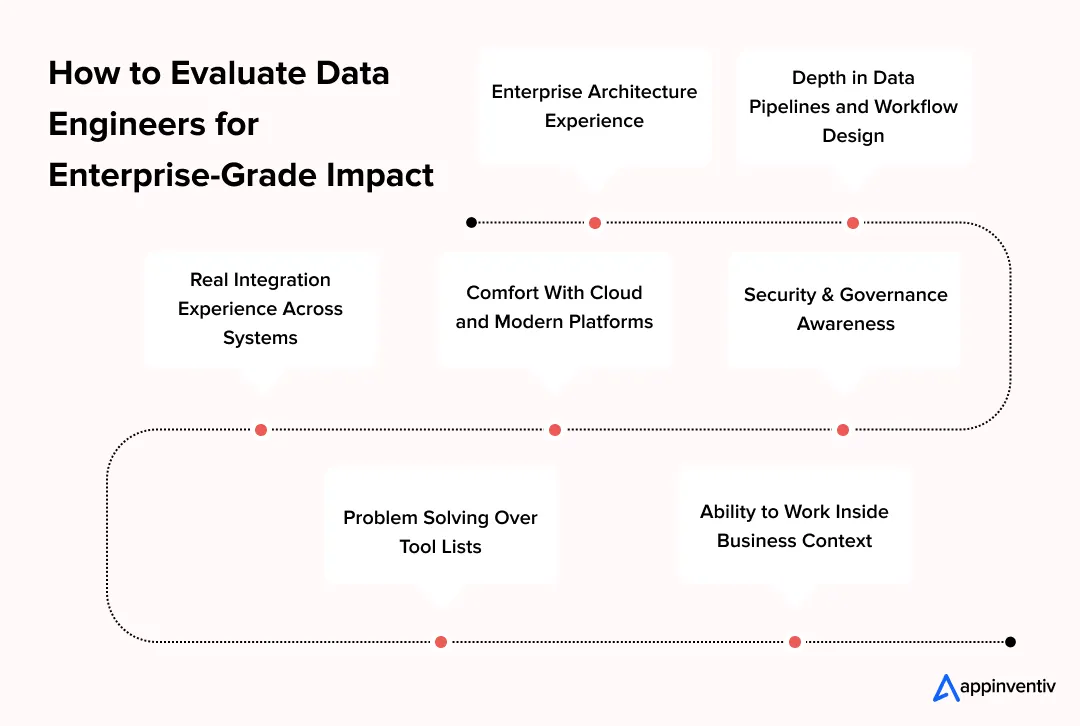
Enterprise Architecture Experience
An enterprise data environment is not a simple setup with one database and one dashboard. It usually involves multiple systems, departments, and business units operating together. A strong candidate understands how data systems connect at scale. When you interview a data engineer for hire, look for experience designing solutions that serve entire organizations, not just single teams. Engineers who have worked only on small systems often struggle when volume, concurrency, and governance come into play.
Depth in Data Pipelines and Workflow Design
Enterprise data fails quietly when pipelines are poorly designed. Reports go wrong. Dashboards break. Teams lose trust in data. When you hire expert data engineer talent, assess how well they design workflows that recover from failure, scale with demand, and handle imperfect data. Anyone can move data once, but enterprise engineers build systems that run reliably every day without manual fixes.
Real Integration Experience Across Systems
Most enterprises do not operate from a single platform. Data flows between CRM systems, ERP software, cloud environments, and analytics platforms. This is where a data integration engineer becomes critical. Instead of focusing only on database knowledge, pay attention to experience working across tools and connecting systems that were never designed to work together.
Comfort With Cloud and Modern Platforms
Any enterprise planning to grow must think beyond on-premise systems. Cloud experience is no longer optional. When you hire big data engineer roles, you should expect familiarity with scalable platforms and distributed environments. Engineers who understand cloud-based infrastructure design are better prepared to handle performance issues, cost control, and long-term scale.
Security and Governance Awareness
Handling business data responsibly is not just a compliance issue. It is a trust issue. Enterprises must ensure that sensitive information is accessed only by the right people and used only for the right purposes. Engineers who understand security, permissions, and data governance prevent risks that are far more expensive than development itself.
Problem Solving Over Tool Lists
Many hiring processes focus too much on whether someone knows a specific language or framework. What matters more is how they think when something breaks. When you look for a data engineer to hire, prioritize candidates who explain problems clearly, test assumptions, and look beyond short-term fixes.
Ability to Work Inside Business Context
Enterprise data work is not isolated from operations. Engineers must understand how systems affect finance teams, operations, sales, and customer service. When you find data engineers for enterprise needs, look for professionals who can work with non-technical stakeholders and translate data into business context.
The better you get at evaluating data engineers for enterprise projects, the more predictable your outcomes become. Businesses must understand that choosing the right engineers is not about getting faster at interviews but about getting stronger at judgment.
By integrating deep data visibility and real-time monitoring, we helped the food giant achieve 30k+ daily orders, a 50% surge in app volume, and a 22% increase in conversion rates.

The Process to Hire Data Engineers for Enterprise Teams
Hiring for enterprise data roles is not something you finish in a few interviews. When systems power operations, reporting, and strategy, shortcuts in hiring create problems that are hard to undo later. A structured process to hire data engineer talent helps avoid wasted time, poor decisions, and mismatched expectations. A structured process to hire data engineer talent, often guided by a digital engineering services firm, helps avoid wasted time, poor decisions, and mismatched expectations.

Define the Business Problem Before the Job Role
Many enterprises begin recruiting without being clear on what needs fixing. Is the issue unreliable reporting, slow pipelines, poor integration, or scaling challenges? Before you hire data engineers for enterprise teams, define the outcomes you expect. When the problem is clear, the role description becomes sharper and easier to evaluate against.
Decide the Engagement Model Early
Not every business needs permanent team expansion on day one. Some require short-term acceleration, others long-term capability building. Decide whether you want to hire remote data engineer resources, contract specialists, or full-time team members. This decision influences cost, speed, and the type of skillset you attract.
Write Job Descriptions That Reflect Reality
Great candidates do not respond to vague roles. Be specific about systems, usage volumes, and business impact. When enterprises write honest job descriptions, they attract engineers who want responsibility, not just a title. This makes it easier to find data engineers for enterprise work who understand scale rather than experiment with it.
Screen for Thinking, Not Buzzwords
Resumes list tools. Interviews reveal judgment. Replace generic questions with scenario-based discussions. Ask how candidates handle failure, scale, and data conflict. When you evaluate a data engineer for hire based on reasoning instead of only syntax, you reduce the risk of beautiful code with broken outcomes.
Test With Real Scenarios
The strongest results come from practical tests. Short assignments based on real pipeline problems reveal far more than theoretical tasks. When you hire expert data engineer talent, you should see how they think in production-like situations, not only how they perform in abstract coding exercises.
Validate Enterprise Experience
Enterprise systems behave differently from startup systems. Higher volume, more stakeholders, more pressure. When you hire experienced data engineer for enterprise roles, verify their exposure to complexity. Ask for examples of systems that ran at scale and what actually broke under pressure.
Move Fast Without Rushing
Long delays lose great candidates. Poor decisions lose trust. Balance matters. The channels that move fastest are often the ones that think most clearly. Enterprises that streamline their process to hire data engineer roles without cutting judgment usually outperform competitors who move slowly and guess often.
Cost to Hire Data Engineers for Enterprise Teams
When leaders ask about the cost to hire data engineers, what they are really trying to understand is where the money goes. Hiring is not just about salary or contract fees. It is about the level of risk you are taking on, the complexity you are asking someone to manage, and how critical data is to daily operations. Enterprises that hire engineers for enterprise environments are not paying for hours alone. They are investing in system stability, delivery consistency, and business continuity.
In most enterprise setups, the annual budget to get data engineering professionals onboard typically falls between $60,000 to $160,000+ per engineer. This range applies whether you are building an in-house team, choosing to hire a remote data engineer, or onboarding specialists through external partners. The wide variation exists because not all data engineers carry the same responsibility, depth, or business impact.
What determines where your organization falls within that range is not guesswork but a small set of decisions that directly shape financial outcomes.
Factors Impacting the Cost of Hiring Data Engineers
The cost of hiring data engineers is rarely driven by salary alone. It is shaped by how critical the role is to your systems, the level of ownership involved, and how fast your business expects results. Let’s look into the factors impacting the cost to hire data engineers in detail below:
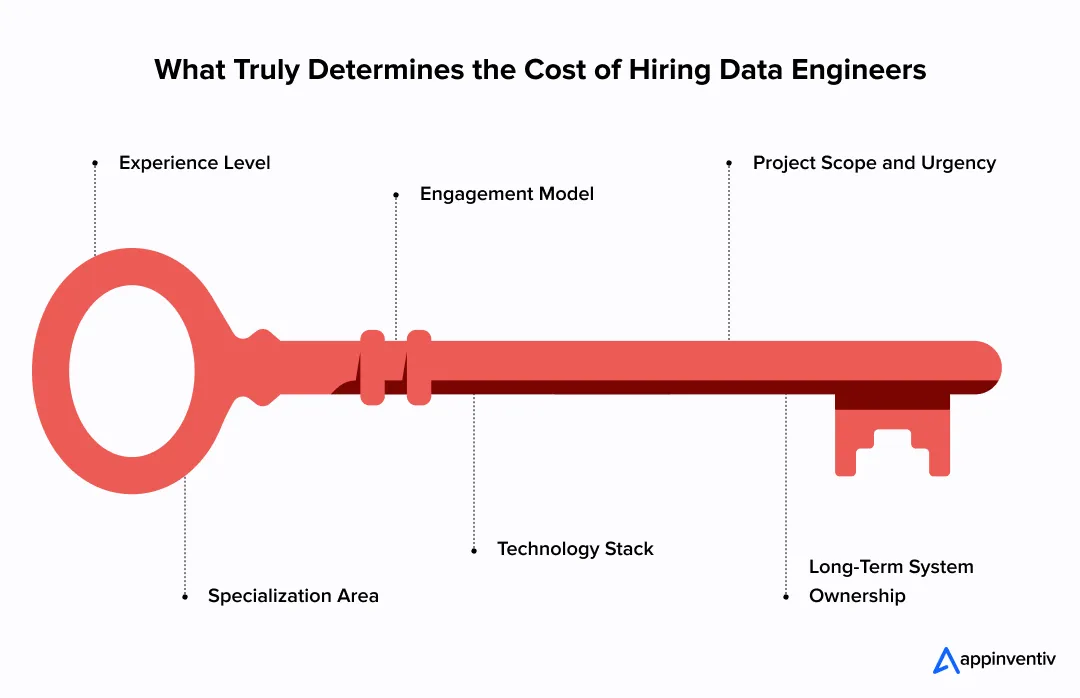
Experience Level
Entry-level engineers are cheaper because they execute tasks. Senior professionals are more expensive because they design systems and prevent failure. When you hire experienced data engineer talent for enterprise systems, you pay for fewer mistakes, faster delivery, and stronger decision-making under pressure.
Specialization Area
General data skills are easier to find than deep platform knowledge. The moment you hire big data engineer profiles or hire data integration engineer expertise, cost rises because you are entering a smaller and more competitive talent pool.
Engagement Model
Whether you hire full-time, engage contractors, or choose to hire remote data engineer professionals impacts budget structure. Permanent roles add payroll stability but increase long-term overhead. Flexible models change cost distribution but improve hiring speed.
Technology Stack
Engineers who understand modern cloud platforms, automation frameworks, and scalable architectures typically cost more. These skills reduce future rebuilds and performance failures, which saves money long after hiring is complete.
Project Scope and Urgency
When projects are large and timelines tight, pricing rises accordingly. If you need a data engineer for hire immediately, competition pushes cost up because availability becomes part of the price.
Long-Term System Ownership
Roles that include monitoring, optimization, and system governance cost more than development alone. The more responsibility you attach to the role, the higher the investment required.
When you understand these factors impacting the cost of hiring data engineers, budgeting becomes rational instead of reactive. Cost stops being a guessing game and becomes a controlled business decision tied to outcomes, not just hiring pressure.
The Business Impact of Hiring Data Engineers: What Enterprises Can Expect in Return
At the enterprise level, hiring is not about adding headcount. It is about creating business advantages that show up in performance and revenue. When businesses hire the best data engineers, the effect is visible in faster decisions, clearer reporting, and smoother operations across teams. This section focuses on what organizations can realistically expect in terms of business impact and return on investment, not just technical output.
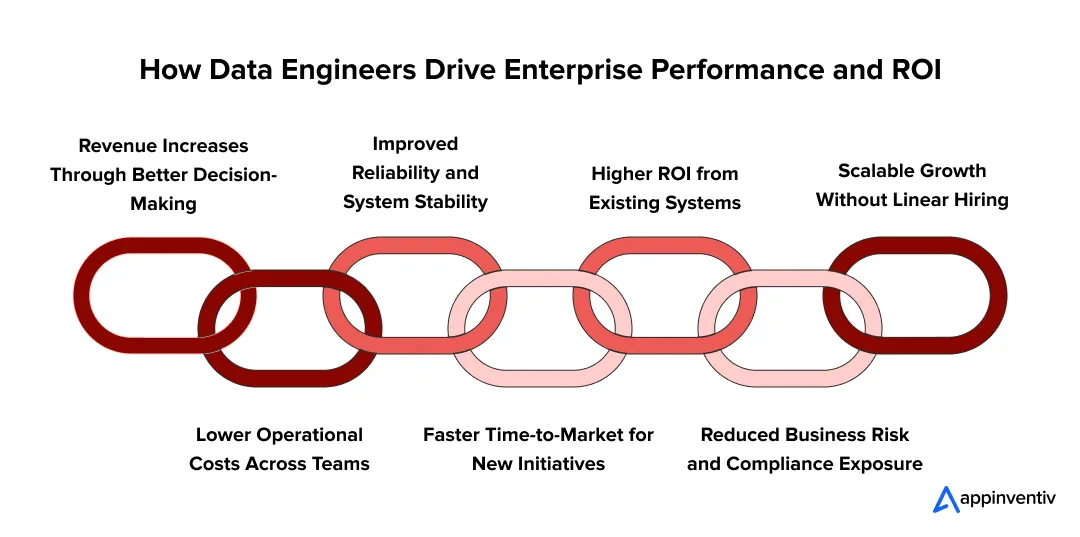
Revenue Increases Through Better Decision-Making
Enterprises generate data every single day, but without the right engineering behind it, that data stays idle. When you hire expert data engineer talent, information starts moving in real time instead of being trapped inside systems. Leadership teams gain faster access to trends, risks, and opportunities. This directly impacts forecasting accuracy, sales planning, and operational decision-making.
Lower Operational Costs Across Teams
Manual reporting, broken dashboards, and redundant systems waste hours across departments. When you hire an experienced data engineer for enterprise environments, processes get streamlined. Data flows automatically instead of being stitched together by hand. This reduces dependency on manual labor and eliminates hidden inefficiencies that quietly inflate operational costs.
Improved Reliability and System Stability
Data outages are not just technical problems. They disrupt finance, customer operations, and executive reporting. A strong data engineer for hire reduces failure points by designing systems that recover quickly and run longer without intervention. Uptime improves. Escalations drop. Business operations become predictable instead of reactive.
Faster Time-to-Market for New Initiatives
Launching new features or integrating AI analytics capabilities depends entirely on whether data is usable. Businesses that hire data engineers for enterprise innovation move faster because data infrastructure no longer blocks progress. New reports, dashboards, and integrations go live without waiting for months of backend rebuilds.
Higher ROI from Existing Systems
Most organizations already pay for tools they underuse. When you find data engineers for enterprise initiatives, those platforms start delivering value. CRM systems become insight engines. Cloud platforms become performance drivers instead of cost centers. Hiring the right engineers unlocks returns from investments you already made.
Reduced Business Risk and Compliance Exposure
Poor data handling is a legal risk as much as a technical one. Engineers with experience in AI governance enforce access control, audit trails, and accountability. The business benefits from fewer security gaps and stronger compliance posture. This lowers the risk of regulatory penalties and reputational damage.
Scalable Growth Without Linear Hiring
Enterprises that rely only on headcount eventually hit a ceiling. Systems built by the right data teams grow faster than teams themselves. When you hire big data engineers strategically, the business scales on systems, not people. This is where long-term ROI becomes visible.
While competitors struggle with hiring challenges, you can implement solutions with expert teams who understand enterprise scale and deliver proven methodologies.

Challenges With Hiring Data Engineers in Enterprise Environments
Even when leadership is ready to invest, execution is rarely simple. Businesses often discover that demand, complexity, and timing collide in ways that slow progress and increase risk.
Below are the real obstacles enterprises face when looking for the right data engineer for hire, and how smart teams resolve them.
| Challenge | What it means | How it is resolved |
|---|---|---|
| Limited availability of skilled talent | Many enterprises compete for the same profiles, especially when they try to hire big data engineer roles with enterprise exposure | Working with partners that already employ ready-to-deploy teams eliminates long talent searches |
| Slow hiring cycles | Traditional recruitment takes months while data projects wait | Applying a structured process to hire data engineer resources reduces idle time |
| Mismatch between resume and reality | Candidates look strong on paper but struggle with production systems | Practical, scenario-based evaluation during hiring prevents future failure |
| High and unpredictable salary expectations | Cost changes during negotiations and budgets become unreliable | Clear cost framework and early budget alignment control salary volatility |
| Specialization gaps | Businesses need integration, cloud, and analytics skills at once | Hiring models that allow on-demand access to specialists solve this |
| Risk of turnover | Losing one hire can derail entire projects | Organizational models distribute knowledge and reduce dependency |
| Lack of enterprise readiness | Engineers without governance experience slow compliance | Prioritizing enterprise exposure when you hire expert data engineer profiles ensures long-term reliability |
| Poor onboarding | New hires struggle to understand internal systems quickly | Standardized onboarding processes shorten ramp-up time |
| Technology lock-in | Wrong hires adopt tools the company cannot scale on | Technical governance and architectural oversight prevent platform debt |
Best Tips for Hiring Data Engineers for Enterprise Projects
When enterprises hire data engineers, they are not buying a skillset. They are making a bet on how reliable, scalable, and future-ready their data environment will be. The wrong hire does not just slow one project. It affects reporting, product decisions, customer experience, and sometimes revenue itself.

Hire For System Ownership, Not Coding Speed
A capable data engineer for hire should think in systems, not scripts. Ask how they design pipelines that survive peak loads, how they handle pipeline failures, and how they prevent data loss before it happens. These answers tell you far more than any coding challenge. When you evaluate data engineers for enterprise projects, focus on how they safeguard operations instead of just how quickly they deliver.
Choose Experience Over Job Titles
Titles mean little in enterprise environments. What matters is whether the data engineer to hire has worked inside real production systems where uptime, accuracy, and accountability are non-negotiable. When you find data engineers for enterprise teams, ask about failures they’ve handled and systems they’ve improved. The best engineers carry battle scars, not just certifications.
Do Not Hire Tools, Hire Problem-Solvers
A resume filled with tools does not guarantee value. Whether you plan to hire a data integration engineer, focus on how they connect systems when things break, data is late, or requirements change overnight. Real enterprise work is messy. Good engineers thrive in it instead of avoiding it.
Interview With Scenarios, Not Trivia
Enterprise hiring fails when interviews look like classrooms. Replace textbook questions with business situations. Ask candidates how they would design your current pipelines, how they would fix known weaknesses, or how they would improve performance under growing data loads. This is how you separate experienced engineers from rehearsed ones.
Communication Is Not Optional
A strong data engineer for hire must explain complexity to non-technical teams without turning it into noise. If your engineer cannot speak clearly to product managers or leadership, problems will stay hidden until they become expensive. Clarity is not a soft skill. It is an operational necessity.
Think Beyond Speed And Into Sustainability
Hiring fast often feels productive, but enterprise damage is usually caused by poor long-term decisions. When you hire expert data engineer talent, assess whether the systems they build today will still work two years from now. Quick wins fade. Clean architecture compounds.
Align Hiring With Business Outcomes
Do not hire in isolation. Every data engineer to hire should support a real business outcome, whether it is faster reporting, better forecasting, or more reliable customer data. When hiring stays technical, ROI disappears. When hiring is driven by outcomes, value follows.
Why Appinventiv is Your Trusted Big Data Services Powerhouse for Next-Level Data Engineering Excellence
When enterprises reach the point where data systems start limiting growth, they need more than recruitment support – they need an execution partner. As a leading Big Data services provider, we work with organizations that want to move faster, operate cleaner, and make decisions based on data that holds up in real operations, not just in presentations.
When you hire data engineers for enterprise systems through us, you are not getting one profile. You are getting access to teams who have already built pipelines, integrations, and enterprise platforms at scale. From cloud-native architecture to modern data stacks, our work focuses on building systems that stay reliable as your business grows.
For businesses trying to hire big data engineer talent without waiting months through recruitment cycles, we provide immediate capability. Whether you need a data engineer for hire to handle ingestion, integration, or large-scale processing, we help you move from planning to execution without delays.
Companies do not come to us only to find data engineers for enterprise projects. They stay because we help design and run systems that last. From guidance on tools to handling production workloads, we support enterprise data engineering end-to-end so your team can focus on growth instead of firefighting.
Ready to transform your data into a competitive advantage? Contact us today to discover how Appinventiv’s expert big data solutions can unlock your organization’s full potential and drive exponential growth.
FAQs
Q. How to hire a data engineer?
A. When considering how to hire a data engineer, the best approach is partnering with specialized data engineering service companies rather than individual recruitment. This strategy gives immediate access to complete teams with diverse expertise, proven methods, and scalable resources.
Start by defining your business outcomes, research potential partners with relevant industry experience, evaluate their technical capabilities and cultural fit, then begin with pilot projects. This partnership model delivers faster results, better risk management, and complete expertise compared to traditional individual hiring approaches that often struggle with talent shortage and long timelines.
Q. What are the key responsibilities of a data engineer in an enterprise setting?
A. In enterprise settings, data engineers focus on building and maintaining robust data infrastructure trends that enable strategic business outcomes. Their key responsibilities include designing scalable data pipelines that automate information flow across systems, implementing data governance frameworks to ensure compliance and security, integrating diverse data sources from multiple business units, and optimizing data storage and processing for real-time analytics.
They also establish monitoring systems for data quality, collaborate with stakeholders to translate business requirements into technical solutions, and maintain documentation for knowledge transfer.
Q. Why hiring the right data engineer is critical for enterprise success?
A. Hiring the right data engineering capabilities is critical for enterprise success because data infrastructure directly impacts every strategic initiative. Quality data engineering enables real-time decision-making, reduces operational costs by 25-40%.
However, “hiring right” increasingly means partnering with specialized organizations rather than individual recruitment. Comprehensive data engineering teams provide the diverse expertise, proven methodologies, and scalable resources necessary to transform raw data into competitive advantage while managing complex regulatory requirements and integration challenges.
Q. How do data engineers contribute to enterprise data strategy?
A. Data engineers are key to company data strategy by turning business goals into scalable technical setups. They build data governance frameworks, ensure regulatory compliance, and create infrastructure that enables advanced analytics and AI projects. Their work includes making automated workflows, keeping data quality standards, and designing systems that adapt to changing requirements. However, good data strategy needs expertise across multiple areas; cloud platforms, security protocols, and industry regulations.
Q. What are the common challenges in hiring data engineers for enterprises?
A. Common problems include serious talent shortage, long 68-day hiring timelines, and 23% salary increases. Skills gaps show up as technology changes quickly, needing expertise across multiple platforms that individuals rarely have. High turnover (18-month average stay) creates constant hiring cycles and knowledge loss. Location limits and remote work preferences make recruiting harder. These problems make company partnerships more appealing, giving immediate access to complete teams, proven expertise, and tested methods without hiring overhead or retention risks.

- In just 2 mins you will get a response
- Your idea is 100% protected by our Non Disclosure Agreement.

How Data Analytics is Shaping the Future of UK Businesses Across Sectors
Key Takeaways Data has moved from support to strategy. UK companies no longer treat analytics as an add-on; it’s shaping how they forecast demand, design products, and compete for customers. Every sector is finding its own rhythm. From retail and healthcare to energy and education, organizations are using data differently, but the goal is the…

Is Your Business Model Compliant with the EU Data Act? A Checklist for C-Suite Executives
Data has quietly become the backbone of modern business. Whether it’s a retailer predicting what you’ll buy next week or a car maker tracking vehicle performance in real time, every decision today leans on streams of information. But with that power comes a tough question: who really owns the data, and who gets to use…

Demystifying Lending Analytics – Benefits, Features, Process, Costs
Key Takeaways Benefits: Faster approvals, clearer risk visibility, less manual work, built-in compliance, and a better experience for borrowers. Use Cases: Credit scoring, fraud detection, SME and microfinance inclusion, mortgage monitoring, stress testing, and cross-sell opportunities. Features: Real-time data, predictive and prescriptive models, explainable decisions, cloud scalability, strong security, and reliable governance. Implementation Steps: Spot…