




























Why Enterprise Content Management Consulting Is a Business Necessity: The ROI Behind Strategy


- The Real Problem Enterprises Face With Content Today
- Why ECM Programs Fail Without a Consulting-Led Approach
- What an ECM Consulting Engagement Delivers in Practice
- The ROI Framework Behind ECM Consulting
- Enterprise Use Cases Where ECM Consulting Becomes Critical
- Cost of ECM Consulting: What Enterprises Should Budget For
- How to Measure Success After ECM Consulting
- Future Trends Shaping Enterprise Content Management Consulting
- How to Choose the Right ECM Consulting Partner
- Why Enterprises Work With Appinventiv on ECM and Large-Scale Digital Programs
- FAQs

Key Takeaways
- ECM programs fail due to weak governance and ownership, not because of missing tools.
- Strategy-led ECM delivers real ROI through faster search, lower storage waste, and reduced audit risk.
- Consulting turns ECM from file storage into a trusted system of record at enterprise scale.
- The real value of a $40K–$400K ECM consulting investment is cost avoidance, not just efficiency gains.
- Strong content foundations are what make automation and AI adoption viable without increasing risk.
Enterprise content management consulting rarely shows up in a planning deck first. It usually appears after a miss. An audit that took too long. A deal stalled because no one could confirm which document version was final. A legal or compliance team working overtime to piece things together. The scale of the issue is growing. By 2032, the enterprise content management market is projected to reach $150.97 billion, largely reflecting how hard it has become to keep control of business content across expanding systems and regions.
When leaders look closer, the root cause is almost never a missing tool. Most organizations already have several. The real problem is fragmentation. Documents are spread across shared drives, email threads, collaboration platforms, and legacy systems. Ownership is blurred. Rules exist, but they are not consistently followed. As a result, teams still spend a surprising amount of time searching for information that should be straightforward to find, slowing work in ways that rarely show up on a dashboard.
That is where enterprise content management consulting begins to earn its place. Not by introducing another platform, but by forcing hard conversations about how content actually moves through the organization.
This blog looks at what that consulting effort actually involves. You will find where enterprises typically lose value, how strategy changes outcomes, what real use cases look like, and how costs and returns should be evaluated before any ECM initiative moves forward.
The ECM market is projected to grow to $150.97B by 2032, accelerating the shift toward strategy-led ECM.

The Real Problem Enterprises Face With Content Today
Content challenges in large organizations rarely announce themselves clearly. Files exist. Systems are live. Teams are working. Yet productivity slows, compliance pressure rises, and operational friction becomes part of daily work. This is the point where content management consulting becomes necessary, not to add more tools, but to address structural issues that sit beneath them.
Content Sprawl and Operational Drag
Enterprise content expands quietly and continuously. Over time, it becomes harder to see, manage, or trust.
Common patterns include:
- Unstructured content spread across shared drives, ECM platforms, collaboration tools, and legacy systems
- Duplicate documents created because teams cannot find existing versions
- Limited visibility into where critical content lives or who owns it
- Search results that return volume, not relevance
The result is operational drag. Work slows not because teams lack effort, but because content is hard to locate and harder to validate.
Compliance, Risk, and Audit Exposure
As content sprawl increases, control weakens. This is where risk starts to surface.
Enterprises often face:
- Retention policies applied inconsistently across systems
- Access rights copied forward without periodic review
- Incomplete audit trails and weak content lineage
- Difficulty responding quickly to audits, investigations, or legal requests
In many cases, a content management consultant is engaged after these gaps are flagged, when it becomes clear that tooling alone cannot restore control.
Technology Without Strategy
Even with advanced features of enterprise content management solution platforms, outcomes remain limited without governance and adoption planning.
Without strategy, organizations see:
- No shared taxonomy or metadata standards
- Unclear ownership across IT, legal, and business teams
- Low user adoption despite technically sound implementations
- ECM platforms used as storage, not as systems of record
These challenges are common examples of key ECM issues that surface as organizations scale content without governance. ECM tools do not fail because of missing features. They underperform because governance, operating models, and adoption planning were never defined around real business workflows.
Why ECM Programs Fail Without a Consulting-Led Approach
Most ECM failures are not technical breakdowns. They fail because early decisions are made without a clear understanding of content behavior, ownership, and business impact. Platforms are implemented, but adoption stays low, governance weakens over time, and leadership struggles to see measurable returns. This gap between deployment and value is where consulting-led strategy becomes essential.
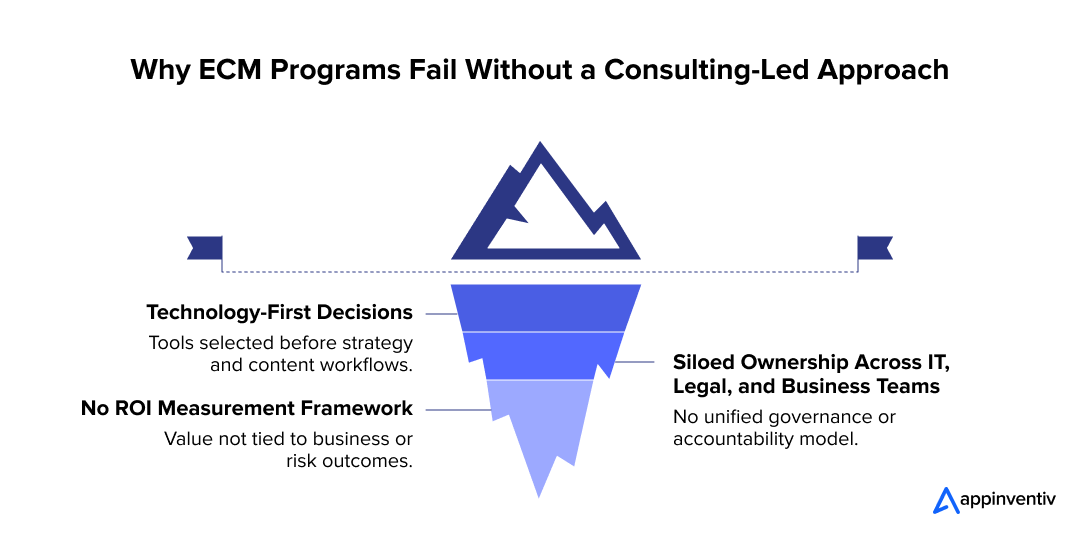
Technology-First Decisions
A common failure pattern starts with platform selection. Enterprises choose an ECM tool based on feature lists, vendor positioning, or licensing alignment, without understanding how content actually behaves across workflows.
Typical issues include:
- Content models designed around platform defaults rather than business processes
- Workflows configured without mapping upstream and downstream system dependencies
- Metadata schemas created after migration, limiting search, automation, and governance
- ECM platforms treated as storage layers instead of process-aware systems
Without consulting-led analysis, ECM solution implementation consulting becomes reactive. Teams spend months reworking architectures that should have been defined before a single document was migrated.
Siloed Ownership Across IT, Legal, and Business Teams
ECM programs sit at the intersection of multiple functions, yet ownership is rarely shared in a structured way. IT manages platforms. Legal defines retention. Business teams create and consume content. When these groups operate independently, standards break down.
Common consequences include:
- Conflicting retention and disposition rules across repositories
- Access controls managed manually instead of through identity-driven policies
- Taxonomies that reflect departmental language rather than enterprise-wide meaning
- Governance documents that exist but are not enforced through systems
A content management consultant helps establish unified accountability models, aligning governance, security, and operational ownership so standards are applied consistently across the ECM environment.
No ROI Measurement Framework
Another reason ECM initiatives stall is how success is measured. Many programs stop tracking value once the platform goes live.
This leads to:
- Success defined by deployment milestones instead of operational impact
- No baseline metrics for retrieval time, approval cycles, or compliance effort
- Inability to quantify cost avoidance from reduced risk or system consolidation
- Limited executive visibility into whether the ECM investment is delivering returns
Enterprise content management consulting introduces ROI frameworks early. These tie technical outcomes to business metrics such as cycle time reduction, audit readiness, productivity gains, and long-term cost control. Without this lens, ECM programs remain IT projects instead of strategic initiatives.
What an ECM Consulting Engagement Delivers in Practice
A content management consultant typically works across five tightly coupled layers: enterprise content architecture, AI-enhanced metadata and semantic indexing, platform and integration design, zero-trust content security with federated access controls, and operating model execution.
Each phase builds on the last, so strategy translates directly into operational change.
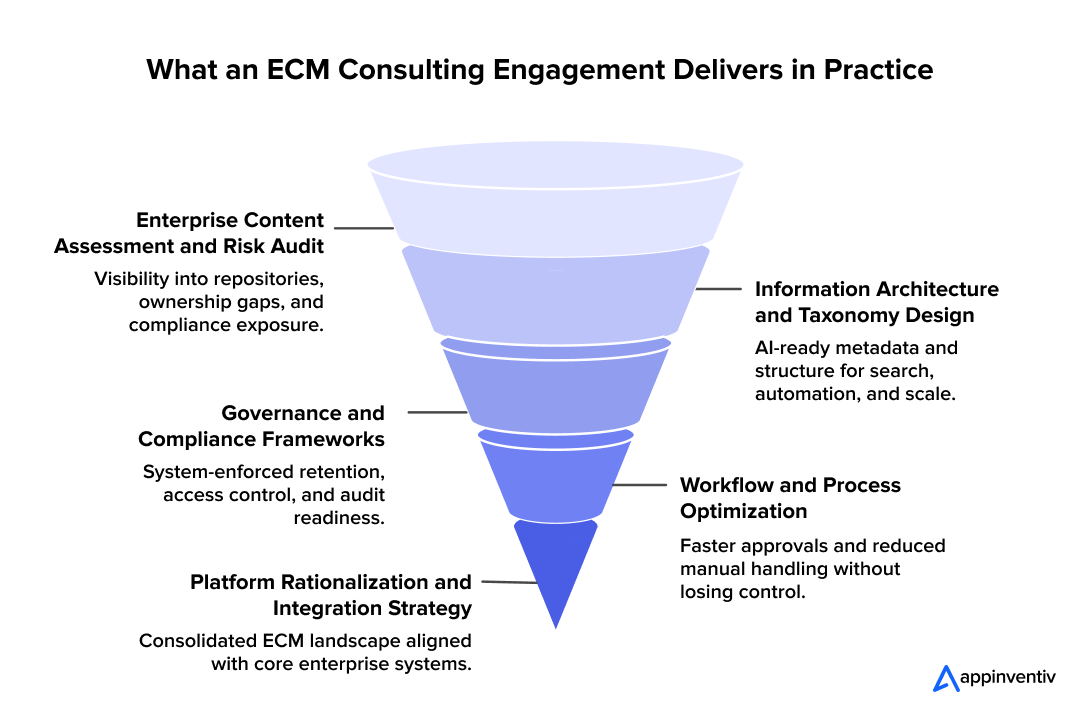
Enterprise Content Assessment and Risk Audit
Engagements typically begin with a comprehensive assessment of the existing content landscape. This is a technical and operational exercise, not a high-level review.
It covers:
- Mapping repositories across ECM platforms, shared drives, collaboration tools, email systems, and line-of-business applications
- Cataloging content formats, volumes, growth rates, and duplication patterns
- Analyzing access behavior, usage frequency, and ownership gaps
- Identifying compliance exposure related to retention, access control, and auditability
This assessment establishes a baseline that informs architecture decisions and highlights areas of immediate risk.
Information Architecture and Taxonomy Design
Once visibility is established, consulting moves into designing the structure that will govern content long term.
Key deliverables include:
- Enterprise-wide metadata/AI models aligned with business processes and compliance needs
- Standardized taxonomies that support consistent classification across teams and regions
- Search optimization through controlled vocabularies and relevance tuning
- Content lifecycle definitions tied to business and regulatory triggers
This foundation is what enables ECM platforms to support automation, analytics, and reliable information retrieval.
Governance and Compliance Frameworks
Governance is where ECM consulting shifts from planning to control.
This phase defines:
- Retention and disposition policies enforced at the system level
- Role-based and attribute-based access models aligned with identity systems
- AI-powered data governance for versioning, audit logs, and content lineage to support investigations and audits
- Clear accountability across IT, legal, compliance, and business teams
Without this layer, even technically sound ECM implementations struggle to maintain trust and compliance over time. Together, these outcomes form the key benefits of ECM consulting, extending beyond deployment into sustained operational control.
Workflow and Process Optimization
Content value is unlocked when it moves efficiently through processes.
Consulting focuses on:
- Identifying manual handoffs and approval bottlenecks
- Designing workflow models aligned with real operational steps
- Automating routing, approvals, and exception handling
- Reducing cycle times without compromising control
This is where enterprise content management consulting for business automation delivers visible operational gains.
Platform Rationalization and Integration Strategy
Enterprises rarely operate with a single content system. Consulting brings coherence to this reality.
This includes:
- Evaluating overlapping ECM platforms and defining consolidation paths
- Designing integration with ERP, CRM, HRMS, and collaboration tools
- Avoiding tight coupling through API and middleware strategies
- Preparing content architecture for downstream automation and intelligence
The result is an ECM ecosystem that supports the business rather than adding complexity.
The ROI Framework Behind ECM Consulting
The value of ECM consulting is not realized at go-live. It shows up in how work changes after implementation. A consulting-led approach defines ROI upfront, ties it to operational metrics, and tracks impact across functions. This is what separates enterprise content management consulting from platform deployment projects.
This section outlines the key benefits of ECM consulting by linking architectural decisions directly to operational and financial outcomes.
Operational Efficiency Gains
One of the earliest ROI signals appears in day-to-day execution. When content structures, metadata, and workflows are designed correctly, routine work speeds up without additional headcount.
Enterprises typically see gains from:
- Faster content creation through standardized templates and controlled metadata
- Reduced retrieval time due to improved classification and search relevance
- Shorter approval cycles driven by automated routing and role-based access
- Fewer rework loops caused by version confusion or missing context
These improvements compound across teams and processes, delivering measurable time savings at scale.
Cost Reduction and Cost Avoidance
ECM consulting also delivers financial impact by eliminating inefficiencies that quietly inflate operating costs.
Common cost drivers addressed include:
- Storage sprawl caused by duplicate and obsolete content
- Overlapping ECM platforms and point solutions maintained in parallel
- Manual labor tied to document handling, classification, and approvals
- Custom API integrations built to compensate for poor architecture
By rationalizing platforms and enforcing lifecycle controls, organizations reduce both direct costs and long-term maintenance overhead.
Risk and Compliance Cost Avoidance
Risk-related ROI is often underestimated until an incident occurs. Consulting-led ECM programs focus on preventing those events rather than reacting to them.
Value is realized through:
- Consistent enforcement of retention and disposition policies
- Strong access controls aligned with regulatory and contractual obligations
- Reliable audit trails and content lineage for investigations and audits
- Reduced exposure to penalties, litigation, and remediation costs
For regulated enterprises, understanding IT compliance helps avoid costs that outweigh operational savings over time.
Productivity and Knowledge Access ROI
Beyond efficiency, ECM consulting improves how knowledge moves across the organization. When content is trustworthy and easy to access, decisions accelerate.
This shows up as:
- Less time spent searching or validating information
- Faster handoffs between departments and functions
- Improved collaboration across distributed teams
- Higher confidence in data used for operational and strategic decisions
These gains are harder to isolate in isolation, but highly visible in aggregate performance.
Scalability and M&A Readiness ROI
A final ROI layer becomes visible during periods of change. Growth, restructuring, and acquisitions expose weaknesses in content systems faster than steady-state operations.
Consulting-led ECM enables:
- Standardized content models that scale across regions and business units
- Faster onboarding of new teams and systems during acquisitions
- Smoother consolidation of repositories and policies post-merger
- Reduced disruption as the organization evolves
This readiness turns ECM from a limiting factor into an enabler of growth.
ROI Impact Snapshot: Traditional ECM vs Strategy-Led ECM
A high-level view of how ECM strategy translates into measurable cost, risk, and productivity outcomes.
| Metric | Traditional ECM (Manual / Tool-Led) | Strategy-Led ECM (Appinventiv Approach) |
|---|---|---|
| Search Latency | ~18 minutes per document on average | Under 15 seconds using semantic search and structured metadata |
| Audit Readiness | 2–3 weeks of manual preparation per audit cycle | Continuous, real-time compliance with enforced governance |
| Storage Waste | ~40% redundant or obsolete content retained | Automated disposition reducing storage costs by ~30% |
| Operational Effort | High manual handling across teams | Workflow-driven automation with minimal human intervention |
| Risk Exposure | Reactive remediation after findings | Preventive controls with auditable content lineage |
| AI Readiness | Near zero due to unstructured content | High readiness through LLM-optimized ingestion and classification |
This comparison is illustrative, based on common enterprise benchmarks and outcomes observed in strategy-led ECM programs.

Enterprise Use Cases Where ECM Consulting Becomes Critical
ECM consulting typically becomes relevant when content complexity begins to interfere with business execution. At this stage, the issue is no longer isolated to storage or tooling. It spans governance, risk, operational efficiency, and cross-functional coordination.
The following use cases for ECM highlight where content complexity begins to affect business execution.
Regulated Industries and Audit-Heavy Environments
In regulated sectors, content functions as an extension of compliance. Records, approvals, and supporting documentation must be governed consistently across systems and over time.
Organizations in these environments often face:
- Fragmented retention enforcement across repositories
- Manual effort required to prepare for audits or investigations
- Limited visibility into access history for sensitive content
- Delays in responding to legal holds or regulatory inquiries
ECM consultants help establish system-enforced governance models, ensuring compliance requirements are embedded into content lifecycle management rather than handled through manual controls.
Global Enterprises and Distributed Teams
As enterprises operate across regions and business units, content standards tend to diverge. Local flexibility gradually leads to inconsistent classification, access rules, and ownership models.
Common challenges include:
- Multiple versions of business-critical documents in circulation
- Access restrictions that slow collaboration across regions
- Search results that vary by platform or geography
- Unclear accountability for content accuracy and maintenance
A content management consultant addresses these issues by defining shared taxonomies, metadata standards, and access frameworks that support consistency while respecting regional requirements.
Mergers, Acquisitions, and Organizational Change
Mergers and restructurings place immediate pressure on content systems. Repositories must be consolidated, policies aligned, and teams given clarity to maintain operational continuity.
Typical issues include:
- Overlapping ECM platforms inherited through acquisitions
- Conflicting retention and governance requirements
- Unclear systems of record for critical documents
- Integration delays caused by content uncertainty
In these situations, ECM consulting provides a structured approach to content consolidation and policy alignment, reducing integration risk and accelerating stabilization.
Digital Transformation and Automation Initiatives
Digital transformation efforts often depend on reliable content inputs. When content structures are inconsistent, automation and analytics initiatives struggle to scale.
Organizations frequently encounter:
- Workflow automation failures due to inconsistent metadata
- High volumes of manual exceptions and rework
- Limited readiness for intelligent capture or AI-driven processing
- Increased technical debt to compensate for weak content foundations
Enterprise content management consulting for business automation focuses on strengthening content architecture and governance first, enabling automation initiatives to deliver sustainable value.
Cost of ECM Consulting: What Enterprises Should Budget For
ECM consulting costs vary widely because the scope is shaped by complexity, not just size. For most enterprises, engagements typically fall between $40,000 and $400,000, depending on how deeply consulting extends into governance, architecture, and execution. This range reflects advisory effort, not ECM software implementation costs, which are usually budgeted separately.
Primary Cost Drivers
Several factors determine where an organization lands within the cost range.
The most influential drivers include:
- Organization size and structure, including the number of business units and regions involved
- Content volume and diversity, spanning documents, records, media, and transactional content
- Compliance and regulatory complexity, especially in regulated or multi-jurisdiction environments
- Integration scope, such as alignment with ERP, CRM, HRMS, case management, and collaboration platforms
- Customization depth, including metadata models, governance rules, and workflow design
These variables represent the key factors of ECM solutions consultancy that influence scope, effort, and overall investment. As these variables increase, ECM solution implementation consulting becomes more intensive, driving costs upward due to the level of architectural and governance work required.
Common Engagement Models
Enterprises typically engage ECM consulting services through one of three models, each aligned to different objectives and budgets.
Common models include:
- Assessment-only engagements, focused on content audits, risk analysis, and roadmap definition
- Phased consulting, where strategy, governance, and implementation advisory are delivered in stages
- End-to-end strategy and advisory, covering architecture design, governance frameworks, integration strategy, and adoption planning
Larger organizations often start with an assessment and expand into phased delivery once priorities and risks are clearly defined.
Cost vs Long-Term Business Impact
When viewed in isolation, ECM consulting costs can appear significant. In practice, they are small compared to the long-term costs of inefficiency and risk.
Without consulting-led strategy, enterprises often absorb:
- Ongoing productivity loss due to poor search, duplication, and manual handling
- Hidden costs from maintaining overlapping ECM platforms and integrations
- Compliance exposure leading to audit remediation, penalties, or legal risk
- Rework and retrofitting costs after failed or underperforming implementations
From this perspective, the investment in ECM consultant functions as risk mitigation and value protection. It ensures ECM initiatives deliver sustained business impact rather than becoming another system that works technically but underperforms operationally.
How to Measure Success After ECM Consulting
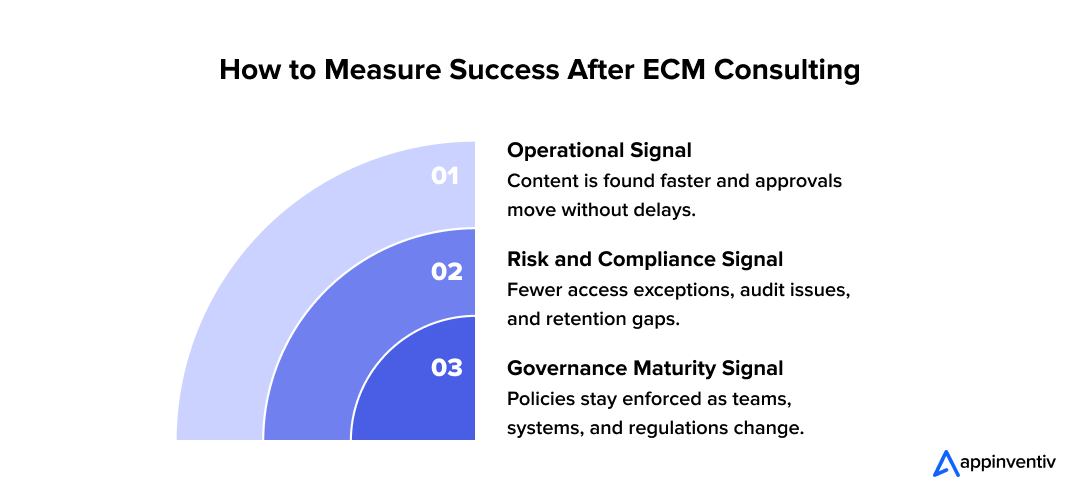
ECM consulting only proves its value once the system has been in use for some time. Early adoption numbers can be misleading. What matters is whether teams work differently, whether risk is easier to manage, and whether content stops slowing the business down. Measuring those shifts requires a small set of practical indicators that reflect real usage and control.
KPIs and Metrics That Matter
Most enterprises focus on a few signals that consistently reveal whether the ECM environment is doing its job.
These typically include:
- How long does it take to find critical content, especially contracts, records, and audit-related files
- Time spent moving documents through approvals, compared with pre-consulting baselines
- Frequency of compliance issues, such as access exceptions, retention gaps, or audit findings
- Reduction in systems and repositories, following consolidation or rationalization efforts
Together, these metrics show whether enterprise content management consulting has improved day-to-day execution rather than just system availability.
Continuous Optimization and Governance
Content environments do not stay stable. Teams change. Regulations evolve. New systems are added. Without active oversight, even well-designed ECM programs slowly lose effectiveness.
Long-term success depends on:
- Regular reviews of classification and access rules
- Ongoing checks to ensure retention policies are applied consistently
- Adjustments to workflows as business processes change
- Clear ownership for enforcing standards when exceptions arise
This is why ECM strategy cannot be treated as a one-time project. Consulting establishes the foundation, but governance and refinement keep it relevant as the organization grows.
Future Trends Shaping Enterprise Content Management Consulting
The direction of ECM consulting is being shaped less by new platforms and more by how enterprises are forced to rethink content control under scale. Content volumes continue to grow, regulations change more frequently, and automation is no longer optional. In this environment, the future of ECM consulting is pragmatic. It is about making existing ecosystems work reliably rather than introducing constant change.
Content Architecture Moving Beyond System Boundaries
Enterprises are increasingly realizing that managing content by platform no longer reflects how work happens. Documents move across systems, processes span multiple tools, and ownership shifts over time. Treating content as belonging to a single repository creates friction.
What is emerging instead is:
- A focus on shared content models that remain consistent even when systems differ
- Metadata standards designed once and applied across multiple platforms
- Greater reliance on APIs and integration layers to access content where it lives
- Less dependence on single systems acting as universal repositories
ECM consulting is becoming the discipline that defines these architectural rules and ensures they are applied consistently across the ecosystem.
Governance Becoming Continuous Rather Than Static
Traditional governance models were built around periodic reviews and static policy documents. That approach no longer holds up in environments shaped by frequent organizational change, automation, and regulatory updates.
Enterprises are moving toward:
- Governance rules enforced directly through platforms rather than manual oversight
- Regular validation of access rights, retention behavior, and classification accuracy
- Stronger alignment between identity management and content controls
- Ongoing governance ownership rather than one-time policy rollout
Consulting engagements increasingly focus on building governance mechanisms that adapt, rather than frameworks that assume stability.
Content Quality as a Prerequisite for Automation
Automation programs are exposing weaknesses in content faster than any audit ever did. When metadata is inconsistent or content ownership is unclear, automation either fails or creates exceptions that require manual correction.
As a result, enterprises are prioritizing:
- Early investment in metadata accuracy and lifecycle definition
- Content structures designed around process requirements, not storage convenience
- Reduction of manual overrides that undermine automation logic
- Consulting-led preparation before automation tools are expanded
This shifts ECM consulting upstream, positioning it as groundwork rather than remediation.
Preparing Content Environments for Controlled AI Use
AI adoption is becoming more deliberate. Enterprises are moving away from experimentation toward defined use cases that must operate within governance boundaries.
This has led to:
- Clear rules defining which content can be accessed by automated and AI-driven processes
- Stronger emphasis on traceability of content usage
- Alignment between data governance and content governance models
- Gradual rollout of intelligent capabilities based on content readiness
Here, ECM consulting acts as the control layer that allows AI to be applied without increasing operational or regulatory exposure.
ECM Consulting Evolving Into an Ongoing Capability
Perhaps the most significant shift is how ECM itself is viewed. Instead of being treated as a project with a start and end date, it is increasingly managed as a continuous capability.
This reflects:
- Constant growth in content volume and complexity
- Ongoing system changes driven by digital initiatives
- Regular organizational restructuring and acquisitions
- Greater executive focus on information risk and efficiency
Future-oriented ECM consulting is designed to support this reality, helping enterprises maintain control over content as conditions change rather than attempting to solve the problem once.
How to Choose the Right ECM Consulting Partner
Most enterprises do not struggle with a lack of options. They struggle with choosing a partner who understands what breaks once ECM moves beyond pilot use. The wrong choice usually becomes visible after go-live, when governance weakens, adoption slows, and teams revert to old workarounds.
Selecting an ECM consulting company is less about credentials and more about the ability to operate across governance, risk, and scale.
Enterprise and Industry Experience
In large organizations, content is rarely neutral. It carries regulatory, legal, and operational consequences. Partners who have not worked in regulated or high-volume environments often underestimate this.
What matters in practice is whether the consultant has:
- Worked through audits, investigations, or regulatory reviews
- Designed retention and access models under real compliance pressure
- Managed content across regions, business units, and ownership models
Experience here reduces risk long before systems are configured.
Strategy-First, Platform-Agnostic Approach
A common enterprise failure pattern starts with tool selection. Platforms are chosen quickly, and strategy is expected to follow. When that happens, teams spend months adjusting processes to fit software limitations.
A capable content management consultant starts elsewhere. They examine how content is created, who owns it, how it moves, and where it creates friction. Only after that do platform decisions make sense. Independence from specific ECM vendors is not a preference. It is a safeguard against rework.
Governance, Security, and Change Management Expertise
Most ECM issues surface after deployment. Access rules are bypassed. Retention is applied inconsistently. Users fall back to shared drives because the system feels slow or unfamiliar.
The right partner anticipates this by:
- Designing governance that can be enforced, not just documented
- Aligning security models with identity and role changes
- Planning for adoption as an operational issue, not a training event
Note: Enterprises that choose partners based on delivery speed or cost often end up paying later through rework, compliance exposure, and stalled adoption. Those that prioritize governance, strategy, and execution depth are far more likely to see sustained value from enterprise content management consulting.

Why Enterprises Work With Appinventiv on ECM and Large-Scale Digital Programs
Enterprise ECM and transformation initiatives tend to surface the same problems over time. Architecture decisions made too early, governance added too late. Systems that work in isolation but struggle at scale. This is where Appinventiv typically gets involved, helping teams move from fragmented execution to controlled, enterprise-ready delivery.
As an enterprise software development company, Appinventiv has supported organizations operating across regions, compliance frameworks, and complex system landscapes. The focus is not limited to implementation. It is on delivering solutions that hold up under audit, change, and long-term operational use. To date, the team has delivered 1000+ enterprise-grade solutions and helped digitize 500+ enterprise processes across industries.
That delivery depth has been externally validated. Appinventiv has been featured in Deloitte Fast 50 India for two consecutive years, reflecting sustained growth driven by enterprise programs rather than short-term projects. The company has also been ranked among APAC’s high-growth companies by Statista and the Financial Times for two consecutive years, reinforcing its credibility in complex, high-scale environments.
Alongside delivery, Appinventiv offers software consulting services that help enterprises make informed decisions before systems are locked in. The emphasis stays on clarity, risk reduction, and long-term value, ensuring ECM and broader digital initiatives remain aligned with how the business actually operates.
If you are assessing how ECM consulting fits into your broader enterprise roadmap, a short discussion can help bring structure to the next steps.
FAQs
Q. What does enterprise content management do?
A. Enterprise content management (ECM) provides a structured way to manage documents, records, and unstructured content across the organization. It ensures content is stored, classified, secured, and retained consistently, regardless of where it is created or used.
In practice, ECM helps enterprises:
- Improve search and retrieval of critical business content
- Enforce retention, access, and compliance rules
- Reduce duplication and unmanaged content sprawl
- Treat content as a governed enterprise asset rather than isolated files
Q. What role do consultants play in ECM implementation?
A. Consultants bridge the gap between ECM technology and business reality. Their role is not limited to configuration but extends to defining how content should behave across processes, teams, and systems.
They typically focus on:
- Content and risk assessment across repositories
- Metadata, taxonomy, and information architecture design
- Governance, security, and compliance frameworks
- Ensuring the ECM platform aligns with real workflows and ownership models
Without this layer, ECM implementations often remain underutilized.
Q. Why do enterprises need ECM consulting if they already use ECM tools?
A. Many enterprises already operate multiple ECM platforms, yet still face search issues, compliance gaps, and low adoption. The issue is rarely tooling. It is the absence of a unifying strategy.
ECM consulting helps by:
- Aligning governance and ownership across departments
- Standardizing metadata and classification models
- Defining clear systems of record
- Turning ECM tools into enforceable operational systems
This is what converts usage into measurable business value.
Q. How long does an ECM consulting engagement typically take?
A. The duration of an ECM consulting engagement depends on scope and complexity rather than organization size alone. Some enterprises require targeted clarity, while others need full-scale redesign.
Typical timelines include:
- 4–6 weeks for content assessment and roadmap definition
- 2–3 months for governance and architecture design
- Longer phased engagements for enterprise-wide transformation
Most organizations start small and expand once priorities are clear.
Q. Is ECM consulting only relevant for regulated industries?
A. While regulated industries see immediate benefits, ECM consulting is not limited to compliance-driven use cases. Any large organization dealing with scale, automation, or distributed teams faces similar content challenges.
ECM consulting is valuable when:
- Content spans regions, systems, or business units
- Automation and digital transformation initiatives depend on reliable inputs
- Knowledge access affects decision speed and productivity
- Growth, restructuring, or M&A increases complexity
In these cases, consulting provides control and predictability, not just compliance.

- In just 2 mins you will get a response
- Your idea is 100% protected by our Non Disclosure Agreement.

Maritime Insurance Claim Software Development for UAE Ports, Insurers, and Logistics Networks
Key takeaways: Manual claims management is too slow for the UAE’s high-volume ports; digital solutions streamline processes and reduce errors. Maritime insurance claim software centralizes data, automates workflows, and ensures compliance with UAE regulations and Takaful principles. Real-time integration with port and vessel systems enables faster claim registration, validation, and settlement. Advanced analytics and risk…

How to Build a Student Management System in Australia?
Key takeaways: Australia’s tightening regulatory landscape (TEQSA, ASQA, CRICOS) makes student management system development in Australia a compliance-driven necessity, not just a digital upgrade. Monetisation models such as SaaS subscriptions, institutional licensing, white-label partnerships, and hybrid pricing offer scalable commercial opportunities in Australia’s expanding EdTech market. Addressing challenges early - data privacy, legacy migration, multilingual…

Guide to Software Risk Management: Identifying and Mitigating Key Risks in Software Development
Key takeaways: Risk management is no longer a peripheral activity; it is a core component of Enterprise Risk Governance (ERG) that ensures software ROI. Successful projects define their risk appetite—the level of risk an organization is willing to accept—before the first line of code is written. By integrating risk assessment into the early discovery phase,…









