






























Why Embedded Finance Is The Next Big Thing For Modern Enterprises


- Strategic Benefits of Embedded Finance for Enterprises: Why Adoption Is Accelerating
- Core Types and Examples of Embedded Finance for Enterprises
- How Embedded Finance Works (The Ecosystem Architecture)
- Enterprise Roadmap to Implement Embedded Finance
- Key Embedded Finance Use Cases for Enterprises Across Industries
- Embedded Finance Challenges & Considerations You Must Address
- Key Implementation Partners in Embedded Finance
- Market Trends and Innovations in Embedded Finance in 2026
- How Appinventiv Enables Embedded Finance for Enterprises
- FAQs

Key takeaways:
- Embedded finance gives you direct control over transaction flows, revenue streams, and customer financial interactions within your platform.
- Platforms embedding payments, credit, and wallets see higher retention as financial activity stays tied to daily user workflows.
- API-driven infrastructure reduces build time and allows faster expansion across regions without full banking integration.
- Real-time data from transactions improves pricing decisions, risk control, and customer segmentation based on actual behavior.
- Success depends on strong orchestration, compliance design, and partner strategy across banking, BaaS, and technology layers.
Enterprise platforms no longer stop at transactions. They now control how money moves inside their own products. A marketplace settles seller payouts. A SaaS tool deploys embedded financial technologies for invoicing and credit. A mobility app issues driver wallets and insurance at the point of use.
This shift comes from API-led banking infrastructure and instant payment rails. Financial services now sit inside your application, not outside it. Users complete payments, access credit, and manage funds without leaving your platform.
Embedded finance for enterprises is not a feature you add later. It changes how your product earns, retains, and scales. You move from offering services to controlling a financial layer tied to every user action. That is not all, close to 94% of companies are increasing investment in embedded fintech capabilities.
This blog breaks down how embedded finance works, where it delivers value, and what it takes to implement it at an enterprise level.
Enterprises are accelerating adoption to capture revenue and retain users. Build financial flows inside your platform before competitors take the lead.

Strategic Benefits of Embedded Finance for Enterprises: Why Adoption Is Accelerating
Large platforms face margin pressure and rising acquisition costs. Growth from core products slows after scale. Embedded finance for enterprises adds a new revenue layer tied to existing user activity.
Users expect instant payments, credit access, and stored balances within the same interface. Each redirect increases drop-offs and delays. Enterprises that keep financial actions inside the product see stronger completion rates.
Embedded financial technologies like payment APIs, lending infrastructure, and BaaS platforms have reduced build complexity and allow faster deployment. What once required full banking integration can now be achieved through modular APIs.
Enterprises are bringing financial services inside the product to control both revenue and user experience.
In enterprise deployments, this shift is often tied to retention. Around 45% of businesses adopt embedded finance to strengthen customer relationships, not just to process transactions.
New Revenue Streams Across Financial Flows
Embedded finance allows you to capture value from transactions already happening on your platform. Payment processing, lending, and account-based services create direct revenue lines.
Revenue shifts from one-time transactions to continuous financial activity tied to user behavior.
In most enterprise cases, the focus is not on cost reduction. More than 80% of businesses prioritize financial outcomes such as transaction revenue and repeat usage once embedded finance is in place.
Higher Customer Lifetime Value and Retention
Users who store funds or rely on embedded financial services interact with the platform more frequently. Financial dependency increases repeat usage. Retention improves as financial activity becomes part of the user’s daily workflow.
Improved Conversion Through Reduced Friction
Every additional step in a payment flow reduces completion rates. External redirects introduce delays and trust gaps. Embedded financial flows remove these barriers. Users complete transactions within the same interface using stored data. This leads to faster transactions and higher completion rates.
Data-Driven Financial Intelligence
Embedded finance gives you access to transaction-level data. Structuring this through a finance data warehouse allows you to centralize and query payment frequency, transaction size, and credit usage patterns efficiently.
This data supports predictive analytics in finance for better pricing decisions, risk control, and user segmentation based on real financial behavior.
Platform Lock-In and Ecosystem Control
As financial services become part of your platform, users depend on more than your core product. Payments, credit, and stored balances increase switching costs. Your embedded finance platform becomes the primary interface for both operations and financial activity. This strengthens control over revenue, data, and long-term customer relationships.
This is reflected in adoption patterns as well. Nearly 75% of enterprises link embedded finance directly to growth through stronger customer retention.
Also Read: A Comprehensive Guide to Decentralized Finance (DeFi) in 2026
Core Types and Examples of Embedded Finance for Enterprises
Embedded fintech integrates financial services directly into your product workflows. Embedded finance payments, credit, insurance, and accounts operate within your application instead of external banking channels. These capabilities run through APIs and regulated partners but appear native to the user.
Enterprises are structuring these capabilities as modular financial layers inside their platforms.
| Type | What It Covers | How It Works Inside Your Platform | Enterprise Impact |
|---|---|---|---|
| Embedded Payments | Checkout, subscriptions, payouts, stored value | Processes transactions within your app using payment APIs and internal flows | Full control over transaction lifecycle and fee capture |
| Embedded Lending & Credit | Short-term credit, installment payments, working capital | Uses platform data such as transaction history to assess and approve credit in real time | Faster credit decisions and new revenue from lending |
| Embedded Insurance | Contextual coverage linked to user actions | Offers insurance at the point of purchase, with underwriting handled by licensed providers | Additional revenue stream tied to user activity |
| Embedded Banking / Accounts | Wallets, accounts, card issuance, balance management | Enables users to store funds and manage money within the platform through banking partners | Increases user dependency and financial engagement |
| Embedded Investments | Asset allocation, automated investing, portfolio tracking | Allows users to invest funds directly within the platform interface | Extends platform usage into long-term financial activity |
Enterprises are no longer offering isolated services. Financial capabilities now sit alongside core product functions. Your platform becomes the place where users not only interact but also transact, manage funds, and access financial services.
How Embedded Finance Works (The Ecosystem Architecture)
An embedded finance platform runs on a layered system where each component handles a defined part of the transaction lifecycle. Your platform owns the user interaction and flow control. Financial institutions handle fund custody, settlement, and regulatory obligations behind the scenes.
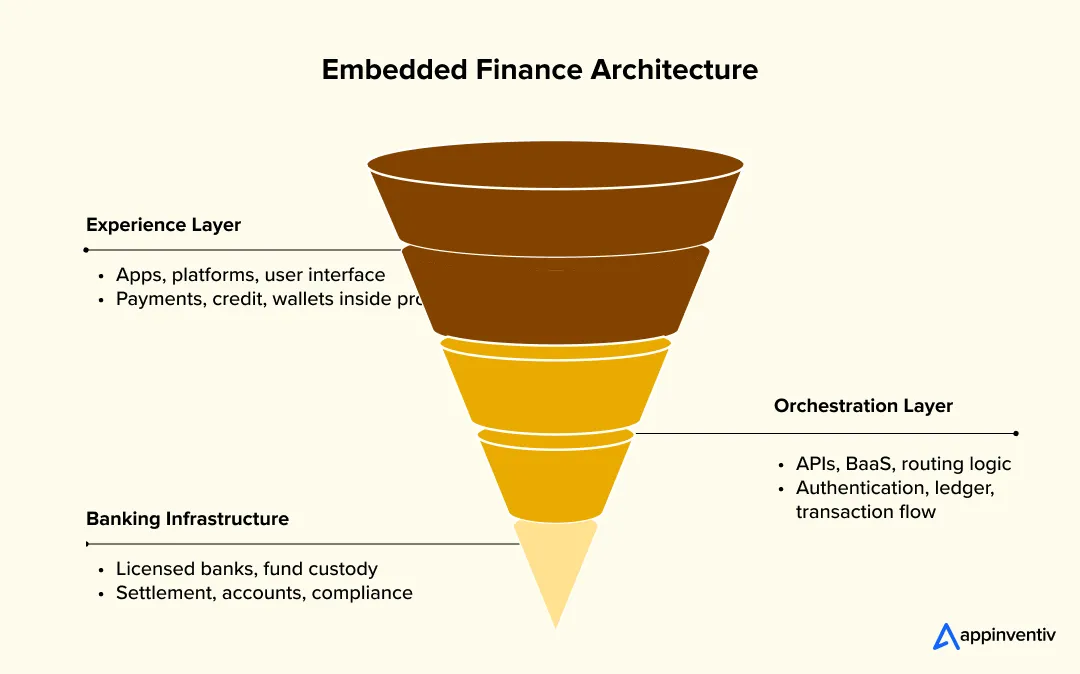
Layer 1: Experience Layer
This is where financial actions are initiated and completed. It includes your web apps, mobile apps, and internal dashboards.
At this layer, you control:
- Payment initiation flows, such as one-click checkout or stored credentials
- Wallet interfaces that display balances and transaction history
- Credit prompts triggered by user behavior, such as cart value or usage patterns
- Payout dashboards for users to track incoming funds
Every action at this layer maps to an API call. The goal is to reduce steps and keep the user inside a single session without redirects.
Layer 2: Orchestration Layer
This layer connects your platform to financial infrastructure through APIs. It acts as the control system for routing, validation, and execution.
Banking-as-a-Service (BaaS) providers sit at the core of this layer. They provide access to regulated banking capabilities through APIs in fintech without requiring you to build direct bank integrations.
This layer includes:
- BaaS providers
They expose APIs for account creation, wallet management, payments, card issuance, and lending. They act as an intermediary between your platform and licensed banks. Instead of integrating with multiple banks, you integrate once with a BaaS provider. - Transaction routing logic
Routes payments based on geography, currency, cost, and success rates. The system can switch providers in real time to maintain high authorization rates. - Authorization and authentication flows
Handles tokenization, 3D Secure checks, and session validation before transaction approval. - Ledger mapping and reconciliation
Maintains internal records of debits and credits mapped to user accounts. This ensures consistency between platform balances and external bank records. - Service orchestration across providers
Combines identity checks, risk scoring, payment processing, and fund disbursement into a single workflow. - Error handling and failover systems
Detects failures and reroutes transactions to backup providers without disrupting the user flow. - API abstraction layer
Standardizes different provider APIs into a single interface, reducing dependency on any one vendor.
BaaS and embedded finance are often used together, but they solve different parts of the system.
Banking as a Service vs Embedded Finance Table
| Aspect | Banking-as-a-Service (BaaS) | Embedded Finance |
|---|---|---|
| Role | Backend infrastructure | Product-level capability |
| Focus | APIs for banking functions | User-facing financial flows |
| Users | Developers/platforms | End users |
| Scope | Accounts, cards, payments APIs | Payments, credit, wallets in-app |
| Ownership | Provided by fintech/banks | Controlled by your platform |
Layer 3: Regulated Infrastructure
This layer executes embedded finance in banking — financial operations run under full regulatory oversight.
It includes:
- Fund custody and account holding
User balances are stored in regulated accounts managed by licensed banks. - Payment clearing and settlement
Transactions are processed through card networks or bank transfer systems. Settlement timelines depend on payment rails such as real-time payments or batch clearing systems. - Card issuance and account provisioning
Banks issue virtual or physical cards and create user accounts linked to your platform. - Credit underwriting and risk exposure
Lending partners evaluate risk, set credit limits, and manage repayment structures. - Regulatory reporting and compliance enforcement
Financial institutions handle reporting obligations to regulators and maintain audit records.
Your platform interacts with this layer through approved partners but does not directly handle regulated activities.
Governance and Compliance Across Layers
Compliance is embedded into every transaction flow, not added after deployment.
- KYC and identity verification
Users are verified through document checks, biometric validation, and database matching before accessing financial services. Computer vision in finance is what powers these document and biometric checks at this stage. - AML monitoring and transaction screening
Transactions are scanned against risk rules, velocity limits, and sanction lists in real time. - PCI-DSS compliance
Card data is tokenized and never stored in raw form within your systems. - PSD2 and Open Banking requirements
Strong customer authentication and secure data sharing protocols are enforced for account access. - Data residency and cross-border controls
Financial data is stored and processed within approved geographic regions based on regulatory requirements. - Audit trails and traceability
Every transaction, API call, and state change is logged with timestamps and identifiers, often secured through blockchain in fintech infrastructure.
Key Insight:
You control the experience, logic, and flow of financial services. Licensed institutions handle custody, settlement, and compliance. The value lies in how well you orchestrate these layers into a single system.
Enterprise Roadmap to Implement Embedded Finance
Execution clarity defines success when deploying embedded finance solutions. Each step builds on the previous one, and gaps at any stage create delays, compliance risks, or revenue loss.
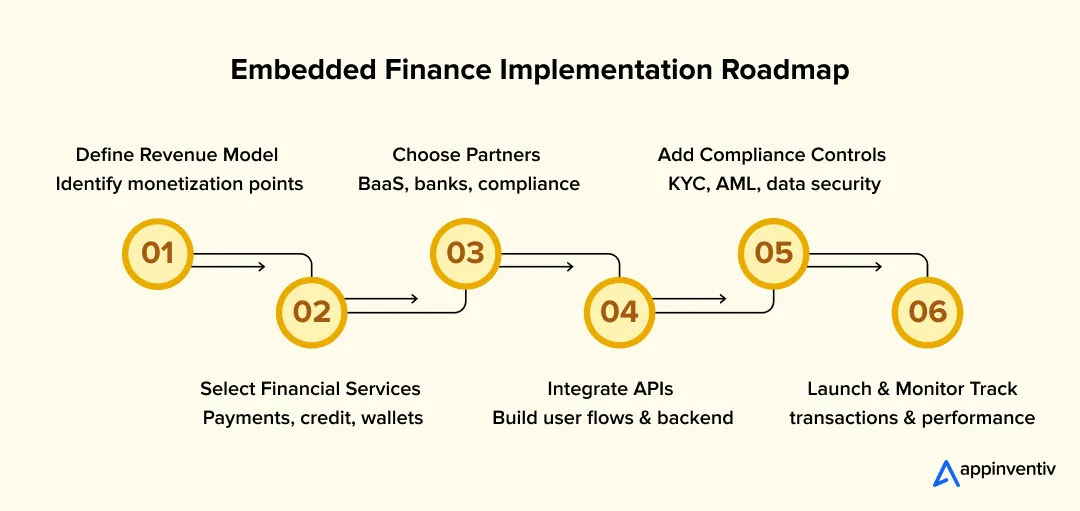
Define Business Model and Monetization
Start with how financial flows will generate revenue. Identify where you can capture fees, margins, or commissions within existing user activity. Align this with your core product usage.
Identify Financial Services to Embed
Select the services that match your platform’s workflows. Payments, credit, accounts, or insurance should solve a clear user need, not add complexity.
Select Partners
Choose BaaS providers, licensed banks, and compliance vendors. Evaluate them on API reliability, geographic coverage, regulatory support, and settlement timelines.
Understanding the cost to build a fintech app with these integrations helps teams plan realistic budgets before partner selection.
Embedded Finance Integration: APIs and User Experience
Connect financial services through APIs using fintech application development best practices, and design flows that keep users inside your platform. Focus on reducing steps in checkout, credit access, and fund management.
Implement Compliance and Risk Controls
Set up KYC, AML checks, transaction monitoring, and data protection controls. Embed these into workflows instead of treating them as separate processes.
Launch, Monitor, and Improve
Track transaction success rates, drop-offs, and user adoption. Use this data to refine flows, adjust routing logic, and improve performance over time.
Key Embedded Finance Use Cases for Enterprises Across Industries
Embedded finance shows up at the exact point where money moves in each industry. The pattern is simple. It replaces external steps with in-product financial actions.
| Industry | Where It Appears | Financial Layer Inside the Product | Direct Effect |
|---|---|---|---|
| Retail and E-commerce | At checkout and refunds | Payment processing, saved payment methods, pay-later options | Faster checkout and fewer abandoned carts |
| SaaS Platforms | During billing and usage tracking | Subscription payments, invoices, and usage-based charges | Stable revenue and tighter user dependency |
| Mobility and Logistics | After each completed service | Wallet balances, instant payouts, and expense tracking | Shorter payout cycles and higher partner retention |
| Healthcare | During billing and treatment cycles | Patient payments, installment options, and insurance processing | Fewer delays in collections |
| Marketplaces | Across buyer and seller transactions | Payment collection, split settlements, escrow, scheduled payouts | Full control over fund movement |
The entry point changes across industries. The structure does not. Payments, balances, and settlements stay inside the product instead of moving across external systems.
Embedded Finance Challenges & Considerations You Must Address
Embedded finance breaks when control is loose at any step. Most issues show up in production once real money starts moving.
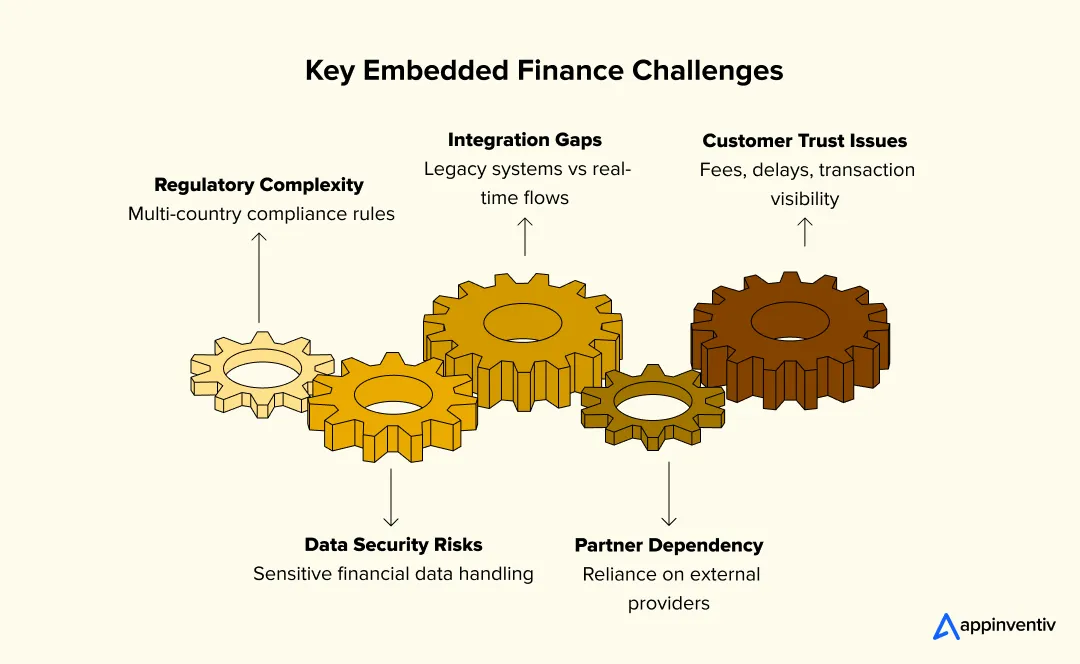
Regulatory Complexity Across Regions
Each country defines its own rules for identity checks, payment authentication, and reporting. For example, European flows require step-up authentication for certain transactions, and Indian flows require strict KYC before wallet usage.
You need location-aware logic at the transaction level. Tag each user and payment with jurisdiction data, then trigger the right checks. Keep these rules outside core code so they can be updated without redeployments.
Data Privacy and Security Risks
Card data and identity records move across multiple services. The risk is not storage alone, but how data travels between systems.
Do not store raw card numbers. Use tokenization from your payment provider. Encrypt all API calls with TLS and store sensitive fields using strong encryption keys. Track every read and write action on financial data. Set alerts for unusual access patterns, such as repeated failed attempts or large value changes.
This risk is widely reported. NNearly 39% of enterprises cite compliance and security as primary concerns when implementing embedded finance solutions.
Partner Dependency and Vendor Lock-In
Most platforms depend on a single payment processor or BaaS provider early on. This works until failure rates increase or costs change.
Keep your system provider-agnostic. Build a service layer that handles requests in a standard format. Route payments based on success rate, cost, or geography. This allows you to shift traffic between providers without changing your product logic.
Integration with Legacy Systems
Legacy systems update balances in batches. RPA in finance is often used as a bridge to automate data exchange between these batch systems and real-time financial layers.
In real-world implementations, this becomes a major blocker. Around 4 out of 10 enterprises face issues during embedded finance integration, particularly when connecting financial APIs, compliance layers, and legacy systems without creating reconciliation gaps.
Also Read: How ERP Finance Revolutionizes the FinTech Industry
Introduce a real-time ledger that records every debit and credit as it happens. Each entry should include a timestamp, user ID, and transaction reference. Sync this ledger with external systems using event streams. This avoids mismatches during reconciliation.
Customer Trust and Transparency
Users expect to see where their money is at any moment. Delayed updates or unclear fees reduce usage.
Show transaction status at each stage, such as initiated, pending, and settled. Display fees before confirmation. Keep a full record of each transaction, so support teams can trace issues without manual checks.
Embedded finance systems fail when these controls are added late. This is where many projects slow down. Teams start with payments but delay compliance, ledger design, or routing logic, which creates failures once transaction volume increases.
They need to be built into the first version of the system, not patched in later.
Integration gaps and compliance delays slow down launches. Build systems with real-time ledgers, strong controls, and stable financial flows from day one.

Key Implementation Partners in Embedded Finance
Embedded finance works only when the right set of partners is in place. Each one handles a different part of the flow. If one layer slows down, the whole system feels it.
| Partner Type | What They Do | What To Check | Why It Matters |
|---|---|---|---|
| Banking Partners | Hold funds, issue accounts, settle transactions | Local licenses, settlement cycles, and currency support | Controls where you can operate and how fast funds move |
| BaaS Providers | Provide APIs for accounts, payments, and cards | API uptime, webhook delays, and failure handling | Affects transaction status, retries, and system reliability |
| Technology Partners | Connect APIs, manage flows, build internal systems | Experience with real-time systems and ledgers | Decides how stable and flexible your setup is |
| Compliance Providers | Run KYC checks, monitor transactions, flag risks | Speed of checks, rule control, and data coverage | Impacts onboarding time and fraud control |
Most issues in embedded finance come from how these partners connect, not from the partners themselves.
For example, delayed webhooks from a BaaS provider can leave wallet balances out of sync. A slow settlement cycle from a bank can delay payouts. If your system cannot handle these gaps, users will notice.
This is where a technology partner like Appinventiv fits in, connecting embedded financial technologies across your system into a single, reliable control layer.
The focus is on building a control layer between these systems. APIs are standardized, transactions are tracked through an internal ledger, and routing logic can shift between providers if failure rates increase.
Partner strategy shapes how your system behaves under real conditions. Most enterprises do not build an embedded finance platform from scratch on their own.
Over 70% rely on external providers for payments, banking, and compliance, which makes partner selection a core technical decision. It affects uptime, transaction success, and how quickly you can enter new markets.
Market Trends and Innovations in Embedded Finance in 2026
The latest fintech trends and innovations in embedded finance are moving deeper into core product logic, going well beyond just adding payments. It now shapes how systems trigger, route, and settle financial actions.
Invisible and Contextual Finance
Financial actions now happen without extra steps. The system triggers them based on user behavior.
A payment completes within the same flow. Credit appears only when the system detects a need. IoT in banking extends this further, triggering financial actions based on physical signals like device usage or location. Users do not leave the product or switch screens.
API-First and Platform-Led Ecosystems
Enterprises rely on APIs instead of direct bank connections. This reduces setup time and avoids long integration cycles.
Teams can replace providers, add new services, or expand into new regions by changing API endpoints. The core system stays intact.
AI-Driven Credit and Risk Decisioning
Risk checks now use live platform data. Transaction patterns, frequency, and account activity feed into decision models powered by AI in fintech.
Approvals happen in seconds. Systems adjust limits based on current behavior instead of fixed credit profiles.
Automated Compliance Systems
Compliance checks run during each transaction. Identity checks, fraud signals, and rule-based filters execute in real time.
High-risk actions are flagged or blocked instantly. Low-risk transactions move without delay.
Also Read: Generative AI in Finance: Pioneering Transformations
Multi-Party Financial Systems
Transactions now involve more than one participant. Funds move between users, vendors, and partners within the same system.
The platform controls how money is split, held, and released. Agentic AI in finance is increasingly used to automate these multi-party decisions without manual intervention.
These patterns show a clear shift. Financial logic now sits inside the system, not outside it.
Also Read: Unlocking the Green FinTech Revolution Via Innovative Use Cases
Enterprises are already upgrading systems for real-time payments, credit flows, and multi-party transactions. Move faster before competitors take control of financial layers.

How Appinventiv Enables Embedded Finance for Enterprises
Appinventiv builds embedded finance solutions with control built into each transaction flow. Compliance checks, audit logs, and identity verification run within the system, not as separate steps. Each transaction is traceable with clear status, timestamps, and user mapping.
Integrations are designed for real-time performance. APIs handle payments, credit, and account actions without delays in balance updates or transaction states. A vendor-neutral layer sits between your platform and external providers, so you can switch partners or route traffic without rebuilding core systems.
Appinventiv has delivered 200+ fintech products through its fintech consulting services, backed by over 10 years of domain experience. Platforms built under this model reach 98% fraud detection accuracy, maintain 99.50% transaction security uptime, and reduce operational costs by up to 30%.
AI-Powered Banking Transformation for a European Enterprise Bank
A large European bank needed to reduce manual processing across its financial workflows. The system handled high volumes of customer queries, transaction validations, and internal checks.
Appinventiv introduced AI-driven automation within the banking system. This included transaction classification, query handling, and decision support.
Key Outcomes:
- 35% reduction in manual operations
- 50% improvement in process accuracy
- 20% increase in customer retention
- Over 50% of queries are handled without human intervention
Enterprise Digital Wallet with Compliance-Ready Infrastructure (Australia)
An enterprise client in Australia required a wallet system that could handle regulated financial flows while maintaining strict compliance.
Appinventiv built a digital wallet with real-time balance tracking, transaction logging, and compliance checks integrated into each step.
Core Capabilities Delivered:
- Real-time wallet ledger with debit and credit tracking
- Built-in KYC and transaction monitoring
- Secure handling of user balances through licensed partners
- Audit-ready transaction logs for regulatory review
Embedded finance for enterprises is becoming part of how platforms operate. It sits inside transactions, user flows, and revenue models. Enterprises that build this layer control how money moves, how users engage, and how revenue is generated within their systems.
Let’s connect and build embedded finance solutions for businesses like yours, with full control over every transaction flow.
FAQs
Q. What is embedded finance?
A. Embedded finance means adding financial functions directly inside your product. Payments, credit, wallets, and insurance run within your application instead of external banking systems.
These embedded financial services connect through APIs and licensed partners. From the user’s view, everything happens inside one platform. From a system view, each action triggers a chain of API calls, ledger updates, and compliance checks in real time.
Q. How can embedded finance create a competitive advantage for our business?
A. It gives you control over how money moves inside your platform. You capture transaction fees, manage payouts, and offer credit without sending users to third-party systems.
This reduces drop-offs and increases repeat usage. Users who store funds or depend on your financial layer return more often. Over time, your platform becomes harder to replace since financial activity stays tied to it.
Q. What is the ROI of embedded finance for enterprise companies?
A. Return comes from three areas. First, direct revenue. You earn from payments, lending margins, and embedded fintech services tied to transactions. Second, higher conversion. Removing external steps improves completion rates, which increases total transaction volume.
Third, lower operational cost. Automated reconciliation, real-time ledgers, and fewer manual checks reduce back-office effort. Many platforms report cost reductions close to 30% after moving financial flows in-house.
Q. What are the latest trends in embedded finance?
A. Financial actions are becoming less visible. Payments and credit now trigger within existing workflows instead of separate steps. Systems rely more on APIs and event-driven updates. This allows faster changes and easier expansion across regions.
Risk checks now use live transaction data. Credit limits and fraud checks adjust based on current behavior, not static profiles. Compliance runs during each transaction. Identity checks and monitoring happen in real time, without manual review queues.
Platforms are also handling more multi-party transactions. Funds move between users, vendors, and partners within the same system, with precise control over how each share is allocated.

- In just 2 mins you will get a response
- Your idea is 100% protected by our Non Disclosure Agreement.

How to Develop an Insurance Portal That Integrates CRM, Claims, and Billing Systems
Key takeaways: Insurance portal development succeeds only when CRM, claims, billing, and policy systems are fully integrated in real time. Architecture choice and workflow orchestration determine transaction accuracy and scalability. Security, compliance, and audit traceability must be embedded across all integration layers. Testing and monitoring are essential to prevent reconciliation gaps after launch. Typical development…

How to Build a Digital Wallet App Like X Money: Cost, Features, and Technology Stack
Key Takeaways: Building a wallet like X Money requires more than payment features. It needs identity verification, fraud monitoring, payment gateways, and a secure financial infrastructure. Development costs usually range between $40,000 and $400,000. The final cost depends on features, compliance requirements, payment integrations, and platform scale. Core technologies include mobile frameworks, backend microservices, financial…

How Much Does Accounting Practice Management Software Development Cost in Australia 2026?
Key takeaways: Custom accounting practice management software development in Australia for mid-to-large firms generally falls between AUD 70,000 and AUD 700,000. Key cost drivers in the 2026 landscape include adherence to the Privacy Act 1988, ATO SBR API integrations, STP Phase 2 compliance, and Sovereign Data Residency requirements. A modular architecture and structured development approach…









