


































Anatomy of The Growing API Market

 Share -




It’s impossible to measure the efficiency of mobile apps without the mention of APIs. Application Programming Interfaces (API) are requirements that allows one computer or program to use the capabilities of another application or software.
APIs allow companies to innovate and grow at an exponential level.
Using APIs, companies are able access newer markets for expansion and are able to not just keep up but also surpass competition. The business benefits that brands like Pinterest, Facebook, eBay, and Twitter have been seeing with the integration of APIs in the business model, has brought in a huge demand for the process.
Here is an infographic on how the present API Market looks like –
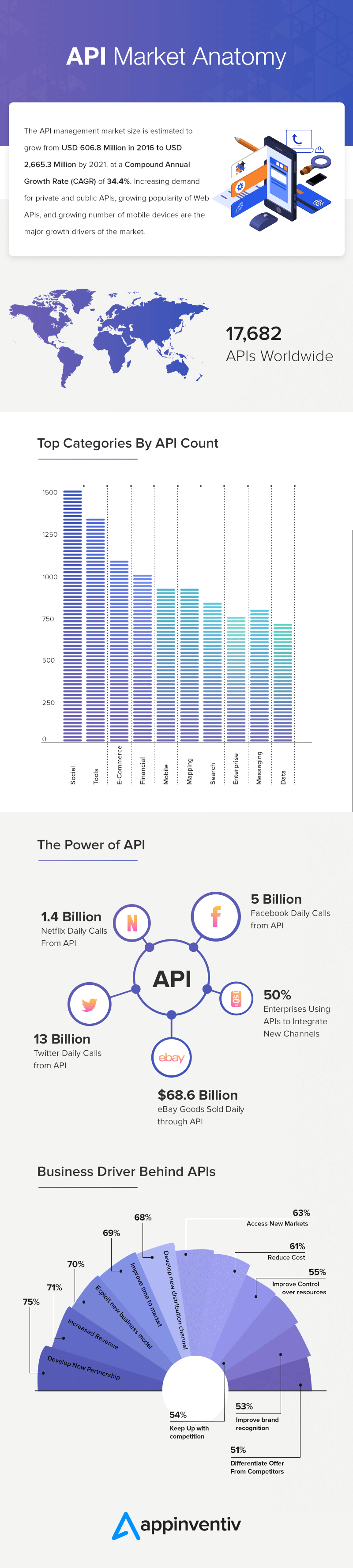
The API Market is on a constant drive uphill. It has been seeing a massive adoption from companies belonging to a varied range of industries. The high scope of innovation and growth that it introduces companies with are the reasons behind its application in a series of ways.
What earlier was restricted to just social media plugins have now been extended to offering services like order tracking and translating one language into another.
The right set of API integrations can change your business scenario 180 degrees. If you are seeking help with finding and incorporating the right set in your app or need a custom interface made for you, contact our team of API Developers, today.


Fast 2-minute response, fully NDA-protected.

Beyond Customer Portal Development: Building Connected Digital Services
Key takeaways: A portal without CRM, ERP and billing integration leaves your staff doing the connecting. Start with customer tasks, then integrate only the systems those tasks actually need. Name one system of record for each data type before choosing APIs or middleware. Plan integration, security and privacy obligations at the start, not after the…

CRM Software for Local Government: From Community Requests to Better Service Delivery
Key takeaways: A council CRM should sit around existing systems as a service layer, not replace them. Integration with ERP, rates, property and GIS systems prevents another data silo and duplicate entry. Start with one high-volume service, pilot it with residents, then scale on measured results. Track resolution time, SLA compliance, self-service rates and cost…

The Ultimate Guide to CRM for Insurance: Features, Cost, Top Platforms, Integration & More
Key takeaways: CRM for insurance connects sales, service, and claims into one governed system, distinct from the policy administration system. Core features span pipeline management, policy visibility, claims tracking, commission management, AI analytics, and compliance controls. Cost ranges from roughly USD 15,000 for configuration to USD 150,000 and beyond for custom development at enterprise scale.…