



























AI-Powered Booking Optimization for Beauty Salons in Dubai: Costs, ROI & App Development


- How Is Digital Transformation Driving AI Booking Systems for Salons in Dubai?
- How Does AI Scheduling Software for Beauty Salons Actually Work?
- What Operational Challenges Can AI Salon Booking Optimization Solve?
- What Features Should an AI Salon Booking App Include for Enterprise Growth?
- How Do You Build an AI Booking App for a Beauty Business in Dubai?
- Custom AI-Powered Salon Booking App Development Process
- What Is the Cost to Develop a Salon Booking App in Dubai With AI?
- Pricing Models for AI Booking Optimization Platforms
- ROI of AI Booking Systems for Beauty Salons
- Build vs Buy Decision Framework
- How Do You Choose the Right AI Development Company in Dubai for Salon Apps?
- What Future Trends Are Shaping AI Booking Optimization for Beauty Salons?
- Why Consider Appinventiv for Beauty Salon Software Development in Dubai
- Frequently Asked Questions

Key Highlights
- AI booking optimization improves utilization, reduces no-shows, and stabilizes predictable salon revenue streams.
- Enterprise salon platforms enable centralized scheduling, customer insights, and scalable multi-location operational control.
- AI-enabled booking platforms can be designed to align with UAE data protection regulations and secure payment standards.
- Predictive scheduling and personalization increase customer retention while significantly reducing operational coordination overhead.
- Custom AI booking apps provide integration flexibility, long-term scalability, and stronger digital competitive differentiation.
AI-powered booking optimization for beauty salons in Dubai is a business technology topic for salon chains, wellness brands, and beauty service operators in the UAE. The focus is on implementation cost, ROI outcomes, and app development considerations. This discussion looks at deployment, operational impact, and measurable business value.
Dubai’s beauty and wellness market continues to expand. Premium service expectations remain high. Tourism demand adds consistent customer inflow. As salon brands scale across locations, appointment management directly affects revenue predictability, staff productivity, and customer retention.
Several operational gaps have continued to affect performance, including frequent no-shows and last-minute cancellations; idle staff hours due to uneven booking distribution; manual or partially automated scheduling workflows; and fragmented booking channels across apps, aggregators, and direct platforms.
AI-driven booking optimization helps address these inefficiencies. It uses demand forecasting, automated scheduling logic, and customer behavior data. The objective is better appointment utilization and smoother service planning.
For brands ready to act on this, investing in an AI salon booking app development in Dubai is a practical first step toward building that optimization layer.
For larger beauty businesses, booking optimization is no longer just scheduling software. Booking optimization is increasingly treated as a core revenue management layer. This shift explains the growing interest in AI-powered booking optimization for beauty salons in Dubai, especially among multi-location brands seeking operational stability and measurable efficiency gains.
Not every salon requires a fully customized AI platform. For single-location salons, advanced SaaS booking systems may be sufficient. AI-driven custom solutions become more relevant for multi-branch operators managing complex demand patterns.
UAE ranked #1 globally in Telecommunications Infrastructure Index, accelerating digital service adoption

How Is Digital Transformation Driving AI Booking Systems for Salons in Dubai?
The beauty and wellness sector in the UAE has been gradually shifting toward digital operations. Dubai’s broader push toward digital services, combined with high smartphone usage and strong competition in premium beauty services, has made online booking systems more of a necessity than an optional upgrade.
The UAE’s strong digital foundation also plays a role here, ranking #1 globally in the Telecommunications Infrastructure Index, reinforcing reliable connectivity for app-based service businesses. Many salon businesses now treat booking infrastructure as part of their operational backbone, this shift aligns with the broader growth of mobile-first service models across Dubai’s retail and wellness sectors.
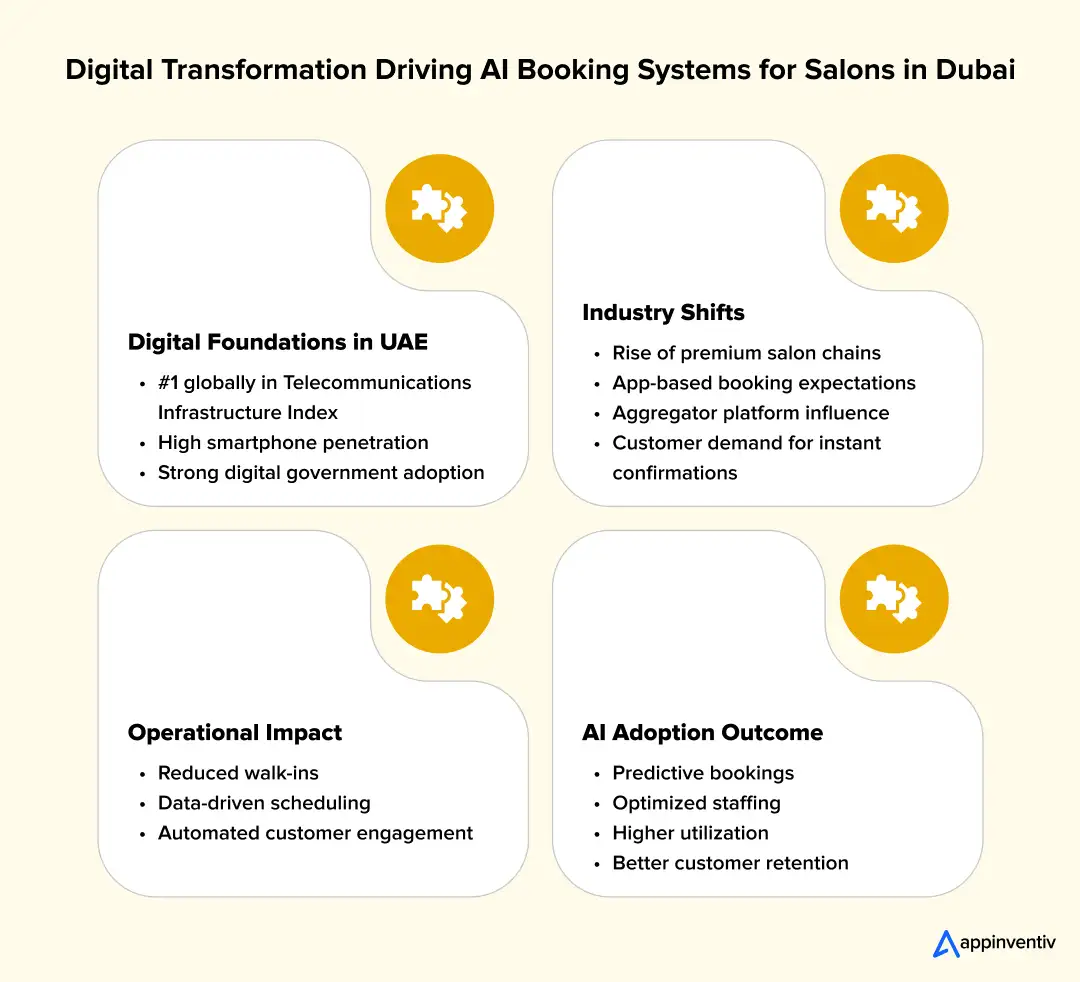
Key market developments influencing adoption:
- Policy-driven digital adoption
The UAE’s broader push toward digital service adoption has encouraged private-sector businesses, including salons, to modernize customer-facing systems. - Customer booking behavior has changed
Walk-in dependence is decreasing. App-based scheduling and instant confirmations are becoming standard expectations, prompting interest in an AI booking system for salons in Dubai. - Structured salon chains are expanding
Franchise growth and multi-location brands require centralized visibility into scheduling. This has increased the uptake of salon appointment automation in the UAE tools. - Aggregator platforms are shaping expectations
Third-party booking marketplaces influence pricing, transparency of availability, and customer retention strategies. Some brands are turning to salon booking optimization software in the UAE to maintain direct engagement. - Operational efficiency focus
Better utilization of staff time, repeat bookings, and consistent customer communication are becoming key competitive factors.
How Does AI Scheduling Software for Beauty Salons Actually Work?
If you manage bookings across more than one location, you already see how quickly scheduling becomes operational rather than administrative. AI-powered booking optimization leverages booking data to improve capacity planning, reduce scheduling gaps, and support more consistent appointment utilization and revenue forecasting.
Businesses evaluating AI scheduling software for beauty salons are typically seeking improved utilization, clearer demand visibility, and smoother system integration.
Core AI Capabilities
Most AI booking platforms rely on predictive analytics and optimization logic. The aim is not full automation, but more informed scheduling decisions.
- Predictive appointment demand modeling
Historical booking data, seasonal fluctuations, promotions, and service popularity are analyzed to estimate future appointment demand. This helps with staff planning and capacity allocation. - Intelligent slot allocation
Scheduling engines account for service duration, stylist expertise, availability patterns, and location-level demand differences. This often reduces unused time slots. - Cancellation and no-show prediction
Past booking behavior, confirmation response patterns, and lead time data can highlight statistically higher-risk appointments based on behavioral patterns. Businesses typically use this insight for reminders or deposit strategies. - Dynamic staff scheduling optimization
Forecast-based scheduling helps balance peak-hour staffing while avoiding over-allocation during slower periods.
Underlying Technology Stack
From a system perspective, most deployments combine several layers rather than a single AI component. Reliability and integration usually drive architecture decisions.
- Machine learning models process booking trends and customer behavior data
- Conversational interfaces support chat-based or app-based booking workflows
- In advanced implementations, computer vision tools may support digital consultations or service previews, though these are not core to booking optimization systems.
- Cloud infrastructure allows multi-location scalability and centralized access
- API integrations connect booking platforms with POS, CRM, loyalty, and reporting systems, enabling centralized data flow across salon management systems.
Also Read: AI Innovations in Dubai: Accelerating Business Growth
Data Inputs Typically Used
Data quality usually determines how useful optimization becomes. Most systems depend on consistent operational data rather than complex external sources.
- Historical bookings, service types, timing patterns, and stylist utilization
- Customer behavior signals such as repeat visits, cancellations, and booking preferences
- Variations in service duration across locations or staff members
- Seasonal demand changes, tourism cycles, Ramadan periods, and major local events
- Data consistency and structured input formats are critical for reliable AI outputs.
Over time, cleaner data tends to improve forecasting accuracy and stabilize scheduling outcomes for multi-location salon businesses.
What Operational Challenges Can AI Salon Booking Optimization Solve?
If you manage salon operations, you have probably seen this firsthand. Some hours stay packed while others go quiet. A late cancellation shows up. A customer drops off because rescheduling feels complicated. These small gaps rarely look serious day to day, yet they affect revenue, utilization, and customer retention over time.
Revenue Leakage From No-Shows
Missed appointments quietly erode revenue, especially for premium services where each slot is more valuable. Once a time slot passes, recovery is difficult.
What typically helps reduce no-shows:
- Automated reminders and confirmations
- Deposit or partial prepayment models
- Clear cancellation visibility
- Easier rescheduling options
While some of these features exist in standard booking tools, AI systems enhance them by predicting risk patterns and adjusting strategies dynamically. Many salons see a gradual improvement once booking behavior is properly tracked.
Underutilized Staff Capacity
Uneven booking distribution is common. Midweek hours stay lighter while peak periods become crowded. This increases the cost per service hour.
Where utilization gains often come from:
- Demand-informed staff scheduling
- Visibility into service duration trends
- Balanced appointment allocation
- Data-informed shift planning
Even modest adjustments usually stabilize utilization over time.
Customer Churn Due to Poor Experience
Customers rarely complain about scheduling. They simply switch if booking feels slow or unclear, a pattern also seen in how AI is being used in retail across the Middle East to reduce customer drop-off.
Common friction points:
- Delayed confirmations
- Limited availability visibility
- Complicated rebooking
- Lack of personalized follow-ups
Smoother booking flows tend to support repeat visits.
Manual Scheduling Overhead
Front desk coordination still consumes time. Confirmations, cancellations, and manual updates add operational overhead.
Where time savings usually appear:
- Automated reminders
- Calendar synchronization
- Cancellation handling workflows
- Basic reporting automation
This usually frees staff to focus more on service rather than schedule management.
What Features Should an AI Salon Booking App Include for Enterprise Growth?
Once bookings start coming from multiple apps, aggregator platforms, and direct channels, scheduling becomes less simple. Your team needs clearer visibility, fewer manual adjustments, and better coordination across locations.
The UAE’s strong digital adoption culture has normalized mobile-first service expectations across industries.
That is where enterprise booking platforms, especially in beauty salon mobile app development, start looking very different from basic salon apps.
Must-Have Features
These features usually form the base layer. Without them, optimization efforts tend to stay limited.
Core capabilities most businesses prioritize:
- AI-driven appointment optimization engine
Uses booking history and service timing patterns to improve slot allocation and reduce idle gaps. - Smart calendar orchestration
Keeps bookings aligned across mobile apps, web portals, and marketplace platforms to maintain consistent availability. - Automated reminders and conversational bots
Helps handle confirmations, cancellations, and quick customer queries without constant front desk involvement. - Predictive rebooking recommendations
Suggests follow-up appointments based on past visits and typical service cycles. - Multi-location franchise management
Central dashboards help track bookings, utilization, and availability across branches.
These are commonly seen as essential features of AI salon booking app deployments.
Advanced Enterprise Features
As operations expand, booking platforms often start supporting broader customer and revenue workflows.
Common enterprise-level additions include:
- Dynamic pricing adjustments based on demand patterns
- Customer value tracking to understand repeat booking behavior
- Loyalty personalization tools for targeted offers
- Real-time reporting dashboards for operational visibility
- Integration with payment gateways and CRM platforms
This layered approach is common in larger beauty and salon app development initiatives where scalability, customer insight, and operational stability become priorities.
How Do You Build an AI Booking App for a Beauty Business in Dubai?
If your team is planning a booking platform for more than one salon location, architectural choices start to shape long-term stability. A basic scheduling app may work for a single outlet. Once bookings arrive from mobile apps, web portals, aggregators, and in-store systems, the backend needs stronger coordination.
Teams looking to build an AI booking app for beauty business operations usually focus early on data pipelines, integration flexibility, and performance reliability.
Reference Architecture
Enterprise booking platforms generally follow a layered architecture, so each component handles a defined responsibility.
Typical architectural components include:
- Frontend interfaces
Native mobile apps, responsive web portals, or in-salon dashboards built with frameworks such as Flutter, React Native, or Angular, with English-Arabic localization a critical consideration for UAE deployments. These handle real-time availability queries, booking confirmation, and customer interaction. - Middleware orchestration layer
API gateways, authentication services, and service orchestration logic. Often implemented with REST or GraphQL APIs, containerized microservices, and event-driven messaging systems such as Kafka or RabbitMQ. - AI optimization engine
Forecasting models process booking history, demand cycles, and behavioral data. Batch pipelines handle training while real-time inference supports scheduling recommendations. - Data lake or warehouse setup
Cloud storage layers capture booking logs, transaction data, customer interactions, and operational metrics. Structured warehouses support analytics dashboards and forecasting workloads. - Integration layer
Secure APIs connect POS systems, CRM systems, loyalty programs, payment gateways, and marketing automation platforms. This integration layer is central to custom salon booking app development in the UAE environments, where legacy systems often exist.
Security and Compliance Considerations in the UAE
Security planning typically begins alongside architecture design, not after deployment.
Key areas usually addressed:
- UAE PDPL alignment for personal data handling, retention, and consent management
- Role-based access control, audit logging, and data lifecycle governance
- Hosting choices, some enterprises prefer UAE cloud regions for latency and regulatory comfort
- PCI-compliant payment integrations with tokenization and encrypted transactions are an area where blockchain integration is also gaining ground in Dubai’s enterprise tech landscape.
Scalability Considerations for Enterprise Chains
Scaling booking systems across branches introduces performance and reliability demands.
Common technical considerations:
- Multi-branch database synchronization with conflict resolution mechanisms
- Load balancing across application servers during peak booking hours
- Latency optimization through CDN usage and regional cloud deployment
- High availability setups with failover clusters and automated recovery workflows
When these elements are planned early, booking platforms can scale without major architectural redesigns as salon networks grow.
Align booking systems, integrations, and AI infrastructure before platform expansion

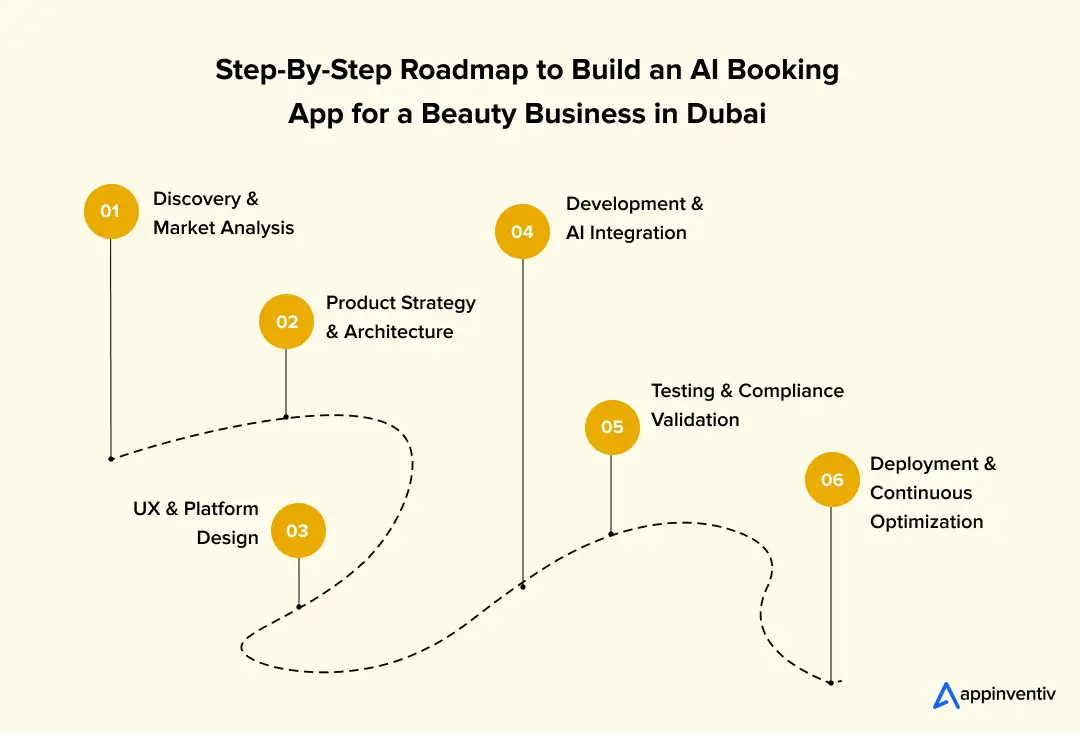
Custom AI-Powered Salon Booking App Development Process
A structured development process helps ensure custom salon booking apps remain scalable, secure, and aligned with operational needs. Most enterprise projects follow a phased approach that balances planning, execution, validation, and ongoing optimization.
Typical custom salon booking app development checklist:
- Initial consultation & market analysis to assess business needs, competitors, and booking workflow gaps
- Strategic planning, brainstorming sessions, mind mapping, and defining the blueprint and vision to shape product direction
- Concept validation to confirm feasibility, technical scope, and feature priorities
- UI/UX design covering booking journeys, staff workflows, and admin panel interfaces
- Core development phase, generating production-ready apk and ipa files for mobile deployment
- QA standards implementation, including functional testing, performance checks, and security validation
- Deployment rollout with monitoring readiness and platform stability checks
- Post-launch support and feature upgrades to maintain performance, introduce enhancements, and support evolving business requirements
What Is the Cost to Develop a Salon Booking App in Dubai With AI?
Budgeting usually starts once scope clarity improves. Costs vary based on AI depth, integrations, scalability needs, and compliance requirements. For most enterprise-grade AI salon booking app development in Dubai, investment typically falls between $50K and $500K. For a broader breakdown of what drives these numbers, the guide on cost to build an AI app in Dubai covers this in detail.
| Cost Component | Typical Cost Range (USD) | What Drives Cost |
|---|---|---|
| Discovery & Consulting | $5K – $25K | Business analysis, architecture planning, compliance evaluation |
| UI/UX Design | $10K – $40K | Mobile/web booking flows, dashboards, multi-device optimization |
| Core Platform Development | $40K – $180K | Backend scheduling logic, databases, and infrastructure setup |
| AI Model Development | $25K – $120K | Demand forecasting, optimization algorithms, recommendation models |
| Integrations (POS, CRM, Payments) | $15K – $70K | Third-party APIs, legacy system connectivity |
| Testing & Deployment | $10K – $40K | QA, security validation, performance optimization |
| Enterprise Scaling & Customization | $20K – $25K+ | Multi-location controls, advanced reporting, customization layers |
Actual costs depend on whether the platform targets a single-brand rollout, a franchise network expansion, or an aggregator-scale deployment.
Pricing Models for AI Booking Optimization Platforms
Once development costs are clear, the next question is usually about operating expenses. The pricing model for the AI booking system salons varies based on deployment scale, customization depth, and commercial structure. In Dubai, pricing often reflects both premium service positioning and enterprise adoption maturity.
Common pricing models include:
- Subscription SaaS pricing
Fixed monthly or annual fees based on locations, booking volume, or feature access. Typical AI salon booking subscription costs in Dubai setups often follow this structure. - Commission-based booking optimization for salons
Providers charge a percentage per confirmed booking, a model that draws parallels from how AI agents in finance are reshaping transaction-based service models across the Middle East. - Hybrid pricing structures
A combination of base subscription plus performance-linked fees, often used where optimization outcomes are measurable. - Enterprise licensing
One-time platform licensing with ongoing support contracts. Common among large salon chains that need deeper customization.
Regional pricing factors usually depend on:
- Market maturity and competitive intensity in Dubai
- Number of locations and transaction volume
- Depth of AI customization and integration complexity
These factors typically shape long-term operational cost planning.
ROI of AI Booking Systems for Beauty Salons
Once implementation begins, the conversation usually shifts from features to measurable business impact, a shift that mirrors how Dubai enterprises are approaching agentic AI ROI more broadly. For businesses that have invested in AI salon booking app development in Dubai, the ROI of AI booking systems for salons typically reflects improved utilization, reduced operational leakage, and more consistent customer engagement.
Revenue Drivers
These factors directly influence top-line growth by improving booking efficiency and customer value.
| Revenue Lever | Business Impact |
|---|---|
| Higher appointment utilization | Fewer idle slots, improved chair productivity |
| Reduced no-shows | More predictable daily revenue flow |
| Upselling optimization | Data-driven service recommendations |
| Increased customer lifetime value | Higher repeat bookings and retention |
Many operators observe a gradual revenue increase from AI scheduling salon workflows once optimization stabilizes.
Cost Reduction Drivers
Operational savings usually come from better resource allocation and reduced manual intervention.
| Cost Lever | Operational Benefit |
|---|---|
| Lower staffing inefficiencies | Better shift alignment with demand |
| Reduced marketing waste | More targeted customer outreach |
| Automation savings | Lower administrative coordination effort |
Suggested ROI Metrics
These metrics help leadership track performance improvements and investment recovery.
| Metric | Why It Matters |
|---|---|
| Payback period | Indicates investment recovery timeline |
| Revenue per chair/hour | Reflects utilization efficiency |
| Retention uplift | Measures customer loyalty impact |
Similar optimization patterns are visible across industries. In aviation, for instance, Appinventiv introduced AI-assisted booking interactions for Flynas, improving engagement and positioning the platform competitively. While industries differ, the underlying principle remains consistent: a better booking experience directly influences conversion and retention.
Build vs Buy Decision Framework
At some point, most salon operators face this choice. Build a custom platform or adopt an existing SaaS booking solution. The right decision usually depends on scale, integration needs, and long-term operational control, which is why many enterprises start with AI strategy consulting before committing to a build-or-buy path. Many enterprises evaluating beauty salon app development in Dubai options weigh flexibility against speed of deployment.
| Decision Factor | Build (Custom Development) | Buy (SaaS Platform) |
|---|---|---|
| Deployment speed | Longer initial timeline | Faster rollout |
| Scalability control | High, architecture tailored to growth | Depends on vendor capabilities |
| Integration flexibility | Easier deep integrations with POS, CRM, ERP | Limited by platform APIs |
| Customization depth | Fully customizable workflows | Standardized feature sets |
| Total cost of ownership | Higher upfront, lower control risk long term | Lower upfront, recurring subscription costs |
| Vendor dependency | Lower once deployed | Higher reliance on the provider |
Enterprises often engage a salon app development company in Dubai when integration complexity, branding control, or data ownership becomes a priority.
Also Read: AI Readiness in UAE: Assessing Maturity and Scaling AI for Enterprises
How Do You Choose the Right AI Development Company in Dubai for Salon Apps?
Choosing a development partner often determines how stable and scalable your booking platform becomes, and knowing how to hire developers in Dubai can help you ask the right questions upfront. Beyond delivery timelines, enterprises usually focus on technical capability, compliance awareness, and real-world deployment experience, especially for AI-driven systems.
Key evaluation checklist:
- AI engineering depth
Look for teams experienced in forecasting models, optimization logic, and production AI deployment. - Beauty and wellness domain expertise
Industry familiarity helps align booking workflows with actual salon operations. - Compliance understanding
Knowledge of UAE data protection expectations, payment security, and governance practices matters. - Integration capabilities
Ability to connect POS systems, CRMs, loyalty platforms, and payment gateways smoothly. - Proven enterprise case studies
Evidence of successful multi-location or enterprise-scale deployments adds confidence.
Enterprises usually prioritize partners who combine strong technical delivery with sector-specific experience.
Quantify operational gains before committing to enterprise booking optimization investments

What Future Trends Are Shaping AI Booking Optimization for Beauty Salons?
Booking optimization is gradually expanding beyond calendar management. Many salon businesses are now looking at how booking data can support personalization, service planning, and customer engagement. The shift is less about automation alone and more about operational intelligence.
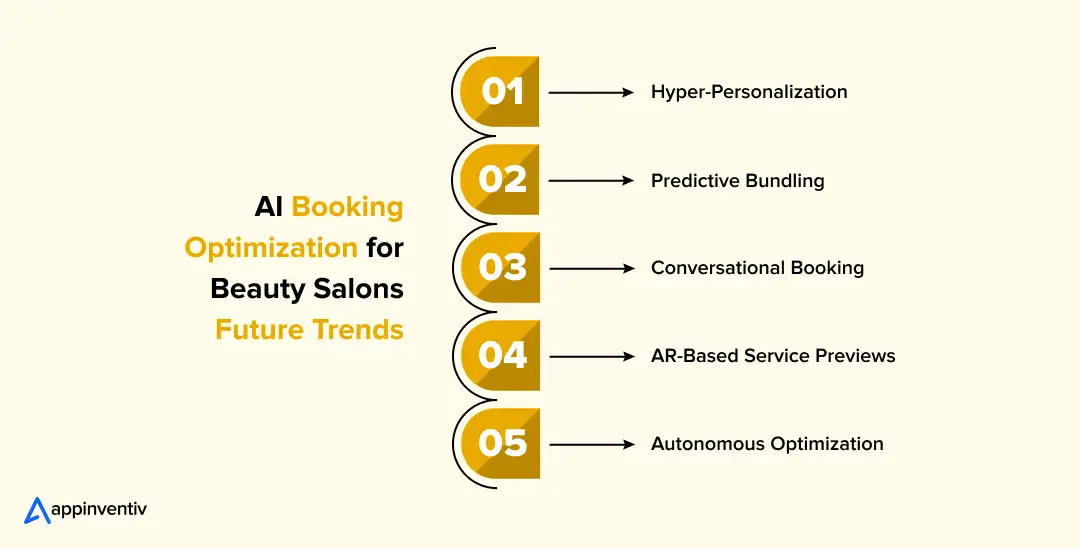
Key developments gaining traction:
- Hyper-personalized beauty recommendations
Booking history, service preferences, and spending patterns help tailor service suggestions and follow-ups. - Predictive service bundling
Systems increasingly suggest combined treatments based on typical customer journeys and seasonal demand. - Voice and WhatsApp conversational booking
Messaging-first booking is growing in the UAE, especially where customers prefer quick confirmations without apps. - AR-driven service previews
Some platforms are experimenting with AR-driven visual previews for hairstyles, makeup, or treatments before booking. - Autonomous operational optimization
Early-stage systems are starting to adjust staffing, pricing, and booking availability dynamically using demand data, a capability closely tied to how AI agents are driving broader digital transformation across the Middle East.
These trends suggest booking platforms are moving toward broader customer and operational intelligence rather than simple scheduling tools.
Why Consider Appinventiv for Beauty Salon Software Development in Dubai
If you are evaluating an AI development company in Dubai for salon booking optimization or digital transformation, execution capability usually matters more than broad claims.
Appinventiv focuses on enterprise AI deployments, scalable platform engineering, and region-specific compliance readiness, helping beauty and wellness brands move from basic booking apps to intelligent operational platforms.
This includes end-to-end AI salon booking app development in Dubai, from architecture design to post-launch optimization.
What typically differentiates Appinventiv:
- Strong Middle East delivery footprint with 1000+ regional digital projects
- 10+ years of experience supporting UAE enterprise technology initiatives
- 95% client satisfaction across large-scale engagements
- Proven ability to modernize 500+ enterprise workflows
- Deep integration expertise across POS, CRM, payments, and loyalty systems
- Experience executing government-aligned compliance and security programs
- Strategic UAE partnerships supporting faster deployment and scaling
Business impact enterprises usually prioritize:
- 99.90% uptime for mission-critical systems
- Up to 40% operational cost efficiency through digital transformation
- Scalable architecture designed for multi-location business growth
If you are looking for a beauty salon app development company in Dubai, Appinventiv brings regional experience, deep AI engineering, and enterprise delivery maturity to help build reliable, future-ready salon technology platforms.
Frequently Asked Questions
Q. How much can salons charge for AI booking optimization?
A. Pricing varies widely depending on deployment scale, feature depth, and integration complexity. Many salons adopt subscription models ranging from roughly $50 to $300 per location, per month, for SaaS tools, while enterprise AI optimization platforms can cost significantly more. When pursuing AI salon booking app development in Dubai, pricing often reflects analytics capability, automation depth, and multi-location management requirements rather than basic scheduling functionality.
Q. How does AI optimize beauty salon bookings in Dubai?
A. AI systems analyze booking history, service duration patterns, peak-hour demand, and customer behavior to improve appointment allocation. Forecasting models help reduce idle slots, automate reminders, and support rebooking recommendations. In Dubai’s competitive beauty market, this typically improves utilization, customer experience consistency, and operational visibility across multi-location salon networks.
Q. Is AI booking software worth it for salons in the UAE?
A. For larger salons or chains, AI booking software often improves operational predictability. Reduced no-shows, better staff utilization, and stronger customer retention usually offset implementation costs over time. UAE salons operating in premium service segments particularly benefit, as appointment values are higher and customer experience expectations are more demanding.
Q. What is the ROI of AI scheduling for salons?
A. ROI typically comes from higher appointment utilization, fewer missed bookings, and improved repeat visits. Some operators report utilization improvements of 10% to 25% after optimization workflows mature. Administrative workload reduction and targeted marketing efficiency also contribute to measurable financial returns over the medium term.
Q. How much does it cost to build an AI salon booking app?
A. Development costs usually range from $50,000 to $500,000, depending on the depth of customization, AI model complexity, integrations, and scalability requirements. Enterprise platforms with multi-location support, advanced analytics, and CRM integrations fall toward the higher end. Ongoing costs include cloud infrastructure, AI model maintenance, and periodic feature upgrades.
Q. Can AI reduce no-shows in beauty salons?
A. AI helps identify patterns linked to missed appointments, such as booking lead time, customer history, and engagement with reminders. Automated confirmations, predictive alerts, and flexible rescheduling workflows often reduce missed bookings. Many salons observe gradual reductions over time once booking data becomes structured and consistently analyzed.
Q. What features should an AI salon booking system include?
A. Enterprise systems typically include demand forecasting, intelligent scheduling, automated reminders, multi-location dashboards, CRM integration, and analytics reporting. Advanced deployments may add dynamic pricing, customer lifetime value modeling, and personalization engines. Integration capability, data governance controls, and scalability are often as important as booking automation itself.

- In just 2 mins you will get a response
- Your idea is 100% protected by our Non Disclosure Agreement.

Simple Steps to Hire AI Governance Consultants in 2026
Key Takeaways Define AI risk tolerance and compliance goals before hiring consultants. Look for multidisciplinary teams combining governance, ML auditing, and MLOps expertise. Ensure consultants understand frameworks like the EU AI Act, NIST RMF, and ISO 42001. Prioritize experts who can operationalize governance inside ML pipelines. Embed responsible AI practices directly into CI/CD and model…
AI in Smart Homes in Australia: Use Cases, Cost & Real-World Impact
Key takeaways: The adoption of AI in Australian smart homes is primarily dictated by energy economics, insurance risk mitigation, and the evolving needs of an ageing population. AI development costs in smart homes range from AUD 70,000 to AUD 700,000+, depending on grid integrations, compliance engineering, and AI model complexity. Adherence to the Privacy Act…

Enterprise AI Integration in the Middle East: Scaling with Expert Architects
Key takeaways: Middle Eastern enterprises lead in AI adoption, driven by strong government support and investment in digital infrastructure. Successful AI integration requires robust data governance, compliance with local regulations, and tailored architectural design. Addressing talent gaps, localization needs, and legacy system challenges is crucial for scalable AI deployments. Systems integrators and big data architects…