
























How to Choose Between Agentic AI and Generative AI: Key Differences, Practical Applications and Benefits for Australian Businesses


- Understanding the Role of Generative AI in Australian Businesses
- Understanding the Role of Agentic AI: The Next Evolution of Autonomous Systems
- What Are the Key Differences Between Agentic AI and Generative AI?
- When Should Australian Businesses Choose Generative AI?
- When Does Your Business Need Agentic AI Instead of Generative AI?
- What are the Quantifiable Benefits of Generative AI and Agentic AI in Australia?
- How Do the Costs of Agentic AI vs Generative AI Compare for Australian Businesses?
- Hybrid AI: Why Most Australian Businesses Will Need Unified Ecosystem
- What Are the Challenges of Adopting Generative AI and Agentic AI for Australian Enterprises and How to Overcome Them?
- How to Choose Between Agentic AI and Generative AI for Australian Businesses?
- What is the Future Outlook for AI in Australia?
- How Appinventiv Helps Businesses Choose and Implement the Right AI Strategy
- Final Thoughts
- FAQs

Key takeaways:
- Generative AI specialises in content synthesis and creation, while Agentic AI focuses on autonomous reasoning and multi-step task execution.
- Targeted benefits of generative AI and agentic AI in Australia include nearly a 35% reduction in operational bottlenecks and 70% faster workflows.
- Prioritise Gen AI for workforce augmentation and Agentic AI for high-stakes, autonomous operations in Mining, Energy, and Logistics.
- Most resilient strategies involve a hybrid model, using generative “brains” for reasoning and agentic “limbs” for compliant, end-to-end action.
Australian enterprises are no longer asking whether to adopt AI. The conversation has moved on. Boards are now asking which AI architecture is right for which problem, and the cost of getting that wrong is increasingly measurable.
A critical tension now exists between agentic AI vs generative AI in Australia. Generative AI dominated early adoption cycles through copilots, content pipelines, and productivity tools. These implementations delivered measurable gains, but they remain inherently assistive. They generate outputs but do not complete outcomes.
The moment an organisation requires AI to act rather than respond, the architectural requirements change entirely. This is where agentic AI enters the frame, and where many leadership teams remain underprepared.
Recent Deloitte Australia data indicates that 69% of Australian organisations are now integrating agentic AI into their operations to move beyond mere information synthesis toward autonomous task execution. However, this shift introduces significant architectural and governance tensions.
For Australian enterprises, the distinction matters more than it might elsewhere. Data sovereignty obligations, APRA’s operational risk guidance, and the evolving expectations under the Privacy Act 1988 mean that deploying an AI system capable of autonomous decision-making carries board-level accountability that a content generation tool simply does not.
For CIOs and CTOs, this is no longer a tooling decision. It is a question of operational design. This blog clarifies that distinction, clarifying where each AI paradigm fits, and how to align investment with measurable business outcomes in the Australian market.
With 69% of Australian firms moving toward agentic systems, ensure your architecture isn’t left behind.

Understanding the Role of Generative AI in Australian Businesses
Generative AI has become the foundational layer for digital transformation across the ASX 200. At its core, these systems leverage probabilistic models to generate high-fidelity content (be it text, structured code, or synthetic media) based on patterns learned from vast datasets.
What Are the Most Impactful Generative AI Use Cases in Australia Today?
Generative AI in Australian industries drives value primarily where human-in-the-loop oversight is naturally part of the workflow.
- Knowledge Synthesis and Discovery: Large-scale organisations, particularly in legal and financial services, use LLMs to query internal data repositories, turning fragmented documentation into actionable insights.
- Code Generation and Modernisation: Engineering teams are employing AI copilots to accelerate legacy system refactoring, a critical need for local firms dealing with technical debt in aging infrastructure.
- Conversational Interface Maturity: Beyond basic chatbots, applications of generative AI and agentic AI for Australian enterprises include sophisticated virtual assistants that handle complex customer enquiries in the banking and insurance sectors, providing empathetic and context-aware responses.
What Are the Key Limitations and Governance Challenges of Generative AI?
Despite its utility, Generative AI is inherently reactive. It requires a specific human prompt to initiate any action and lacks the internal logic to “check its own work” against real-world outcomes without external intervention.
From a risk perspective, the “hallucination” remains a boardroom concern. In the context of the Australian Privacy Act and APRA’s CPS 230 operational resilience standards, the lack of autonomy in GenAI is actually its primary safety feature; it ensures a human remains the ultimate decision-maker.
However, this same lack of autonomy creates a ceiling for ROI, as the system cannot independently resolve a multi-step supply chain bottleneck or execute a trade without a person clicking “approve.”
Understanding the Role of Agentic AI: The Next Evolution of Autonomous Systems
If Generative AI is the sophisticated narrator, Agentic AI is the executioner. While the former focuses on the synthesis of information, the latter is designed for goal-oriented autonomy. For an Australian business, this shift is the difference between an AI that writes a procurement report and an AI that independently identifies a supply chain disruption, evaluates alternative vendors based on local ESG compliance, and updates the ERP system.
What Are Real-World Agentic AI Use Cases in Australia’s Key Sectors?
Agentic AI systems in Australia move past the linear prompt-response cycle. They operate through a loop of perception, reasoning, and action.
- Multi-Step Reasoning and Planning: Unlike a standard LLM, an agentic system breaks down a high-level objective into sub-tasks. It can self-correct when a specific step fails, a critical requirement for complex use cases of generative AI and agentic AI for Australian businesses.
- Tool Usage and API Orchestration: These agents are “hand-on.” They can interface with your existing technology stack, SQL databases, Salesforce, or proprietary mining telemetry software, to pull real-time data or trigger external events.
- Persistent Memory and Learning: Agentic architectures often include long-term memory components, allowing the system to remember previous interactions and refine its strategy over time without retraining the underlying model.
What Governance, Risk, and Compliance Challenges Come with Agentic AI?
Moving to an agentic model introduces a higher degree of “vendor risk” and operational liability. When an AI acts on your behalf, the question of accountability becomes central. You must implement robust “guardrail layers” that intercept an agent’s decision before it reaches a live production environment. For Australian firms, this involves aligning agentic logic with the ASIC and ACCC guidelines on algorithmic transparency.
Implementing these systems requires a more significant upfront investment in custom architecture than off-the-shelf GenAI, but the outcome is a system that removes the human bottleneck entirely from repetitive, high-volume decision cycles.
What Are the Key Differences Between Agentic AI and Generative AI?
Navigating the difference between agentic AI and generative AI in Australia requires a shift from viewing AI as a tool to viewing it as a teammate. While Generative AI is built to assist, Agentic AI is built to act. This distinction is vital for Australian firms managing thin margins or remote operations where human intervention is a costly bottleneck.
The following table outlines the architectural and operational trade-offs Aussie innovators need to evaluate when outsourcing digital engineering services in Australia.
| Comparison Parameter | Generative AI | Agentic AI |
|---|---|---|
| Core Function | Synthesis & Creation | Reasoning & Action |
| Autonomy Level | Low (Prompt-dependent) | High (Goal-oriented) |
| Human Involvement | Continuous (Co-pilot) | Occasional (Supervisor) |
| Complexity | Moderate (Interface-led) | High (Orchestration-led) |
| Infrastructure | Cloud APIs / Vector DBs | Multi-agent frameworks / API mesh |
| Primary Output | Content, Code, Answers | Completed Workflows / Decisions |
| Risk Profile | Information Accuracy (Hallucination) | Operational Liability (Action error) |
| Time to Value | Days to Weeks | Months |
The fundamental gap lies in the execution layer. A Generative AI model will tell you your inventory is low based on an ERP extract. An Agentic AI system will see the low inventory, check pending sales orders, verify supplier lead times, and draft a purchase order for approval.
For Australian businesses, particularly those in logistics or retail, moving from “telling” to “doing” is where the most significant ROI is found. However, this transition increases the technical debt if not managed correctly.
Implementing generative AI and agentic AI in Australia means moving beyond simple API calls to building a robust “agentic orchestration” layer that can handle failures and state management across your local cloud environment.
When Should Australian Businesses Choose Generative AI?
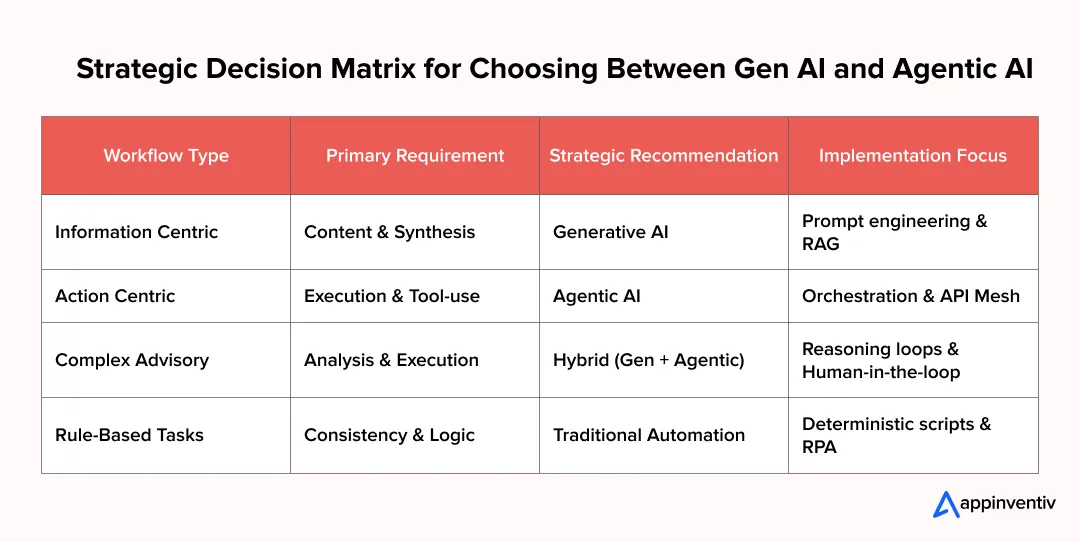
Deciding on generative AI vs agentic AI for Australian businesses usually depends on whether you want to assist a human or replace a task. If the goal is workforce augmentation, Generative AI is the pragmatic choice. It acts as a sophisticated co-pilot, ideal for workflows where human oversight is a regulatory or operational necessity.
Strategic Drivers for Gen AI Adoption
You should prioritise Generative AI for:
- Content and Creativity: Scaling marketing assets or product descriptions for retail and e-commerce.
- Knowledge Retrieval: Using RAG (Retrieval-Augmented Generation) to allow staff to query complex internal policy documents or legal frameworks.
- Rapid Prototyping: Improving developer productivity through automated code generation and documentation.
High-Impact Sectors
For sectors like Banking and Wealth Management, the ROI is immediate through reduced handle times and faster document processing. Because it requires less custom orchestration than agentic systems, the time-to-value is shorter, making it the preferred path for firms looking for “quick wins” in productivity without overhauling their entire architectural stack.
When Does Your Business Need Agentic AI Instead of Generative AI?
Agentic AI serves as an “operator” rather than a “writer.” Australian firms should pivot toward agentic architectures when business objectives shift from information production to end-to-end process execution. In a market defined by high labour costs and remote assets, the capacity for a system to reason and self-correct offers a significant competitive moat.
Strategic Drivers for Agentic AI Adoption
You must prioritise Agentic AI when operations require:
- Autonomous Workflows: Moving beyond prompts to execution. A logistics agent identifies a late shipment, evaluates alternative carriers, and updates the ERP without manual intervention.
- Real-time Decisioning: In the Resources sector, agents monitor sensor data from the Pilbara to dynamically adjust maintenance, preventing downtime costs that often exceed $150,000 per incident.
- Continuous Compliance: For APRA-regulated entities, agents act as persistent auditors, autonomously flagging suspicious transactions and drafting regulatory reports in real-time.
High-Impact Sectors
The ROI is most pronounced in capital-intensive industries like Mining, Energy, and Logistics. While the initial investment for agentic AI vs generative AI in Australia is higher for autonomous systems, the reduction in operational bottlenecks provides a more sustainable long-term yield than generative tools alone.
What are the Quantifiable Benefits of Generative AI and Agentic AI in Australia?
Evaluating benefits of generative AI and agentic AI in Australia requires looking past technical metrics and focusing on commercial outcomes. For a local firm, the “needle” moves when AI reduces the cost of doing business in a high-wage economy or accelerates speed-to-market.
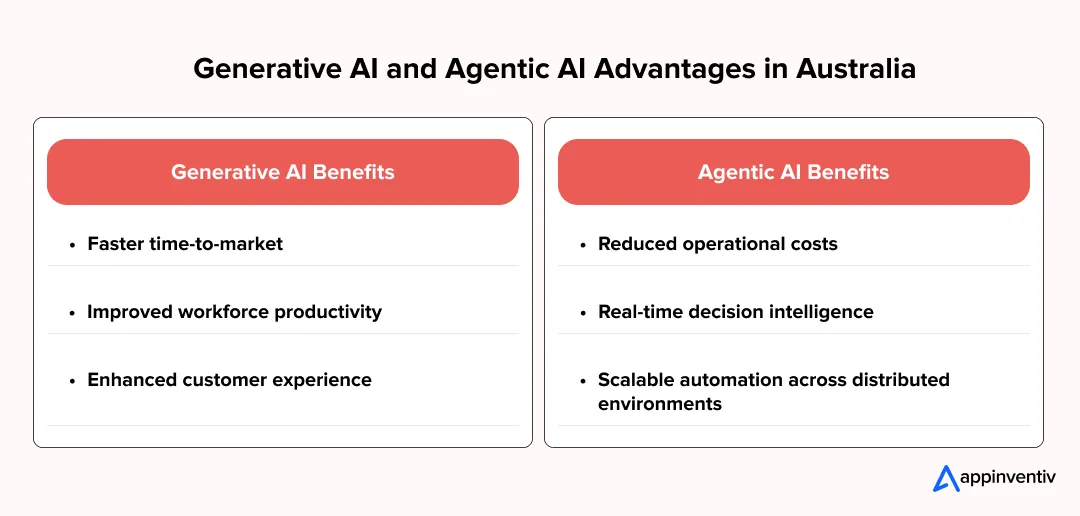
Generative AI Benefits: Workforce Augmentation
- Accelerated Productivity: Local firms report significant time savings in administrative and creative tasks. By automating first-draft generation, professionals focus on final review and strategy.
- Customer Engagement: High-fidelity conversational AI improves Net Promoter Scores (NPS) by providing 24/7 support that feels personal and context-aware.
- Democratic Innovation: Low-code GenAI tools allow non-technical departments to build their own efficiency hacks, fostering a culture of innovation without burdening central IT.
Agentic AI Benefits: Operational Transformation
- Drastic Opex Reduction: By automating multi-step processes, Agentic AI removes the “human middleware.” In logistics and supply chain, this leads to leaner operations and reduced error rates.
- Real-time Intelligence: The ability to act on data as it arrives, rather than generating a report for a human to read later, enables a “proactive” business model.
- Scalability in Remote Regions: For sectors like mining and agriculture, autonomous agents provide a level of operational oversight in remote locations that is physically and financially impossible with human staff alone.
While Generative AI improves the quality of work, Agentic AI scales the volume of outcomes.
How Do the Costs of Agentic AI vs Generative AI Compare for Australian Businesses?
Capital allocation for AI initiatives in Australia requires a clear-eyed view of both initial implementation and long-term total cost of ownership (TCO). While Generative AI is often seen as an “opex” play driven by seat-based licensing or API consumption, Agentic AI typically demands a “capex” approach due to the custom orchestration required to integrate with local legacy systems.
The following table provides a high-level cost comparison for implementing generative AI and agentic AI in Australia, based on 2025 market rates for professional services and infrastructure.
| AI Type | Estimated Investment (AUD) | Key Cost Drivers |
|---|---|---|
| Generative AI | $70,000 – $200,000 |
|
| Agentic AI | $150,000 – $700,000+ |
|
Understanding the Cost Drivers
When evaluating the cost comparison of agentic AI vs generative AI for Australian companies, the “hidden” costs often reside in data readiness and governance.
- Integration Depth: A GenAI chatbot sitting on a website is significantly cheaper than an autonomous agent that requires write-access to a core banking system or a SAP ERP instance. The latter involves rigorous security auditing and “middleware” development to ensure the agent doesn’t trigger unintended actions.
- Talent and Local Expertise: Engaging a specialised AI development company in Australia ensures that the architecture complies with local data residency requirements. While offshore talent may seem cheaper, the cost of remediating non-compliant data structures often erodes those initial savings.
- Operational Insurance: For agentic systems, boards must factor in the cost of “human-in-the-loop” monitoring tools. Unlike GenAI, where a user spots an error in a drafted email, an agentic error can result in a physical or financial transaction that is difficult to reverse.
For most Aussie innovators, the “sweet spot” is a phased investment: starting with a GenAI pilot to prove value, then reinvesting those productivity gains into the more complex agentic frameworks that drive structural cost reduction.
Don’t over-invest in unproven infrastructure. We specialise in phased “Pilot-to-Production” roadmaps that fund complex Agentic systems through early Generative AI productivity wins.

Hybrid AI: Why Most Australian Businesses Will Need Unified Ecosystem
The debate between agentic AI vs generative AI in Australia often suggests a hybrid model. Generative AI provides the “brain” for communication and content, while Agentic AI provides the “limbs” for execution. Relying on just one creates an operational gap: GenAI produces insights that nobody acts on, or agents execute tasks without the nuance of human-like communication.
The Power of the Hybrid AI
A hybrid approach allows for a “reason-then-act” sequence. In a typical Australian firm, the interaction looks like this:
- Generative Layer: An LLM monitors incoming regulatory updates from ASIC or APRA and summarises the impact on internal policies.
- Agentic Layer: An autonomous agent takes that summary, identifies which internal systems or contracts are affected, and initiates a compliance review workflow in the ERP.
This combination is becoming a practical necessity. According to Deloitte Australia’s 2026 AI report, while 61% of local companies report efficiency gains from AI, only those moving toward “agentic assistants” are seeing deep transformation.
Strategic Advantages of Hybrid AI
Integrating both paradigms offers:
- Closed-Loop Automation: Eliminating the “human bridge” between data insight and data action.
- Scalable Personalisation: Using GenAI to draft hyper-localised customer communications while agents handle the underlying account adjustments or logistics rerouting.
- Risk Mitigation: Generative AI can be used to “explain” the logic behind an agent’s autonomous decision, providing the audit trail required for board-level accountability.
For Australian firms, the hybrid model is the most resilient path. It ensures that as agentic AI vs generative AI examples for Australian businesses evolve, the organisation isn’t locked into a static architecture but maintains a flexible, “AI-orchestrated” operating model.
What Are the Challenges of Adopting Generative AI and Agentic AI for Australian Enterprises and How to Overcome Them?
Transitioning from pilot to production reveals friction at the intersection of global tech and local regulation. Addressing these requires bespoke architectural governance.
Regulatory Alignment and Data Sovereignty
- Challenge: Privacy Act reforms and APRA’s CPS 230 demand strict handling of Australian data, often clashing with international model routing.
- Solution: Prioritise implementing generative AI and agentic AI in Australia using locally-hosted cloud regions and robust PII masking layers.
The “Black Box” and Operational Liability
- Challenge: Agentic AI executes transactions; without a clear audit trail, incorrect autonomous actions create significant board-level financial and legal liability.
- Solution: Deploy “Logic Logging” frameworks that force the AI to record every reasoning step, satisfying ASIC requirements for algorithmic transparency.
Integration Latency and Technical Debt
- Challenge: Fragile legacy core systems in many Australian firms lack the API maturity required for seamless autonomous agent orchestration.
- Solution: Focus on digital engineering services in Australia to modernise the API layer, creating a secure “handshake” between AI and ERPs.
Talent Scarcity and Vendor Risk
- Challenge: A shortage of local engineers capable of building multi-agent architectures leads to risky over-reliance on single global vendors.
- Solution: Partner with a specialised AI development company in Australia to build modular, model-agnostic architectures that avoid permanent vendor lock-in.
How to Choose Between Agentic AI and Generative AI for Australian Businesses?
Deciding how to choose between agentic AI and generative AI for Australian businesses requires a move from technical curiosity to commercial pragmatism. Boards must evaluate the trade-off between the speed of GenAI and the structural transformation of Agentic systems.
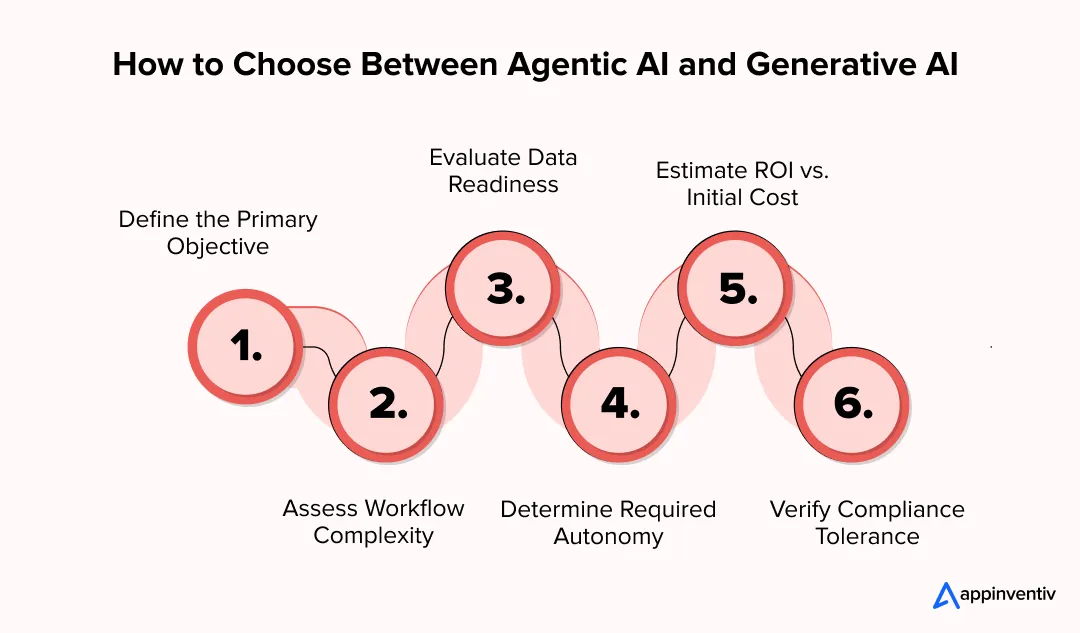
Define the Primary Objective
Determine if the goal is to assist a human (Generative) or to complete an autonomous workflow (Agentic). If a human “eyes-on” review is legally required, stick with Generative models.
Assess Workflow Complexity
Map the number of external systems involved. Generative AI thrives in siloed content tasks; Agentic AI is necessary when a process spans multiple APIs, databases, and third-party platforms.
Evaluate Data Readiness
Prepare your data. High-quality, real-time data access is the fuel for agents. If your data is trapped in legacy silos with poor API maturity, a Generative “Knowledge Assistant” is a safer first step.
Determine Required Autonomy
Consider the cost of an error. If an autonomous mistake in a financial transaction or mining operation is catastrophic, implement a supervised agentic framework with hard-coded guardrails.
Estimate ROI vs. Initial Cost
Balance the lower upfront cost of GenAI against the long-term operational savings of Agentic systems. Use a 24-month TCO (Total Cost of Ownership) lens to account for Australian labour costs.
Verify Compliance Tolerance
Ensure the chosen AI path aligns with APRA and ASIC requirements for explainability and data residency.
By applying this framework, leadership teams can avoid “pilot purgatory” and ensure their AI roadmap delivers a measurable competitive advantage in the local market.
What is the Future Outlook for AI in Australia?
The Australian AI landscape is approaching a critical tipping point. Under the federal government’s National AI Plan 2025, the nation is shifting from early adoption to a “whole-of-economy” integration strategy.
This roadmap prioritises sovereign capability, with over $100 billion in forecast data centre investments to ensure AI development aligns with local ethical and security standards.
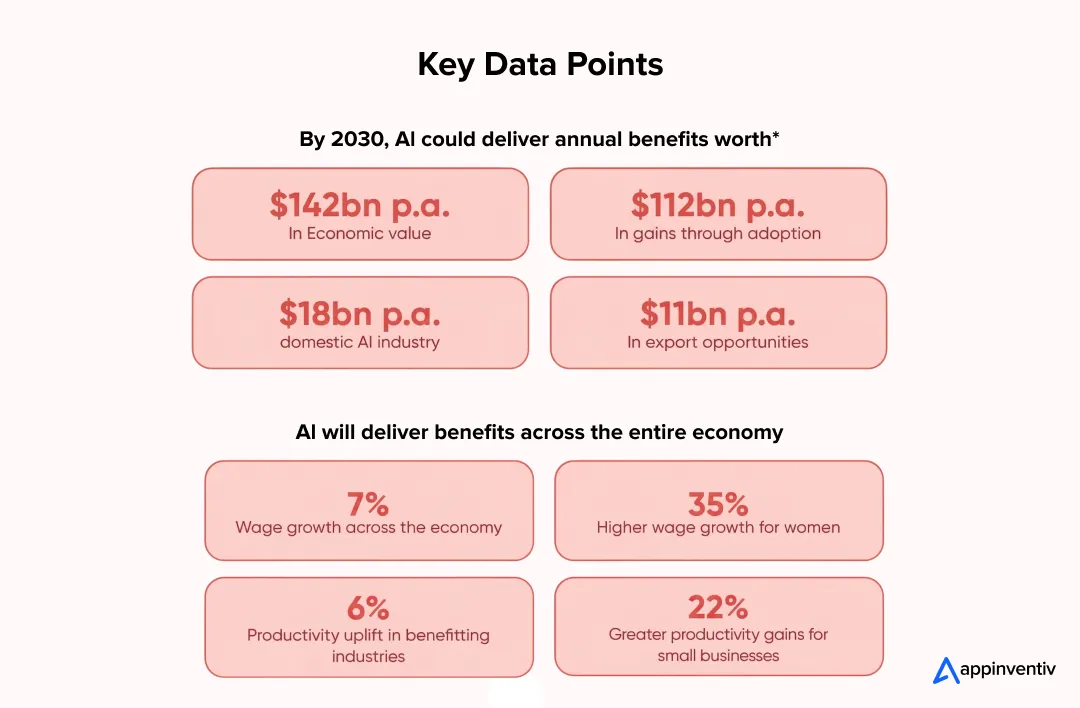
By 2030, the economic impact is expected to be transformative:
- Economic Value: AI adoption is projected to add up to $142 billion annually to the Australian economy.
- Workforce Growth: The Tech Council of Australia predicts the creation of 200,000 AI-related jobs, requiring a 500% increase in the current specialist workforce.
- Productivity: Small businesses are set to be the biggest winners, with a projected 22% productivity uplift.
For Aussie firms, the future lies in “Human-Centred AI” where the $29.9 million AI Safety Institute and mandatory transparency statements ensure that as agentic systems scale, they remain trusted, secure, and uniquely Australian.
How Appinventiv Helps Businesses Choose and Implement the Right AI Strategy
Deciding between agentic AI vs generative AI in Australia requires more than technical code; it necessitates a deep understanding of the local commercial and regulatory environment. As a strategic tech partner, we move beyond the “AI hype” to deliver production-ready systems that align with your long-term digital transformation goals.
Our approach as a leading AI development company in Australia is rooted in our 11+ years of APAC delivery experience. Our team of 1600+ tech experts architect ecosystem-wide intelligence that respects Australian data residency and security standards. Having mastered over 35 industries, our digital engineering services in Australia are designed for the risk-aware enterprise looking to scale beyond simple automation.
Our Specialised AI Delivery Track Record
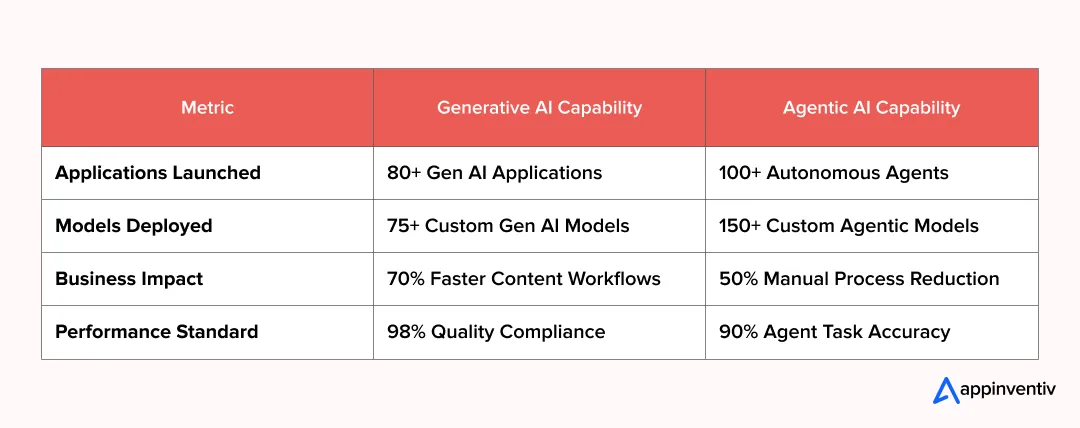
To help leadership teams navigate the difference between agentic AI and generative AI in Australia, we provide distinct delivery outcomes based on our extensive APAC experience. The following table outlines our proven capability in both domains:
Proven Execution and Scalability
We bring a track record of delivery excellence across the APAC region, helping firms like Rapid Teachers, Multinail, Lite n’ Easy, MyExec, Reel Media, Flynas, JobGet, Mudra, Vyrb, etc. move from experimental pilots to core operational AI.
This scale of delivery has been recognised by our inclusion in the Deloitte Fast 50 and being ranked among APAC’s High-Growth Companies by Statista and the Financial Times for two consecutive years.
The impact is tangible: while our generative solutions focus on content quality and speed, our agentic systems deliver a 2x increase in scalability for enterprise operations. By maintaining a 99.50% security compliance SLA (ISO/SOC2), we ensure that your implementation of generative AI and agentic AI in Australia translates into a sustainable, high-growth competitive advantage without compromising on governance.
Final Thoughts
The choice between agentic AI vs generative AI in Australia is not about selecting the “better” technology, but about identifying the right architectural fit for your specific operational friction. Generative AI remains the premier choice for augmenting human intelligence and creativity, while Agentic AI offers the autonomous execution required to solve Australia’s unique labour and distance challenges.
As regulatory expectations from APRA and ASIC continue to tighten, the most resilient Australian enterprises will be those that adopt a hybrid, governed approach, using Generative AI to reason and Agentic AI to act.
Still unsure which AI approach best fits your custom project needs? Share your project vision with us and we will help you choose the right approach and make the winning AI roadmap in Australia.
FAQs
Q. What is generative AI?
A. Generative AI (Gen AI) uses probabilistic models to synthesise high-fidelity content, including text, images, and code, based on specific human prompts. For Australian businesses, it acts as a sophisticated co-pilot that augments workforce productivity through rapid information discovery and knowledge retrieval.
Q. What is agentic AI?
A. Agentic AI is an autonomous evolution of AI designed for goal-oriented execution. Unlike reactive Gen AI, agentic systems use reasoning to plan, orchestrate multi-step workflows, and interface with external APIs (like ERPs or CRMs) to complete tasks independently with minimal human intervention.
Q. What is agentic AI vs generative AI in Australia?
A. Generative AI focuses on creating content (text, images, code) based on human prompts. Agentic AI is an evolution that uses reasoning to plan and execute multi-step tasks autonomously through tools and APIs.
Q. Which is better for Australian enterprises: agentic AI or generative AI?
A. There is no single “better” option; it depends on the use case. Generative AI is superior for knowledge management and customer service, while Agentic AI is better for supply chain, mining, and complex logistics.
The best approach is to opt for hybrid AI that combines booths Gen AI and Agentic AI.
Q. When should Australian businesses use generative AI vs agentic AI?
A. Use Generative AI when you need a “co-pilot” to assist staff. Choose Agentic AI when you want to remove the human bottleneck from high-volume, decision-heavy workflows.
Q. How much does it cost to implement generative AI and agentic AI for Australian companies?
A. A typical cost comparison of agentic AI vs generative AI for Australian companies shows Gen AI projects ranging from $70,000 to $200,000, while complex Agentic systems usually require an investment between $150,000 and $700,000+ due to custom orchestration.

- In just 2 mins you will get a response
- Your idea is 100% protected by our Non Disclosure Agreement.

How Much Does It Cost to Build a Conversational AI Chatbot in the UAE?
Key Takeaways AI chatbot development in the UAE typically costs AED 150,000–1,470,000 ($40K–$400K), based on complexity. Backend integration and compliance drive cost more than the chatbot interface itself. Arabic NLP, UAE hosting, and PDPL requirements increase budget and engineering effort. LLM + RAG enterprise chatbots sit at the higher end due to integration and infrastructure…

AI Inventory Management in Australia: Benefits, Use Cases, and Implementation Strategies
Key takeaways: Traditional ERP planning reacts to history; AI predicts demand shifts, reallocates stock dynamically, and prevents costly stockouts across distributed Australian networks. AI in inventory management in Australia typically reduces inventory levels 20–40% while maintaining service targets, unlocking significant working capital across multi-state operations. Enterprise implementations usually range from AUD 70,000 to AUD 700,000+,…

How to Hire RAG Architects for Enterprise AI
Key takeaways: Define your RAG architecture scope to avoid misaligned hiring decisions Identify end-to-end architectural ownership across retrieval, governance, and scaling Evaluate deep technical capabilities beyond prompt engineering and tools Validate governance and compliance readiness at the retrieval layer Test system-level thinking through real-world failure scenarios Choose the right hiring model based on scale, risk,…