































How Fintech Is Transforming Businesses Across Banking, Retail, Healthcare, and Real Estate

 Share -




Key takeaways:
- Fintech is transforming industries by making payments, lending, investments, and financial services faster, smarter, and more accessible.
- AI, blockchain, open banking, and embedded finance are driving the next wave of fintech innovation across business sectors.
- Digital wallets and payment apps are reshaping customer expectations around speed, convenience, and financial accessibility.
- Fintech enables businesses to reduce operational costs, improve risk management, and unlock new revenue opportunities.
- Industries including banking, retail, healthcare, real estate, and crowdfunding are rapidly adopting fintech-driven business models.
- As fintech adoption accelerates, customer trust, security, compliance, and seamless digital experiences are becoming critical competitive differentiators.
For a long time, new entrants have been finding it difficult to enter the market. But not anymore! Financial disruptors are taking over the industry with new technology and fast paced methods to make finance an easier stick to handle. Startups are flocking the market with innovations that are not only profitable and scalable but also altering the traditional methods.
The Finance world, while having established itself as a secure industry is also the one that frequently becomes the victim of a number of glaring issues like lack of transparency, a still less real-time ecosystem, and a case of slow digitized adoption. Also, given the level of sensitive data being dealt with, Fintech companies have highlighted security as their topmost concern.
The threat to security along with the need to bridge the gap between the general population and the real-time access of their money, has brought up a dire need of adding technological innovations into the traditional financial processes to improve its status quo and deliver better services to the end users.
A technological innovation called Fintech.
Fintech or Financial technology is revamping the finance industry as well as other business verticals by significant numbers. The pace at which FinTech is moving has ensured that the popularized segment will contribute to the majority of the revenues that the Financial sector would draw.
This has increased the necessity to develop a Fintech app and embrace the Fintech products into our business, about which we will discuss in this blog – starting with the importance of considering Fintech app development followed by how Fintech works.
Discover how fintech technologies can help you accelerate payments, improve customer experiences, and unlock new revenue opportunities.

Why Invest in Fintech App Development
The fintech impact on financial services is no longer confined to challenger apps and consumer wallets. Enterprise platforms from Coinbase, Stripe, Credit Karma, and Avant have proven that embedded finance, programmatic risk scoring, and API-led banking infrastructure can outperform legacy systems on cost, speed, and customer retention. For CTOs and CIOs evaluating where to allocate technology budgets, the importance of fintech lies in its ability to convert financial operations from a cost center into a measurable competitive advantage.
Understanding the different types of fintech, ranging from payments and lending infrastructure to wealthtech, insur-tech, and regtech, helps enterprise teams identify which use case maps to their existing tech stack and compliance requirements. Below are the core business outcomes driving fintech app investment for enterprises today.
1. Easier Payment Process
Payment friction is one of the clearest measures of fintech impact on traditional banking. Enterprise fintech apps replace manual reconciliation, batch settlement cycles, and card-network dependency with API-driven rails that settle in near real time. The key technologies in fintech powering this shift include tokenized payment gateways, ISO 20022 messaging, and embedded wallets that sit directly inside the customer’s existing app experience.
- Digital wallets and banking APIs eliminate dependency on cash and card terminals
- Cryptocurrency and stablecoin rails reduce cross-border settlement time from days to minutes
- Blockchain-based wallets add an auditable, tamper-resistant transaction layer for finance teams
2. Evaluating Risks Effectively
Risk underwriting is where the impact of fintech on banking industry practices becomes most visible. Traditional credit models relied on static bureau scores and manual underwriting; modern fintech platforms ingest behavioral, transactional, and alternative data through machine learning models that update risk profiles continuously rather than at quarterly intervals.
- ML-based fraud detection flags anomalies in milliseconds rather than post-transaction audits
- Alternative data sources widen credit access without raising default rates
- Automated compliance checks reduce manual review load on risk and audit teams
3. Faster Investment
How do fintech innovations improve investment platforms? By replacing human advisory bottlenecks with algorithmic engines that run portfolio analysis, rebalancing, and risk-adjusted recommendations around the clock. Robo-advisory and wealthtech platforms now process thousands of data points per user to remove the bias and latency that came with traditional advisory desks.
How has fintech impacted small business lending options? It has shortened underwriting cycles from weeks to hours by connecting directly to a business’s accounting, payroll, and transaction data through open APIs, allowing lenders to assess real cash flow instead of relying solely on collateral or credit history.
- Algorithmic advisory removes the latency and bias of manual consultation cycles
- Open banking APIs bring banking and non-banking lenders onto a shared infrastructure, widening capital access for entrepreneurs
4. Lower Cost
Cost has historically been the biggest barrier to entering financial services, and the impact of fintech here is structural rather than incremental. By moving services onto smartphones that customers already own, enterprises avoid the capital expenditure of physical infrastructure while gaining analytics data that sharpens engagement strategy.
- Cloud-native PoS systems cut hardware and maintenance overhead
- Built-in analytics replace separate business intelligence tooling and licensing costs
These four outcomes only scratch the surface of the broader fintech impact reshaping business strategy. The next section breaks down the specific forces driving that disruption forward.
5. Stronger Customer Trust and Retention
The importance of fintech also extends beyond transactions and financial products. As customers manage payments, investments, lending, and banking interactions across multiple digital channels, Fintech UX design has become a key differentiator. Enterprises are investing in fintech platforms that combine secure financial infrastructure with consistent, trust-building customer journeys, improving both retention and lifetime customer value. Recent industry research found that 78% of customers expect consistent brand experiences across touchpoints.
What makes Fintech the Driving Force of Future Businesses?
The Fintech impact on financial services is proving to be a disruptive force in business verticals as well. It is helping them improve their business models and lessen the associated risks – be it payment, lending process, wealth management, or any other such finance-related activity.
The technology is adding higher value to the consumer experience and market strategies by incorporating cutting-edge techniques and tactics into the process, which is eventually drawing the time of disruption of the future of the business world.
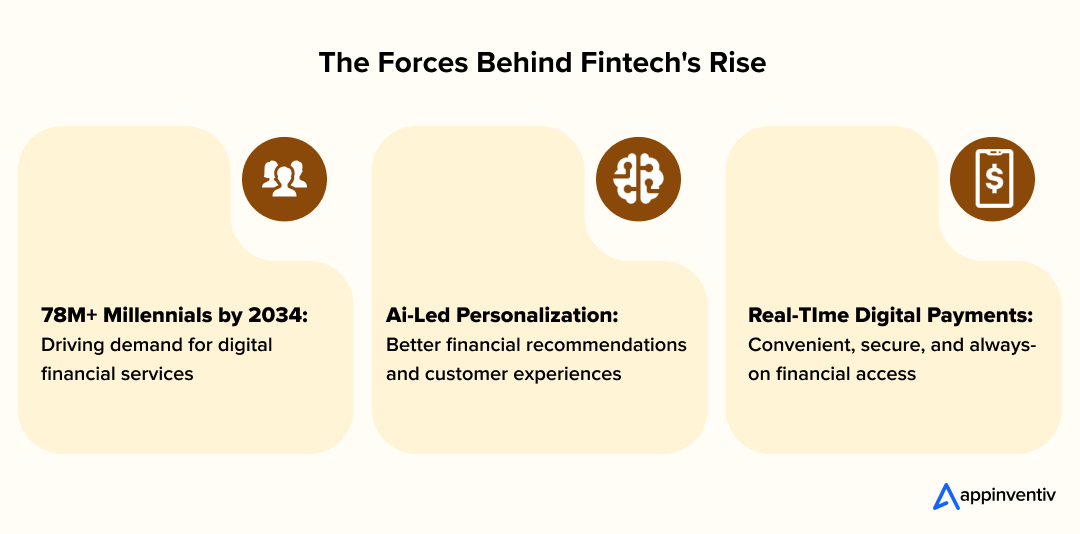
A few factors that are ensuring the prominent presence of FinTech in the world around us are:
1. Rise of millennials
The foremost factor that made Fintech a disruptive force in the business world is the millennial generation. The millennials highly depend on social media platforms for gaining information or financial advice, which has been a challenge for the conventional financial institutions. They are more demanding and less loyal – asking for personalized services at the speed of light.
According to Morgan Stanley’s report, millennials will be the largest generation ever in the United States by 2034, peaking at 78 million people, quicker than the Congressional Budget Office’s models. By 2040, millennials may account for a third of all consumer debt in the United States, as their borrowing levels rise in the 2030s. This has increased the need for technological advancement in the Financial industry, i.e, the rise of Fintech solutions.
Fintech startups ideas by new age entrepreneurs and established companies, as compared to the conventional financial institutions, are offering better services at data utilization and customizing the options as per the users’ needs and preferences using modern use cases of AI in fintech, which makes them satisfied and helps businesses gain higher revenue.
2. Payment Apps and Digital Wallets
The surplus use of P2P payment apps and digital wallets, has not just triggered a rise in the query on how to develop a P2P app, but is also proving Fintech to be a disruptive force in the market. These payment apps and digital wallets are providing users with quick and secure access to their money and send/receive any amount at any time and pay their utility bills without running for their pocket or purse.
As digital payments become part of daily transactions, businesses are investing in payment app development to deliver faster transfers, secure wallet access, utility bill payments, and real-time transaction visibility from one platform. This convenience is turning payment apps into a core fintech use case, helping businesses improve user engagement, reduce payment friction, and build products that customers use more frequently.
Bonus Read- How can Financial Services Business be Made Resilient
Now as you know what factors make Fintech a catalyst in the business world, let’s look into the impact of Fintech trends on different sectors:-
Different Sectors Where Fintech is Bringing Considerable Changes
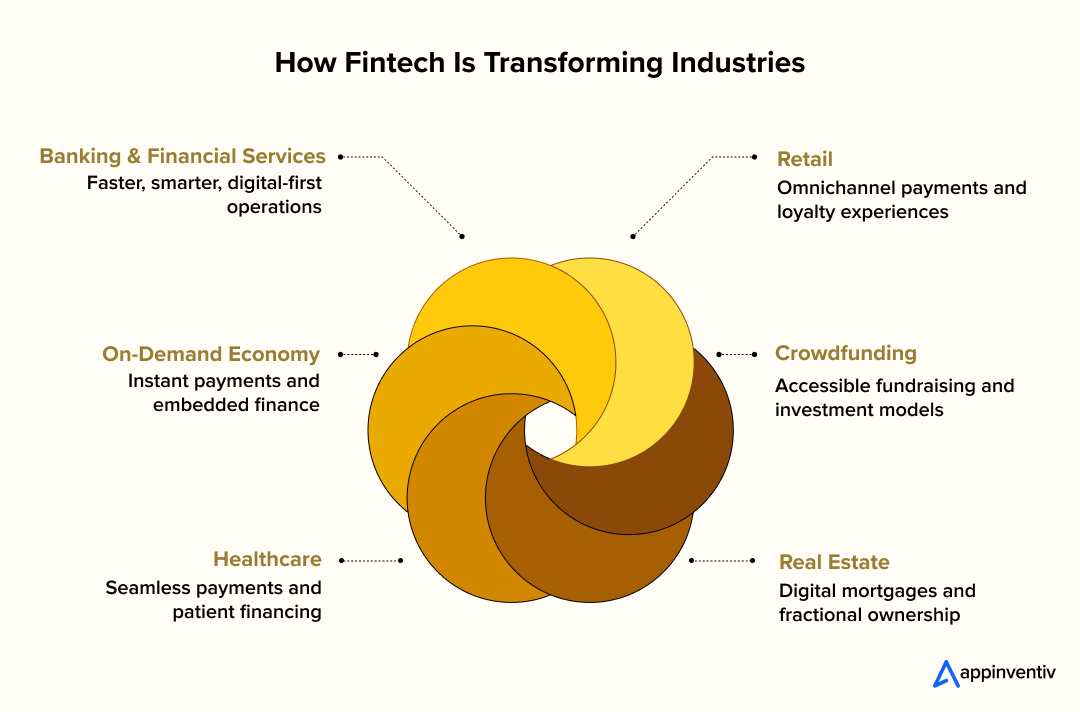
The impact of fintech on traditional banking has already reshaped core processes inside the banking sector. That same disruption is now spreading across adjacent industries.
Before exploring each vertical individually, here is a snapshot of what percentage of respondents across different industries expect fintech to disrupt their domain, as shared in the image below.
1. On-demand Economy
Fintech is transforming the on-demand economy in a multitude of ways, both for customers and gig workers.
It is removing the time lag in ride payments by letting users connect their bank accounts directly with ride-sharing apps. The insurance sector embracing mobile app development reflects the same momentum toward business expansion and scalability.
A clear real-world example of this shift is Uber’s embedded finance push. Through Uber Money and the Uber Pro Card, built in partnership with fintech infrastructure provider Branch, drivers and couriers receive earnings directly into a digital wallet within seconds of completing a trip rather than waiting on a weekly payout cycle.
The program also layers in expense management tools and cashback rewards, turning a logistics app into a functional banking layer for its workforce.
The impact of financial services technology in the ride-sharing economy is so much, various insurance companies and fintech startups are investing heavily in the taxi-hailing industry, offering all the services to the users on the same platform.
In addition to this, the top blockchain-based fintech apps like Coinbase are increasing their interest in promoting making transactions and sharing e-gift cards in the on-demand mobile apps.
2. Healthcare
Fintech in healthcare is spawning new opportunities. It helps mitigate current challenges and provides an exemplary experience to both patients and healthcare service providers.
On one side, financial technology is serving the industry with seamless payment solutions. On the other, it is paving new ways for lending and insurance use cases.
Various medtech startups have added fintech to their services to provide medical-related services under one roof. Practo is one such example, having integrated embedded lending solutions that let patients finance medical bills and insurance premiums directly within the platform, widening access to care for users across income levels.
Also, a significant rise will be observed in the adoption of Blockchain technology in Healthcare industry, implying payment will be possible through virtual currencies (Cryptocurrencies) in addition to a higher level of data security through Smart Contracts.
3. Retail
The retail industry is enjoying a wave of revolution with fintech app development, especially across payment and customer experience.
It is providing users with an omnichannel experience, making it possible for customers to interact with retail stores via different platforms. It is also simplifying the payment and checkout process to help retailers cater to a wider audience.
Walmart’s OnePay is a strong real-world example of this convergence. Built on Walmart’s retail footprint, OnePay has scaled to roughly 6 million monthly active users and around 50 billion dollars in annualized payments.
It does this by combining buy-now-pay-later financing, a debit account, and in-store checkout integration into a single fintech layer, reducing Walmart’s reliance on third-party financial providers.
It is estimated that the technology will boost the marketing strategy by empowering retailers to know what order the customers have placed, paid for and returned, and thus plan a loyalty program accordingly.
Besides this, digital payment apps and social messaging apps will coincide, making it possible to perform retail centered payment from all the social media apps and messages via payment apps. The retail platform, through the payment gateway integration process, will aim at creating an omni-channel presence by making it possible for the users to checkout from everywhere — the app, website and social media.
4. Government Ruled Banks
Fintech is also reinforcing government and regulator-backed banks by offering them digital services and platforms to connect with users and deliver transparent, impactful solutions.
One way this is being achieved is through open banking.
Open banking is a collaborative model where banking data can be shared among independent parties via APIs with the customer’s consent. It enables institutions to enhance customer experience, generate better revenue, and build a sustainable service model for conventionally underserved markets.
HSBC’s participation in the Hong Kong Monetary Authority’s Interbank Account Data Sharing initiative is a real-world example of this in action. Customers can consolidate balances and transactions from multiple banks into a single HSBC app view, with regulator oversight ensuring the data sharing stays consent-driven and secure.
This is empowering multiple fintech innovators as well as various one-off bank agreements, which was not possible under the traditional financial industry model.
Open banking enables organizations to build a sustainable service model for conventionally underserved markets, and green fintech solutions are taking this concept further by incorporating environmental considerations into financial products.
5. Crowdfunding
Earlier, it was tough to gain visibility in the market and raise funds effectively due to a lack of platforms, resources, and historical data, leaving startups and established brands vulnerable to fraud.
With the introduction of fintech apps, the crowdfunding process has become a lot more streamlined. It brings more effective and profitable approaches by fostering P2P payment, easing investor follow-up, and assisting the fundraising process.
Kickstarter is a well-known real-world example of this shift. Since its 2009 launch, the platform has helped fund more than 265,000 projects, with over 23 million backers pledging more than 8.2 billion dollars.
To manage fraud risk across multiple payment methods and expand backer payment options globally, Kickstarter rebuilt its payment infrastructure on fintech tooling. This approach mirrors how enterprises across sectors are layering modern payment rails onto legacy fundraising models.
It is also encouraging that the technological impact of financial services is leading financial institutions like banks and NBFC to turn towards online fundraising platforms to extend their reach and offer better services in the market as “alternative investment.” In this way, fintech technology is contributing to bridge the gap between public and private investment, which will open up new avenues to get funds from.
6. Real Estate
Real estate has long been one of the slowest sectors to digitize, weighed down by paper-heavy closings, fragmented lending workflows, and high entry barriers for investors.
Fintech in real estate is now compressing each of these friction points, from mortgage approval timelines to how property ownership itself is structured.
Rocket Companies is a real-world example of this shift at scale. Through Rocket Logic, its AI-driven mortgage platform, the company combines more than 10 petabytes of proprietary data with deep learning models to cut down the time homebuyers spend confirming details and waiting on approvals.
Rocket Companies has also moved to acquire Redfin, a major digital real estate brokerage, in a move aimed at connecting property search directly with mortgage financing under one technology stack.
On the investment side, blockchain-based tokenization is unbundling real estate into fractional, tradeable units.
By converting a property’s ownership rights into digital tokens, fintech platforms allow investors to buy into commercial or residential assets without the large upfront capital traditionally required, while also widening access for international investors who previously faced regulatory and logistical barriers to entry.
From banking and healthcare to retail and real estate, we help businesses launch secure, scalable fintech solutions tailored to evolving customer expectations.

FinTech App Development Trends
According to Mordor Intelligence, the global fintech market is expected to grow from $320.81 billion in 2025 to $652.80 billion by 2030, expanding at a 15.27% CAGR. The growth is being fueled by real-time payment infrastructure, open banking adoption, AI-powered fraud detection, embedded finance, blockchain-based transactions, and cloud-native financial platforms. As the market continues to evolve, several technologies and trends in fintech that are expected to drive innovation across business verticals, such as:
1. Blockchain will Become a Prominent Part of Fintech Strategy
Blockchain, the technology behind Bitcoin and Cryptocurrencies, have already been considered to improve the Fintech services across different sectors.
While the impact of Blockchain on Fintech has mainly been restricted to banking and other sectors for trading and supply chain management, the technology will create more opportunities in the field of Payments Infrastructure, Digital Identity Management and Funds Transfer Infrastructure. It will be considered by most of the financial companies for creating immutable records of their sensitive financial information and use them safely and securely.
2. AI will Enhance Financial Consumer Strategy
The fact that Artificial Intelligence is one of the biggest disruptions in the business economy with almost every business vertical either embracing the technology or planning to add it into their process by the next 5 years (as shown in the image below), Fintech mobile app developers will show a profound interest in this technology.
Fintech organizations and development companies will add AI, Machine Learning and Predictive analytics to their tech stack to understand the customer behavior, choices and preferences, and deliver better customer experience along with automating a significant amount of work. By pairing this with an expert fintech consulting services provider, businesses can turn technology adoption into a strategic advantage and deliver stronger customer experiences.
3. New Payment Solutions will be Introduced
The shift away from physical banking is accelerating at a pace that few industries anticipated. Mobile payment adoption continues to climb globally, driven by the rapid proliferation of digital wallets, contactless solutions, and mobile-first banking experiences. As consumer preference moves decisively toward seamless, app-based transactions, businesses across sectors are rethinking how they design and deliver payment infrastructure.
A parallel disruption is underway on the blockchain front. Cryptocurrencies and decentralized payment systems are gaining ground as viable alternatives to traditional rails, owing to their ability to enable faster transactions, reduce cross-border friction, and operate without intermediary dependency. This growing momentum is driving sustained investment in blockchain wallets, a shift we explore in greater detail in our Blockchain Wallet guide.
4. CyberSecurity will Get More Attention
To combat cyber security threats, the organizations will embrace different Fintech technologies – majorly Big Data and Biometric authentication. They will employ Big Data to analyze and predict the upcoming internal and external security issues and respond at the earliest. Besides, they will add biometric authentication to their processes to ensure that no unauthorized person could get access to their data, which will increase security, build trust and reduce the efforts and cost of securing their data via traditional means.
5. Digital-Only Banks will Gain Momentum
With the increasing mobile based banking and other financial solutions, there will be lower-to-no need of a traditional bank in the future. This will boost the concept of Digital-only banks, i.e, banks that have no brick-and-mortar outlets but provide the users with an access to all the banking resources and services virtually and swiftly.
How Appinventiv Powers Modern Fintech Solutions
Fintech, as we have covered in this article, has opened up a new world of opportunities for the business world, helping companies deliver more innovative services and generate better returns on a fraction of the spend they were investing earlier.
The segment is bringing a major impact on the present and future of the business world, implying every business owner needs to look forward to investing in fintech app development services to provide users with higher value and generate higher revenue.
What this looks like in practice depends on the engineering partner behind it. At Appinventiv, our fintech hub brings together 200+ fintech solutions delivered across banking, payments, lending, insurance, and trading, backed by over 10 years of experience supporting regulated financial systems.
Our platforms have achieved 98% fraud risk detection accuracy and 99.50% secure transaction assurance, while helping clients realize up to 30% in operational cost optimization, proof points that the right fintech app, built right, pays for itself.
These outcomes are reflected in our work across clients. Mudra, an AI-driven personal finance platform we built, scaled across 12+ countries on PCI DSS and SOC 2-ready architecture. Edfundo, a gamified financial literacy platform, went on to secure 500K dollars in pre-seed funding and a “FinTech Startup of the Year” recognition. And for an enterprise digital wallet client, we restructured compliance architecture across the AU, EU, and NA regions, cutting onboarding time by 85% while holding 99.97% platform uptime.
So, contact our team today to add the optimal fintech solutions to your business model.
FAQs
Q. How do fintech innovations improve investment platforms?
A. Fintech innovations improve investment platforms by using AI/ML models, robo-advisory engines, real-time market data APIs, and automated portfolio rebalancing systems. These platforms analyze user risk profiles, transaction history, market volatility, and asset performance to deliver faster, more personalized investment recommendations with lower manual intervention.
Q. How has fintech impacted small business lending options?
A. Fintech has made small business lending faster and more data-driven through open banking APIs, automated underwriting, alternative credit scoring, and real-time cash flow analysis. Instead of relying only on collateral or traditional credit scores, lenders can assess accounting data, payroll records, bank transactions, and repayment behavior to approve loans with better speed and accuracy.
Q. Why is fintech important?
A. Fintech is important because it makes financial services more accessible, efficient, and secure for both businesses and consumers. It enables faster payments, digital banking, automated compliance, intelligent risk management, and personalized financial experiences. For enterprises, fintech helps reduce operational costs, improve customer engagement, accelerate innovation, and create new revenue opportunities through digital financial products and services.
Q. What is the advantage of Fintech to a company?
A. Fintech has enabled the integration of physical and digital payment methods that consolidate multiple bank accounts or cards using a single interface. This capability empowers businesses with easier transaction methods and reduced overall costs.
Q. Why is Fintech better than banks?
A. Fintech is forward-thinking, customer-focused, and simplifies complex financial processes, making them more accessible to the general public. Fintech companies can also offer products and services that are less expensive than traditional banks due to a more streamlined corporate structure.
Q. What basic security measures would you implement for a financial app?
A. By incorporating a multi-factor or two-factor authentication option – such as generating one-time passwords or biometric authentication methods such as fingerprints – you can add an extra layer of protection that cannot be easily circumvented.
Q. How to create a Fintech app?
A. It’s critical to ensure that fintech app development is done correctly in order to avoid security risks and provide high-quality functionality. Follow these steps to get a fintech app produced for your company.
- Determine your niche and ensure legal compliance
- Decide features & estimate costs
- Hire a professional app development team
- Integrate innovation in the UI/UX design
- Develop an MVP first
- Improve and support your Fintech app


Fast 2-minute response, fully NDA-protected.

Cost of Developing a Payment Gateway: A Complete Breakdown
Key takeaways: Custom gateway development requires $50,000 to $500,000 in upfront capital, and enterprise platforms cost more at scale. Core infrastructure, security compliance, and settlement logic consume far more budget than basic checkout screens. High transaction volumes require concurrency controls, failover systems, monitoring tools, and automated reconciliation engines. Platform ownership creates recurring costs for security…

How Much Does RegTech Software Development Cost in the UK in 2026?
Key takeaways: RegTech software development cost in the UK spans £40,000 to £400,000+, with regulatory scope and legacy integration depth driving the cost. High-performance systems deliver a 30% to 50% reduction in manual workloads, protecting enterprises from severe FCA penalties. Advanced AI features generally represent around 25–40% of the total project investment due to the…

Building Next-Generation Digital Payment Systems for Australia's NPP Economy
Key takeaways: Australia's NPP is approaching 1.82 billion real-time transactions annually; BECS decommissioning by 2030 creates a hard migration deadline that cannot be managed through incremental patches. The July 2026 Payday Super mandate makes real-time payment infrastructure a legal compliance requirement. Enterprises without NPP-capable payroll systems are already operating against a regulatory clock. NPP platform…