



























5G and AI for Businesses: Enterprise Use Cases, ROI, and Strategic Advantages in 2026

 Share -


- 01How 5G and AI Shape Strategic Enterprise Priorities
- 02How 5G and AI Work Together to Create Business Value
- 03Enterprise Use Cases of Private & Advanced AI-Powered 5G Across Industries
- 04How to Integrate Agentic AI, Edge Computing, and Private 5G for Enterprise Workflows
- 05The ROI of 5G and AI Investments
- 06Security, Governance, and Compliance Considerations
- 07AI-RAN and the Future of Intelligent Networks
- 08Sustainability and Energy in 5G and AI Deployments
- 09How Can Enterprises Prepare Networks for 5G Advanced and 6G
- 10A Roadmap for Successful Implementation of AI-Powered 6G
- 11The Future of Enterprise Transformation with AI-Powered 6G
- 12How Appinventiv Combines AI and Advanced 5G to Build Enterprise-Grade Telecom Software
- 13Frequently Asked Questions

Key takeaways:
- AI investments increasingly fail at the infrastructure layer. 5G closes the latency and connectivity gaps, limiting scale.
- Private 5G, edge AI, and AI agents are shifting enterprises from monitoring operations to autonomous execution.
- The largest returns come from combined gains in uptime, throughput, maintenance efficiency, and operational speed.
- Security, governance, and Zero Trust controls have become board-level requirements for enterprise AI deployment.
- Organizations building AI-native infrastructure today are positioning themselves for autonomous operations and future 6G networks.
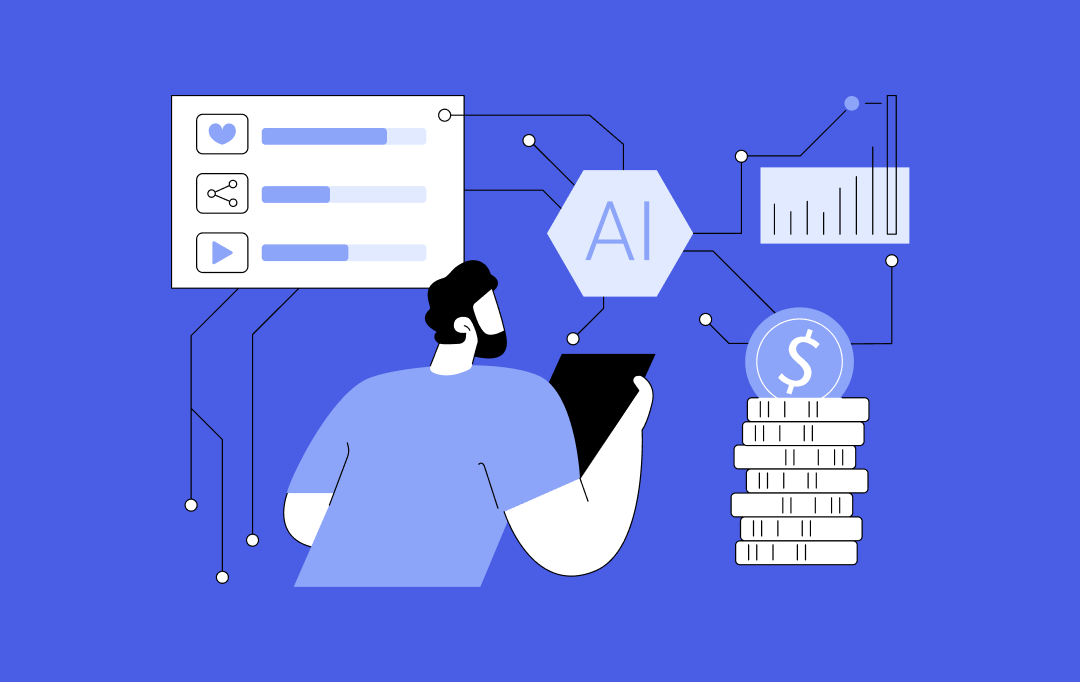
Enterprise leaders no longer treat 5G and AI for businesses as separate bets. The two now work as one system. AI produces the intelligence. Advanced 5G moves that intelligence to the point of action in milliseconds.
This shift defines 2026. AI has pushed past chatbots into agentic systems that act on their own, and into inference that runs at the network edge. These workloads need ultra-low latency and steady bandwidth. Public 4G and standard cloud round-trips cannot deliver either.
Standalone 5G (5G SA), built on its own core rather than bolted onto a 4G network, makes real-time AI practical at scale. Private 5G, network slicing, and edge computing now carry the load.
The 5G and AI impact on business is large. PwC estimates AI will add 15.7 trillion dollars to the global economy by 2030. Much of that value rests on the network beneath it.
This guide shows what the convergence means for your business. You get real enterprise use cases, the cost and ROI math, the security questions your board will raise, and a clear path to deployment.
Models alone are not enough. Build the connectivity foundation needed for production-scale AI operations.
How 5G and AI Shape Strategic Enterprise Priorities
AI now drives decisions on the factory floor, in the warehouse, and across the branch network. 5G gives those decisions the speed and reach to work in the physical world.
The Shift from Connected Enterprises to Intelligent Enterprises
For ten years, businesses focused on bringing assets online. Sensors and machines sent data to a central system. Now, the focus shifts from visibility to action.
An intelligent enterprise does not just see a problem. It predicts faults, redirects robots, and adjusts the line. AI and 5G technology combine raw telemetry to give systems the judgment and reflexes needed for instant decisions.
Why Traditional Networks Cannot Support Modern AI Workloads
Modern AI workloads break older networks in specific ways:
- Wi-Fi drops connections during access point handoffs. A moving robot loses its link mid-task.
- 4G latency sits near 50 milliseconds. This delay is too slow for safety stops.
- Computer vision pushes large data streams. These streams congest shared networks.
- A single plant runs thousands of devices. This volume breaks 4G cells. Late decisions do not work. Calls must land in under 10 milliseconds.
The Role of Ultra-Low Latency, Edge Computing, and Real-Time Intelligence
5G closes these gaps with four capabilities that matter to AI:
- URLLC (Ultra-Reliable Low-Latency Communication): air-interface latency near 1 millisecond at 99.999% reliability, built for control loops and safety systems.
- Network slicing: one physical 5G network split into isolated virtual lanes, so a vision-AI line and a guest network never compete for capacity.
- Massive IoT (mMTC): support for up to a million connected devices per square kilometer, enough for dense sensor grids.
- Edge processing: compute is placed at the cell site or on-premises, so AI inference runs meters from the data rather than in a distant cloud region.
Put together, these let AI act on live data inside the window that a physical process allows.
How 5G and AI Work Together to Create Business Value
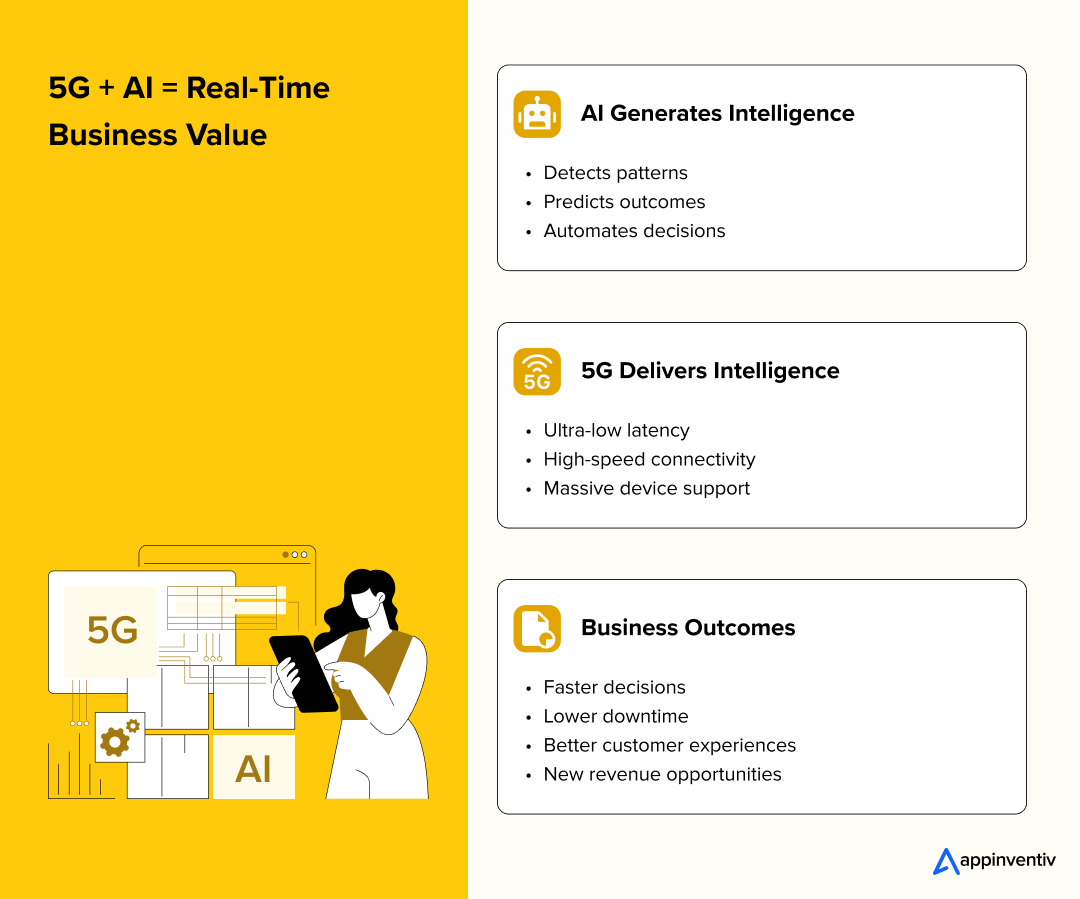
AI and 5G each solve half the problem. AI decides what to do. 5G makes sure the decision arrives fast enough to matter.
AI Generates Intelligence
AI reads the data and produces the call. Machine learning models spot defects in a video frame. Predictive models flag a bearing about to fail. Agentic systems chain together several steps and then act without a human prompt. The quality of these outputs depends on fresh, high-volume data reaching the model fast.
5G Delivers Intelligence in Real Time
A model is only as good as its delivery. 5G carries sensor data to the model and the model’s decision back to the machine, both in milliseconds. A defect call stops the line before the next part moves. A safety alert halts an autonomous vehicle before impact. Speed turns a smart prediction into a physical action.
The Emergence of Edge AI Architectures
Sending every frame to a central cloud adds delay and cost. Edge AI moves the model closer to the source. Inference runs on a gateway, an on-site server, or the device itself. 5G links these edge nodes without cables, so a factory or port can place compute wherever the work happens. Less data travels to the cloud, and decisions land faster.
Cloud AI vs Edge AI vs Hybrid AI
Quick Overview Table
| Factor | Cloud AI | Edge AI | Hybrid AI |
|---|---|---|---|
| Where Inference Runs | Central data center | On-site node or device | Split across the edge and the cloud |
| Typical Latency | 50–100+ ms | 1–10 ms | Low at the edge, deeper work in the cloud |
| Best For | Model training, batch analytics | Real-time control, vision, safety | Most enterprise deployments |
| Main Limit | Round-trip delay, bandwidth cost | Limited on-site computing and memory | Harder to design and govern |
| Example | Demand forecasting | Defect detection on the line | Edge inference plus cloud retraining |
Most enterprises land on hybrid. The edge handles instant calls. The cloud handles training, oversight, and long-range patterns. 5G ties the two layers together.
Key Business Benefits of 5G and AI for Businesses
The advantages of 5G and AI in business show on the balance sheet, not just on diagrams. Enterprises record clear benefits.
Faster Decision-Making
Edge inference reduces round-trip times to milliseconds. Machines stop or adjust instantly to prevent accidents.
Increased Operational Efficiency
AI tunes automated processes constantly. Deloitte found that poor maintenance drags productive capacity down by 5 to 20 percent. Closing that gap lifts output.
Lower Downtime Through Predictive Intelligence
McKinsey reports predictive maintenance cuts equipment downtime by up to 50 percent. It lowers maintenance costs by 10 to 40 percent. 5G keeps sensor data flowing. Models catch faults early. This dynamic is clear in AI and IoT in business.
Enhanced Customer Experiences
Live data lets brands customize experiences instantly. McKinsey notes AI analytics for businesses drive 20 to 30 percent higher customer satisfaction.
New Revenue Opportunities
McKinsey finds personalization lifts revenue by 5 to 15 percent. Fast-growing companies pull in 40 percent more revenue. This choice makes adopting AI in business a board priority. 5G opens new options like premium network slices.
Greater Business Agility
Teams deploy secure private networks for new sites in days, not months. The business evolves with the market.
Enterprise Use Cases of Private & Advanced AI-Powered 5G Across Industries
5G and AI use cases already run in production across industries, not just slide decks. These are real deployments across seven sectors, with the named companies behind them.
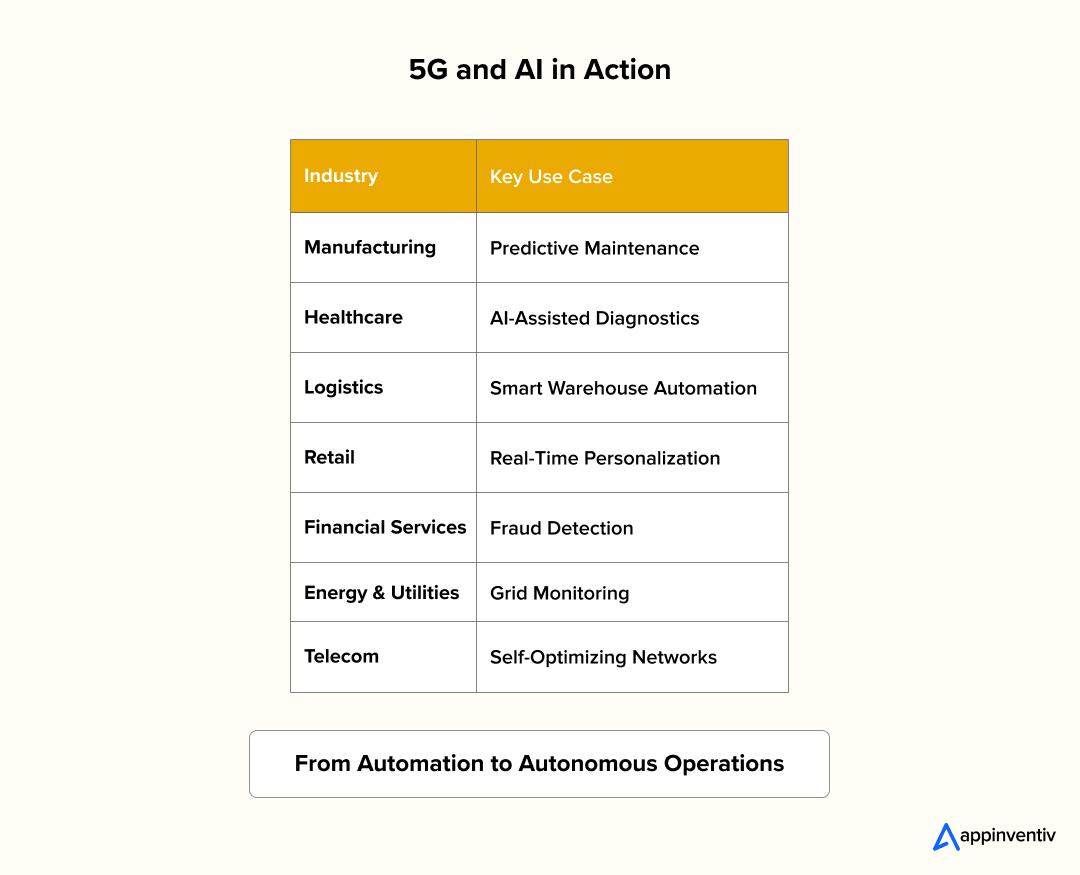
Manufacturing
5G and AI in manufacturing go far beyond basic inspection. Predictive models read vibration and heat data to flag failing machines before lines halt. Robots and automated vehicles move and adjust without physical cables.
An example of 5G and AI in business is Hitachi Astemo. They run a private advanced 5G network with Ericsson and AWS at their Kentucky plant. Edge video analytics catch assembly defects faster than manual checks.
Also Read: How 5G is Making the Automotive Sector More Efficient And Secure
Healthcare
Hospitals need strong network coverage across large campuses. 5G moves heavy MRI files to screens in seconds. This speed allows AI-assisted imaging and remote diagnostics to work without transfer delays.
An example of this is the Cleveland Clinic. They integrated private advanced 5G healthcare technology into their Mentor Hospital for asset tracking and patient care. Hanyang University Hospital in South Korea runs AI on private 5G to detect patient falls on camera.
Logistics and Supply Chain
Warehouses lose money to dead zones and dropped links. AI manages warehouse automation, robot maintenance, and indoor tracking. Fleet intelligence reads live traffic data to plan routes.
An example of this is CJ Logistics. They deployed private advanced 5G across South Korean sites so handheld scanners and robots never lose connection. This steady link delivers the main benefits of AI in logistics.
Retail
Retailers place AI on cameras and shelves. Cashier-free chains track shoppers with edge cameras and charge baskets automatically. 5G adds the bandwidth needed to send instant offers to shoppers in the aisle.
A notable example is Walmart, which uses private advanced 5G networks across parts of its operations to support connected devices, real-time inventory visibility, and smarter store operations.
Financial Services
Edge AI scores transactions at payment terminals before cash leaves the machine. Branch intelligence ties camera feeds and live data together so staff can act on alerts instantly.
A notable example is JPMorgan Chase, which has explored advanced 5G-enabled connectivity to support faster data transmission, improved branch operations, and enhanced digital banking experiences.
Energy and Utilities
Utilities cover remote territories that public networks serve poorly. Smart grids collect data from millions of meters to power dynamic pricing. AI reads that data flow to monitor assets and catch transformer faults before outages hit.
An example of this is Memphis Light, Gas and Water. They built a private advanced 5G network with Nokia to cover systems across Shelby County. China’s State Grid operates a private network to collect utility data in real time.
Telecommunications
Operators apply AI to their own infrastructure. Self-optimizing networks manage themselves, cut manual labor, and maintain service quality as traffic climbs.
An example of this is AT&T. The company uses AI in 5G infrastructure through agents that watch performance and predict traffic surges. Deutsche Telekom and Google Cloud build AI agents for radio network operations.
How to Integrate Agentic AI, Edge Computing, and Private 5G for Enterprise Workflows
Enterprise teams are moving past generative AI assistants. A new architecture fits factories, warehouses, and airports. The goal goes beyond text generation. Leaders want 5G AI solutions for enterprises. They need AI systems to observe events and make decisions across operations.
Real-Time Connectivity and AI Agents
An AI agent performs tasks rather than just generating outputs. For example, a machine vision system detects an abnormal vibration. An autonomous agent receives the alert, checks maintenance records, and reviews spare parts. It creates a work order and updates schedules. Data moves between sensors and enterprise tools. Network latency becomes a business issue.
Investing in Private 5G Networks
Industrial environments often face Wi-Fi coverage gaps. Private 5G fixes these problems with dedicated spectrum. The enterprise controls the local network.
- BMW uses private 5G for connected manufacturing.
- Siemens runs smart factory operations.
- Amazon facilities coordinate warehouse robotics.
Thousands of sensors and robots operate simultaneously. Private 5G handles this heavy traffic.
Edge AI and Local Inference
AI decisions require instant action. Cloud data transfers take too long. A quality inspection system evaluates images in milliseconds. Autonomous vehicles react immediately to obstacles.
This drives a shift toward edge inference. Enterprises deploy models on local servers and gateways. They do not send raw data to remote data centers. This structure reduces latency and protects sensitive data.
Generative AI at the Edge
Enterprises are testing small language models inside private environments. This extends generative AI for business to on-premises infrastructure.
- Maintenance bots connect to equipment manuals.
- Engineering systems train on internal files.
- Manufacturing models run inside production plants.
This setup yields faster responses and protects proprietary data.
AI Agents and Enterprise Workflows
Enterprises connect AI agents across procurement and maintenance. This shows the value of AI agents in an enterprise. One agent identifies a supply disruption, another checks inventory, and a third adjusts production. The result is a coordinated decision chain across business functions. Private 5G provides connectivity, edge AI brings local intelligence, and agents execute tasks.
The ROI of 5G and AI Investments
The 5G and AI impact on business is defined by quantifiable operational improvements and cost reductions. While exact metrics vary by sector, the core investment and return categories remain highly consistent.
Where the Costs Come From
The highest upfront expenses stem from building the foundational infrastructure required to support real-time workloads. Understanding the full cost of AI development is essential before scaling beyond initial pilots.
| Investment Area | Cost Drivers |
|---|---|
| Private 5G | Spectrum licensing, radios, small cells, 5G core infrastructure |
| Edge AI | GPUs, edge servers, inference hardware and local storage |
| AI Platforms | Foundation models, orchestration layers, MLOps tooling |
| Integration | APIs, middleware, ERP integration, data pipelines |
This investment profile scales directly with deployment scope, from a single facility to a global rollout.
Where Enterprises Generate Returns
Enterprise leaders evaluate success through a matrix of operational and financial metrics rather than a single KPI.
| Metric | Target Outcome |
|---|---|
| Equipment Downtime | Decrease |
| System Throughput | Increase |
| Labor Productivity | Increase |
| Asset Performance | Increase |
| Maintenance Costs | Decrease |
Industry benchmarks validate this model. McKinsey reports that predictive maintenance reduces equipment downtime by up to 50% and lowers maintenance costs by 10% to 40%.
In practice, manufacturing organizations realize immediate gains in asset availability, while logistics operators maximize throughput via real-time asset visibility.
Ultimately, the 5G and AI impact on business delivers the highest returns through compounding effects: minimized downtime optimizes asset performance, which drives throughput and increases revenue without a linear rise in operating costs.
The biggest returns come from production deployments, not isolated proofs of concept.
Security, Governance, and Compliance Considerations
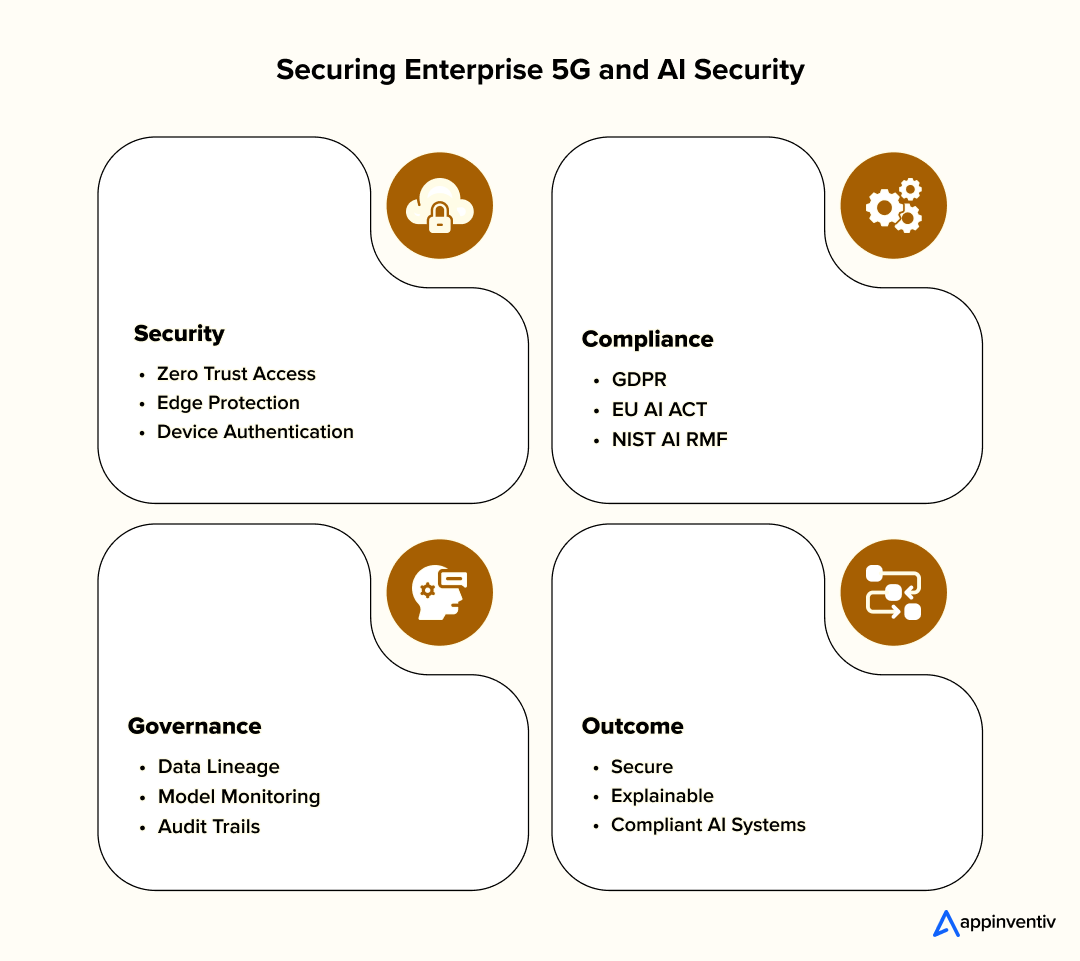
Understanding AI in 5G networks challenges and use cases helps teams secure distributed data. Data movement creates new risks. Security influences deployment decisions as much as performance.
The Attack Surface of 5G and AI Systems
A 5G and AI ecosystem has no simple boundary. Sensors and edge servers exchange data continuously. Each connection introduces a new risk point. Common risks include:
- Unauthorized device access
- API vulnerabilities
- Model manipulation
Data interception. Connected devices multiply across facilities, increasing this threat.
Securing Edge AI Environments
Edge computing reduces latency. It moves workloads outside centralized data centers. An edge server inside a factory processes sensitive operational data. Attackers can compromise these servers to gain access to production systems and equipment telemetry. Security teams are adopting specific controls:
- Hardware security modules
- Device authentication controls
- Encryption for data in transit and at rest
- Continuous monitoring of edge infrastructure
- Secure model deployment practices
These controls help reduce risk across distributed environments.
Data Governance for Distributed AI
Many AI deployments operate across multiple locations and platforms. They pull from many data sources. This setup creates a governance challenge. Enterprise teams must know:
- Where does the data originate?
- How does data move?
- Who accesses the data?
- How long do systems store it?
- Which models use it?
AI systems create compliance and operational risks without clear governance policies. These risks become difficult to track over time.
Zero Trust Architectures
Organizations no longer assume default trust for users and devices. That principle sits at the center of Zero Trust security models. Systems continuously verify identity and permissions before allowing access. They check device status. Core Zero Trust practices include:
- Least-privilege access controls
- Continuous authentication
- Network segmentation
- Device verification
- Real-time monitoring
These controls become critical. AI agents and edge systems interact more often. Connected devices share data across the enterprise.
Responsible AI and Regulatory Considerations
Regulators pay closer attention to how organizations develop and deploy AI systems. Enterprise leaders must demonstrate specific capabilities:
- Model transparency
- Data privacy protections
- Human oversight mechanisms
- Audit records
- Bias monitoring
Frameworks shape enterprise governance programs today. Examples include the EU AI Act and GDPR. The NIST AI Risk Management Framework plays a role. Sector-specific regulations apply. Successful AI adoption goes beyond system performance. Systems must remain secure and compliant. They must remain explainable and accountable throughout their lifecycle.
AI-RAN and the Future of Intelligent Networks
Beyond edge applications, a critical shift is occurring at the network layer: Artificial Intelligence Radio Access Network (AI-RAN) replaces traditional, static network rules with machine learning models.
Backed by infrastructure leaders like Ericsson, Nokia, and Samsung, AI in 5G networks dynamically analyzes traffic patterns, predicts congestion, and adapts resources instantly to manage rising enterprise data workloads.
How AI Autonomously Optimizes Infrastructure
Operating at scale, AI in 5G networks converts massive system telemetry into automated operational benefits:
- Predictive Traffic & Routing: Anticipates and routes around congestion before performance drops.
- Dynamic Resource Allocation: Optimizes network capacity and slices on demand.
- Automated Energy Management: Autonomously powers down inactive radio segments to cut utility costs.
- Self-Healing Diagnostics: Instantly identifies anomalies and executes corrective patches without manual intervention.
The Operational Imperative for CIOs & CTOs
As enterprises scale private 5G and edge infrastructure across distributed locations, manual network management becomes unsustainable. AI-RAN aligns with broader enterprise automation goals by ensuring high-volume AI workloads remain resilient, secure, and self-managing. This brings the section down to its absolute core value proposition.
Sustainability and Energy in 5G and AI Deployments
AI adoption increases compute demand across industries. Enterprises face heavy pressure to lower energy consumption and control infrastructure costs. Energy planning now sits high on the agenda for technology leaders.
The Energy Challenge of AI Infrastructure
Training models requires immense power. Large language models and computer vision systems rely heavily on GPUs. Digital twins and predictive analytics tools need high-performance hardware. Electricity use rises as organizations deploy AI across multiple locations.
Key energy drivers include training clusters, data center operations, model inference, and connected IoT devices. Enterprise AI planning must address these energy needs from the start.
How Edge AI Cuts Data Transfer Costs
Do all AI workloads need to send data to a centralized cloud? No. Some work stays local. A factory camera processes images on the floor, and a warehouse robot makes navigation decisions on-site.
An industrial sensor analyzes equipment performance at the edge and transmits only relevant information. You can read more about this in edge computing for IoT. This structure cuts network traffic, data transfer costs, cloud processing, and storage demands. Local processing lowers power use.
5G Networks and Energy Planning
Newer 5G networks track energy use accurately. AI now manages network resources actively.
| AI Application | Energy Impact |
|---|---|
| Traffic forecasting | Cuts unused network resource allocation |
| Active capacity management | Matches network resources to demand levels |
| Smart radio control | Lowers power consumption during low activity |
| Predictive maintenance | Drops equipment failures and physical waste |
Telecom providers use these tools today to support data growth without increasing energy use. This creates clear gains for enterprises. Organizations can expand AI adoption and connect more devices without a linear rise in infrastructure costs.
How Can Enterprises Prepare Networks for 5G Advanced and 6G
The telecommunications industry builds new technologies to expand wireless networks. Standards like 3GPP Release 18 and Release 19 inject machine learning directly into the radio network.
| Network Phase | Core Technologies | Primary Business Benefit |
|---|---|---|
| 5G Advanced | 3GPP Release 18 and 19, ISAC | Precise tracking without extra sensors |
| 6G Development | Sub-terahertz frequencies, Native AI | Native intelligence at the physical layer |
These updates change how network hardware processes high-volume data streams.
- Integrated Sensing and Communication (ISAC) lets radio waves detect physical objects.
- Factories track moving assets to get centimeter-level location accuracy across deep industrial spaces.
- Smart sleep modes power down cell towers during low traffic to cut utility costs.
These developments prepare corporate networks for the shift to 6G. They define the current 5G and AI trends. Engineers test sub-terahertz frequencies to increase data transfer speeds. The physical network layer will handle AI processing natively.
Enterprise leaders must buy hardware that supports software upgrades. Selecting programmable, open radios prevents early equipment obsolescence. This choice protects your network investment for the next ten years.
A Roadmap for Successful Implementation of AI-Powered 6G
For 6G and AI for businesses, most successful deployments do not begin with a network upgrade. They do not start with an AI model. They start with a business problem. Successful organizations connect technology investments to operational goals. They expand from that foundation.
What Enterprise Teams Focus On
| Deployment Step | Action Items |
|---|---|
| Identify high-value use cases | Prioritize problems tied to revenue and productivity. Focus on reducing downtime and improving safety. Target predictive maintenance, computer vision, and asset tracking. |
| Assess connectivity readiness | Review network capacity and latency requirements. Check device density, coverage gaps, and infrastructure limits. |
| Evaluate 5G options. | Decide if workloads need dedicated connectivity or local network control. Assess security needs and support for large device fleets. Compare public and private networks. |
| Build edge infrastructure | Deploy edge servers and gateways. Install local compute resources. Move data processing closer to physical operations. |
| Deploy AI workloads | Roll out AI models and inference pipelines. Launch automation systems and agent workflows in controlled phases. |
| Establish governance and security. | Define data ownership and access controls. Set model monitoring practices, compliance rules, and security policies. |
| Measure ROI and scale | Track business metrics and validate outcomes. Expand successful deployments across other facilities, regions, or business units. |
Many leaders try to change the whole company at once. True success in integrating emerging technologies for enterprise workflows requires a phased approach. Leading enterprises begin with a single production line. They test one process, validate results, and then expand. This path reduces risk. It creates measurable outcomes before boards approve large investments.
Organizations that align AI, connectivity, and infrastructure today will move faster tomorrow.
The Future of Enterprise Transformation with AI-Powered 6G
5G and AI integration for business transformation lays the foundation for the next decade. The focus now shifts toward AI-powered 6G networks. These platforms combine wireless signals with native computation to drive enterprise evolution.
Cognitive 6G Networks
AI-powered 6G handles complex tasks across corporate ecosystems. For example, a sub-terahertz network automatically tracks raw materials. An intelligent node identifies a supply shortage, reviews inventory levels, and creates a purchase request. This application shows how AI in the supply chain reshapes procurement workflows.
6G Autonomous Operations
Factories and utility networks require faster connections than current wireless provides. AI-powered 6G lets millions of sensors and robots coordinate actions with zero lag. This network capability eliminates control bottlenecks across heavy manufacturing and large distribution networks.
6G-Native Infrastructure
Next-generation hardware places intelligence directly into the physical radio layers. This setup handles edge-first computing, real-time data pipelines, and distributed inference natively. Infrastructure choices will depend entirely on these built-in cognitive capabilities.
Also Read: The Six Ways AI Can Take Your Mobile App to the Next Level
Future Private Ecosystems
Large enterprises connect campuses, factories, and ports using advanced private infrastructure. These dedicated networks support industrial IoT and edge computing while preparing systems for 6G speeds.
The key 5G and AI trends point directly toward an AI-powered 6G future. Networks are becoming self-managing, and infrastructure is more distributed. Organizations that adopt these tools early will scale better over the next decade.
How Appinventiv Combines AI and Advanced 5G to Build Enterprise-Grade Telecom Software
How do you execute a complex AI and 5G strategy? Many organizations understand the technology, but they struggle with deployment. Enterprise environments involve legacy systems and fragmented data.
They require edge infrastructure, cloud platforms, and strict security controls. Teams must connect these pieces into a working system.
As a trusted telecom software development company, Appinventiv delivers 5G AI solutions for enterprises, helping them move from experiments to active deployments. We build AI tools and cloud integrations. Our data engineers connect complex operational workflows.
| Capability | Experience |
|---|---|
| AI Solutions Delivered | 300+ |
| Data Scientists and AI Engineers | 200+ |
| Custom AI Models Deployed | 150+ |
| Enterprise AI Integrations | 75+ |
| Bespoke LLMs Fine-Tuned | 50+ |
| Industries Served | 35+ |
Our enterprise teams deliver specific results:
- Up to 75% faster decisions
- Up to 98% AI prediction accuracy
- Up to 10x faster time to market
We deploy private 5G environments and edge AI. We build AI agents and enterprise automation. Businesses use these tools to expand operations and support long-term growth.
Turn investments in 5G and AI for businesses into results. Appinventiv builds secure systems that deliver measurable financial and operational impact. Let’s connect and move from AI pilots to enterprise-wide deployment.
Frequently Asked Questions
Q. What key 5G advanced capabilities make it valuable for enterprise operations?
A. 5G and AI for businesses offer faster network speeds, lower latency, enhanced capacity and bandwidth, greater device capacity, and improved network reliability. Features such as network slicing, private networks, built-in security upgrades, and integration with artificial intelligence and edge computing support real-time applications and scalable enterprise infrastructure.
Q. How can enterprises manage security risks in advanced 5G and AI environments?
A. Enterprises can reduce risks by adopting a zero-trust security model, multi-factor authentication (MFA), role-based access controls, and continuous verification. AI-driven threat detection, network access monitoring, device management policies, and enhanced monitoring, detection, and response capabilities help address the expanded attack surface and support regulatory compliance.
Q. How do advanced 5G and AI work together in enterprise environments?
A. 5G provides the connectivity layer that allows AI systems to process and exchange data with minimal delay. Together, they support real-time applications such as predictive maintenance, autonomous operations, intelligent automation, computer vision, and connected asset monitoring across enterprise environments.
Q. Should enterprises choose public or private 5G for AI deployments?
A. The choice depends on workload requirements. Private 5G offers greater control, security, reliability, and support for high-density device environments. Public 5G can be suitable for broader connectivity needs where dedicated network performance and localized control are less critical.
Q. What industries benefit most from advanced 5G and AI?
A. Manufacturing, logistics, healthcare, retail, telecommunications, and energy are among the leading adopters. Common outcomes include reduced downtime, faster decision-making, improved asset utilization, higher operational productivity, and stronger customer experiences through real-time data-driven processes.
Q. Why choose Appinventiv for enterprise 5G advanced and AI development?
A. Appinventiv combines expertise in AI, data engineering, enterprise integration, cloud, edge computing, and emerging technologies. With 300+ AI solutions delivered, 150+ custom AI models deployed, and experience spanning 35+ industries, we help enterprises build scalable, production-ready AI ecosystems.


Fast 2-minute response, fully NDA-protected.

Retrieval Augmented Generation in Australia: Architecture, Implementation and Cost
Key takeaways: RAG grounds LLM answers in approved content, improving reliability without retraining a model. Data quality and access permissions decide production outcomes more than the model. Indicative build costs run from AUD 70,000 to 700,000, driven by data and integrations. Measure value against a pre-deployment baseline, separating realised benefits from projected savings. A general-purpose…
The Multiplier Effect of AI Agents: The Rise of AI Swarms
Key takeaways: AI agent swarms coordinate specialized agents to solve complex problems that may be difficult for a single agent to handle effectively. More agents do not automatically mean better outcomes. Swarms deliver value when work can be divided, executed in parallel, and coordinated toward a shared objective. Enterprise readiness depends on governance. Clear accountability,…
AI Data Integration: How to Connect, Clean and Prepare Data for AI
Key takeaways: AI initiatives fail when fragmented, poor-quality data reaches models without sufficient context, controls or ownership. AI-ready pipelines must connect, clean, enrich, govern and continuously monitor data across its lifecycle. Real-time processing matters when AI decisions depend on current transactions, events, inventory or operational conditions. Data architecture should follow the AI use case, balancing…