


































How is Cloud Computing Helping the Telecom Industry Grow?

 Share -


- 01The Shift from CapEx to OpEx in Telecom Operations
- 02Cloud Computing Types and Archetypes for Telecom Businesses
- 03Benefits of Cloud Computing for Telecom Companies
- 04Key Applications of Cloud Technology in Telecom Networks with Real-Life Examples
- 05Stages of Cloud Implementation in Telecom
- 06Foundational Technologies in Telecom Cloud Computing
- 07Key Challenges of Cloud Adoption in Telecom
- 08The Future of Cloud Computing in Telecom
- 09How Appinventiv Enables Telecom Cloud Transformation
- 10FAQs

Key takeaways:
- Cloud computing is a great option for telecom operators who want to scale up quickly, cut infrastructure expenses and make the network more agile.
- Legacy CapEx vs. OpEx cloud models drive 5G, IoT, and edge service deployments.
- Cloud-native platforms are crucial in delivering greater automation, security, and operational efficiency to help roll out new digital services more quickly.
- Telecoms can benefit from hybrid and multi-cloud solutions to reduce costs, avoid vendor lock-in and facilitate international expansion.
- Automation and edge computing, powered by AI, are the next big things in telecom innovation and customer experience.
To handle the growing volume of data, accommodate the rollout of 5G, and provide quicker digital services while keeping infrastructure costs down, telecom operators are coming under increasing pressure. Conventional hardware-based networks are struggling to meet today’s connectivity expectations and deliver high-performance, reliable, real-time services to customers.
Cloud computing in telecom appears as a paradigm shift in the industry as operators move away from traditional infrastructure models toward more scalable, software-driven, and on-demand network architectures. The global telecom cloud market size is expected to reach $194.42 billion by 2033, at a compound annual growth rate (CAGR) of 21.8% between 2026 and 2033 (Source: GVR).
The growth is driven by a shift from legacy infrastructure to a cloud-native environment, using Network Function Virtualization (NFV) and containerized network functions.
This separation of network services and physical hardware enables cost savings, including lower capital expenditure, faster service scalability and greater network agility. Cloud-native platforms can also enable automated lifecycle management, faster rollouts of new services, and greater network resilience for telecom service providers, helping them compete in the digital era.
Let’s have a detailed look at how cloud computing is influencing the telecom industry and propelling its growth towards a more connected future.
Work with our cloud specialists to improve flexibility, efficiency, and service delivery.

The Shift from CapEx to OpEx in Telecom Operations
The telecom sector is also undergoing a transformation of its infrastructure investments and operational expenses as a result of the adoption of cloud technologies for digital transformation. In the traditional telecommunications world, these were high investment, fixed infrastructure and long deployment times. The flexible operational spending, faster scalability and service delivery of the model are changing with the help of telecom cloud computing.
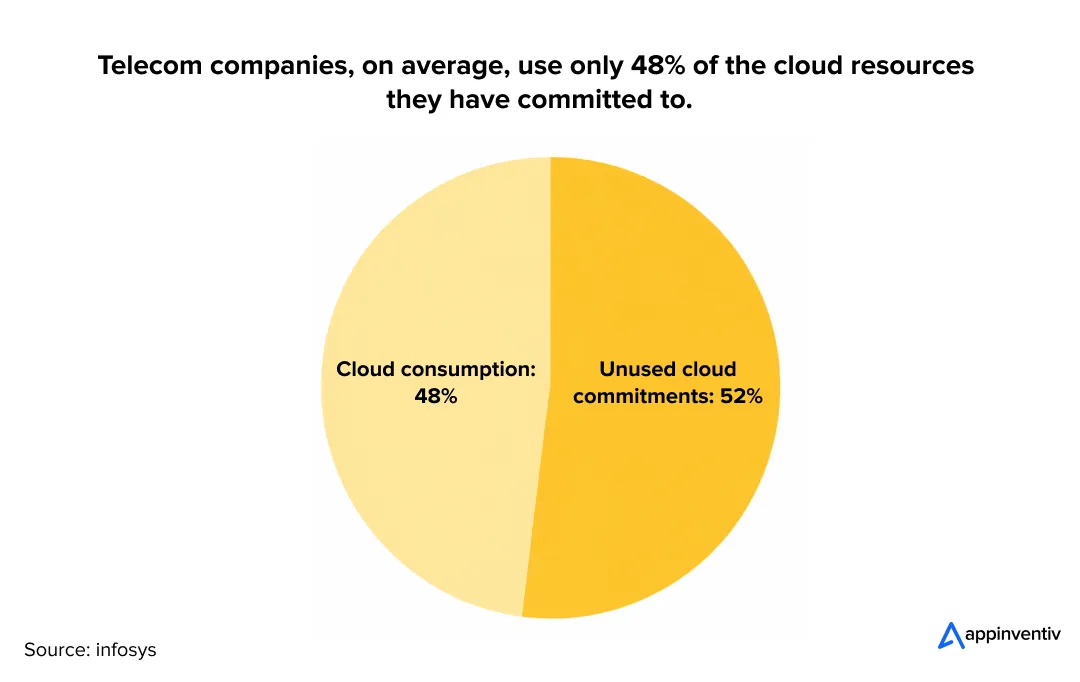
By moving OSS platforms, network functions, billing systems, and customer applications to the cloud, telecom companies can reduce upfront infrastructure costs and pay based on actual usage. However, as per Infosys Knowledge Institute, many providers are still using only about 48% of their committed cloud capacity due to the complexities of legacy systems, migration to the cloud and concerns that cloud vendors are entering telecom service markets.
Meanwhile, cloud computing for telecom is still in a state of flux as service providers work to achieve modernisation and operational control.
This CapEx to OpEx transition is here to help:
- Reduce the need for infrastructure and maintenance expenses
- Faster deployment of 5G, edge services
- Accelerate 5G, edge service deployment
- Improved scalability in peak demand situations
- Greater agility due to automation
- Lower financial risk of large-scale investments in infrastructure
Cloud-based telecom operations provide flexibility in terms of costs and enable long-term network modernization.
Cloud Computing Types and Archetypes for Telecom Businesses
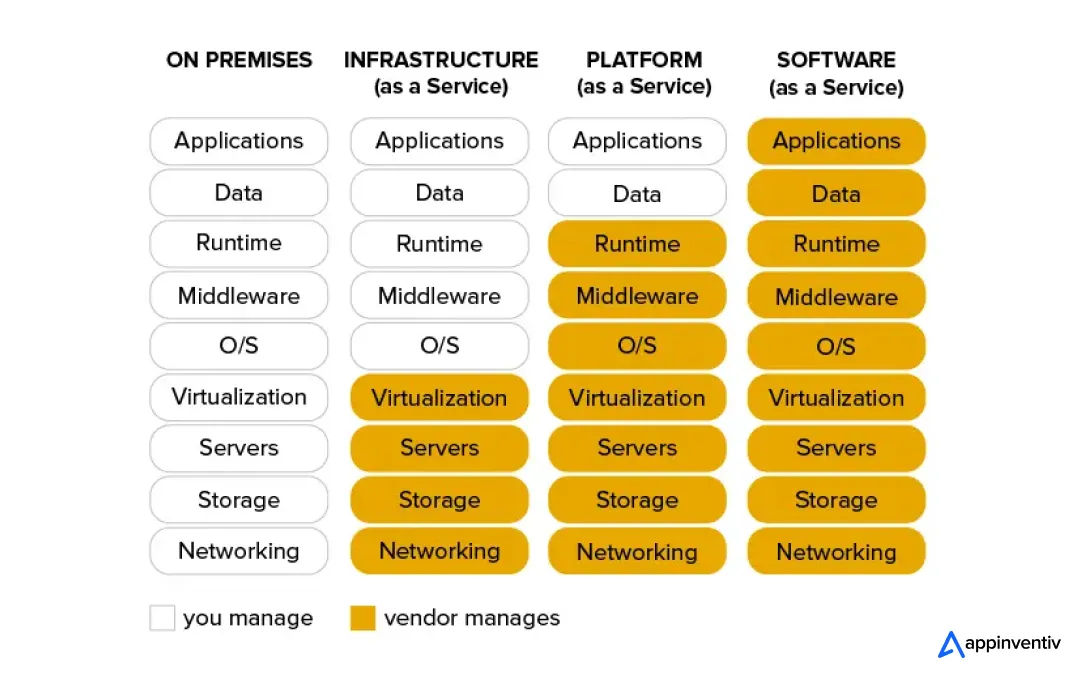
Generally, there are three cloud computing models widely adopted by telecom businesses to facilitate growth.
- IaaS (Infrastructure-as-a-Service), where you can leverage computing resources such as network infrastructure, data storage, data server, etc., from your provider.
- PaaS (Platform-as-a-Service), where your platform vendor provides access to the usability of the software platform.
- Software-as-a-Service, where you can use your software development company’s off-the-shelf software.
If you are worried about the responsibilities taken by you and your vendor, here’s how the charges are divided.
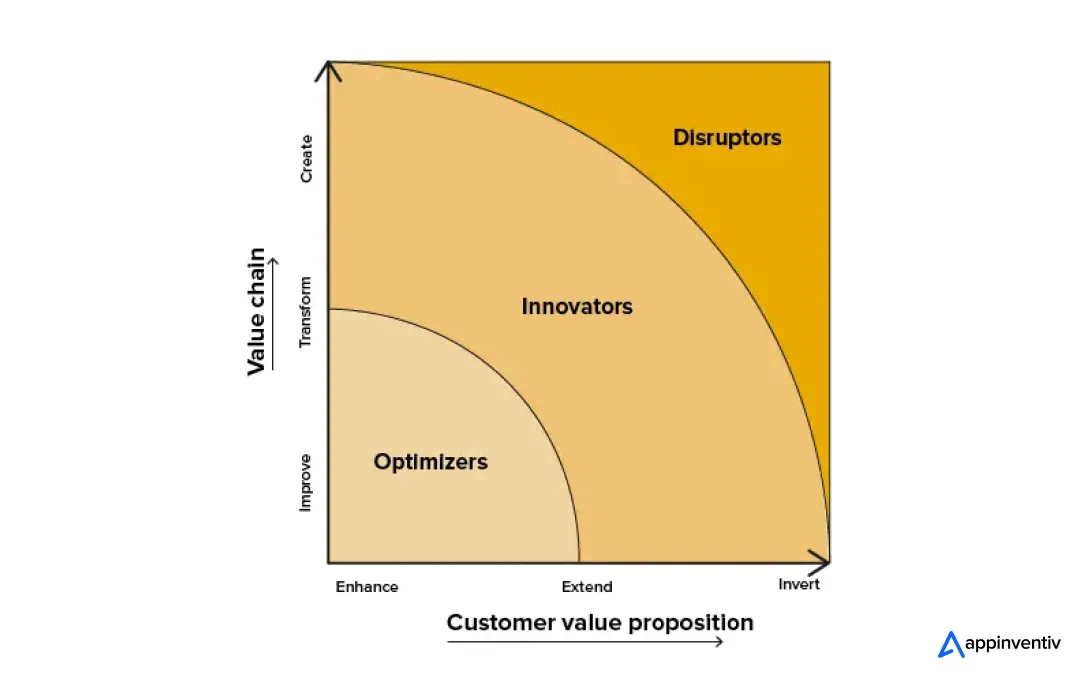
Apart from these telecom cloud solutions, cloud computing is also categorized in archetypes based on its level of adoption. A cloud archetype is also described as a cloud-enabled framework in which the customer service providers can choose from varying degrees of cloud adoption, enablement, and innovation.
There are majorly three cloud computing archetypes available for telecommunication businesses for adoption:
1. Optimizers
Optimizers use the cloud to perform current business efficiently by increasing their customer value proposition. As a telecom service provider, you can embrace this degree of cloud adoption to offer connectivity aligned with customer needs. You can use cloud caching, data acceleration, and other methods to deliver connectivity more innovatively.
By far, the adoption of archetypes of cloud computing for telecom companies has positively impacted both the telecom cloud market and customers.
The critical roles of being a telecom cloud optimizer are:
- Offering public cloud solutions
- Fulfilling data sharing requirements
- Adopting a single cloud-based solution for effective operations
2. Disruptors
As the name suggests, disruptors create new value propositions, innovative products and services, and even entirely new customer needs. To become a disruptor, you must leverage your most valuable resource, unique customer data and apply data analytics in telecom, combining it with other distinctive technological assets to develop new services and address emerging needs.
Given the current scenario, telecom businesses hold a strong position to lead in B2B telecom cloud services. They can easily enhance their telecom software and services through custom telecom software development powered by cloud capabilities.
The key roles of being a telecom cloud disruptor are:
- Offering a tailored customer experience to users
- End-to-end quality service
- Analyzing customer insights
- Aggregation expertise
- Fulfilling local telecom presence
3. Innovators
Innovators are at the degree of cloud adoption where you have to tap the cloud potential to expand your business value proposition and create new revenue streams. In simple terms, to become an innovator, you will need to transform the roles within your value chain and enter adjacent industries and markets to gain new revenue streams.
The key roles of being a telecom cloud innovator are:
- Offering a tailored customer experience to users
- Increasing sales by placing ads
- Enhancing workflow management
- Gaining rapid insights into performance across multiple channels
Here’s a graph that depicts all three cloud archetypes and their key role.
To harness cloud computing in telecom industry, you can start with effective telecom operators’ cloud strategies. Effective cloud strategies, such as extensive cloud collaboration services, workflow management, enterprise resource management, etc., can help you stay ahead in the market.
The role of cloud computing in the telecom industry is significant and inevitable. A few popular cloud service providers, such as AWS, Azure, Google Cloud, etc., can offer you top cloud architectures in terms of on-demand solutions.
If your telecom business hasn’t been cloudified yet, you are probably missing out on the top benefits of cloud computing in the telecom industry.
Benefits of Cloud Computing for Telecom Companies
Cloud computing is enabling telecom companies to create more flexible, scalable and cost-effective network boundaries. Here are some vital benefits of cloud computing in the telecom industry:
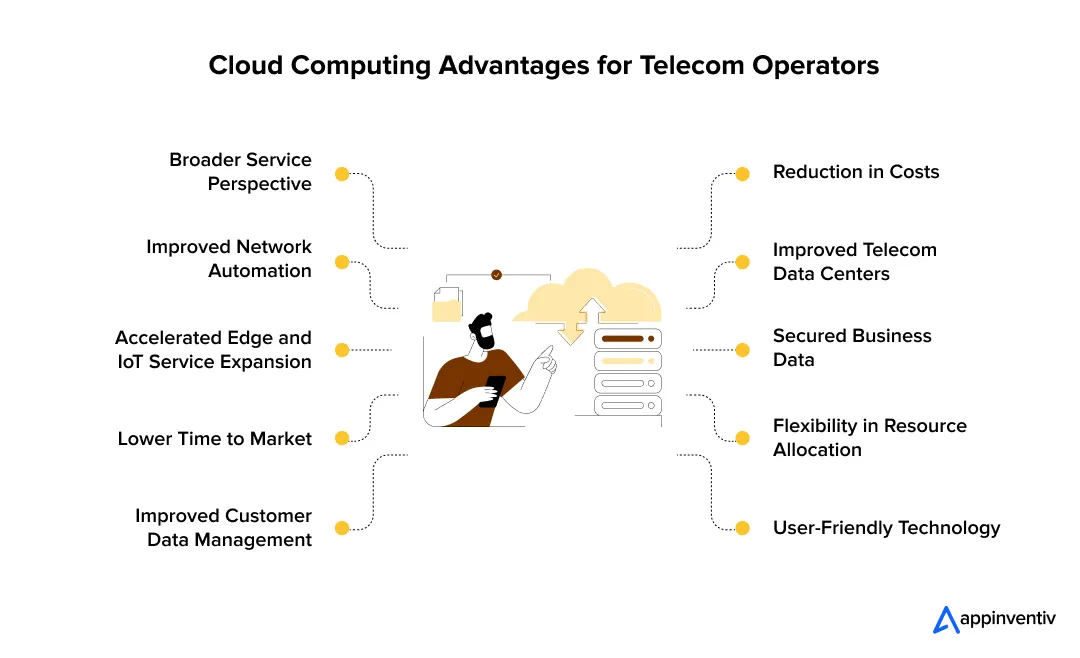
Reduction in Costs
Cloud computing for the telecom industry provides software at much lower rates with the help of software virtualization on remote servers. This allows easy allocation of the computing resources as required and thus helps reduce the hardware cost as well.
You can generate more revenue with cloud computing capabilities than with general local infrastructure services. Since cloud service providers follow a pay-as-you-go approach, you will only be paying for the resources you utilize.
Improved Telecom Data Centers
It is rather beneficial for telecom companies and cloud service providers to collaborate since it leads to enhanced data centers and complete server utilization. Another positive impact of cloud computing on the telecom industry is the adoption of cloud data migration practices at a very low cost.
If you are not satisfied with the provided cloud services, it is quite easy to migrate to a new telecom cloud solution by terminating the previous contract, signing a new one, and transferring your user data to a new server.
Secured Business Data
Cloud computing offers extensive data backup where you can back up, store, and protect your customer data on multiple cloud servers. This backup can be done at various servers simultaneously so that if one server fails, the data can be made available on other servers. This is how big telecom enterprises such as Vodafone, Airtel, and Jio carry their connected data services without any interruption or failure.
Flexibility in Resource Allocation
A very useful feature of cloud computing is that you have the flexibility to allocate resources whenever required. Cloud computing helps telecom businesses scale resources, such as networks, servers, storage and IT, up and down at any time.
This scalability and flexibility feature allows you to meet the peak loads and seasonal variant demands based on requests. Scale up the resources when the demand is high without any downtime.
User-Friendly Technology
If you compare cloud computing with other technologies, you’d realize the cloud is very convenient and user-friendly because it places a minimal load on businesses. The telecom market benefits from cloud network functions deployment, faster critical solutions, and quicker response to customer requests.
Broader Service Perspective
Through the adoption of cloud computing in telecom industry, businesses can transform into digital operators now that IT services can be delivered over any network.
Your telecom business can make solutions beyond connectivity with a broader service perspective. You can go for 5G solutions, IoT-based services, bespoke software, app solutions, etc.
Improved Network Automation
Self-healing network features are supported by cloud-native telecom platforms by employing automation and AI-based monitoring. These systems can be programmed to identify failures automatically, reroute traffic and restore service with minimal human interaction to enhance uptime and minimize service disruption.
Accelerated Edge and IoT Service Expansion
Telecom firms can scale edge computing and IoT ecosystems more seamlessly in distributed deployments with cloud infrastructure. Operators can support any connected device, smart infrastructure and real-time applications without overloading the centralized network systems.
Lower Time to Market
Cloud solutions enable telecom companies to rapidly create, test, and deploy new digital services, which is not possible with traditional infrastructure models. This enables providers to deploy new 5G applications, enterprise solutions and customer services into the field with quicker cycles and reduced risk.
Improved Customer Data Management
Cloud is a natural ecosystem for faster data processing; since the customer-generated data in telecom is humongous, telecom cloud businesses can process data faster. Moreover, using cloud analytics helps you gain data insights from processing which is a highly valuable feature in today’s competitive era.
For instance, Appinventiv created a cloud data analytic solution for a global telecom enterprise striving to find more ways to connect people. Using customer data management and optimization and customer-centric solutions, Appinventiv followed an agile approach to create an ecosystem that can process and categorize customer data based on user behavior and other factors.
This resulted in an 85% increase in data quality and 100% consumption and processing of customer data. This is a classic example of turning customer data into quality insights using cloud computing.
In short, telecom businesses can discover innumerable business opportunities using cloud capabilities. Not only this, your telecom business can sustain itself in the long run with trending cloud computing solutions.
We help telecom providers build agile, cloud-native infrastructure that improves scalability, network performance, and operational efficiency across evolving digital ecosystems.

Key Applications of Cloud Technology in Telecom Networks with Real-Life Examples
Cloud technology is transforming how telecom networks are built, managed, and scaled across modern digital ecosystems. Here are some of the key cloud use cases for telecom with real-life examples:
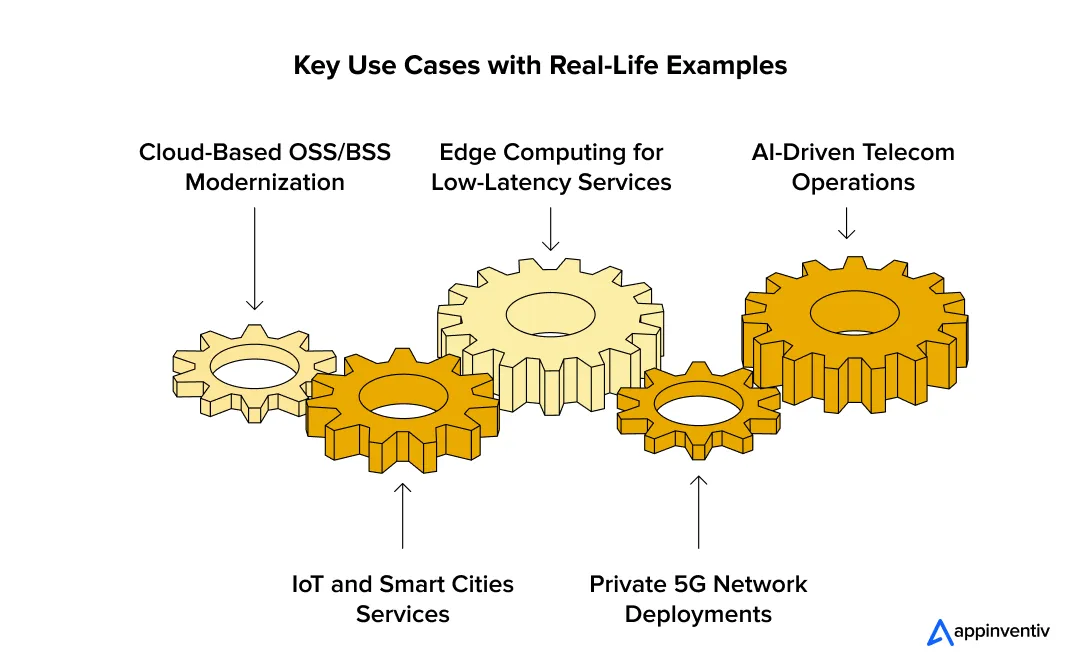
Cloud-Based OSS/BSS Modernization
Modernization of OSS/BSS in the cloud supports telecom providers by automating billing, customer management, service provisioning, and network monitoring. Telecom cloud architecture minimizes reliance on legacy infrastructure, boosts scalability and visibility in the telecom landscape.
To support its massive telecom infrastructure, AT&T has invested heavily to make its telecom operations cloud-native, enabling automation, service management, and modernizing legacy network systems.
IoT and Smart Cities Services
Telecoms are leveraging the cloud to enable smart city ecosystems, connected devices and big deployments of IoT. Centralized management of IoT, quicker data processing, and better operational control of urban infrastructure systems are all ways in which the growing impact of cloud computing on the telecom industry is seen.
Vodafone has developed a number of smart city applications to create connected traffic systems, utility monitoring and cloud-based IoT infrastructure in various geographic areas.
Also Read: IoT in Telecommunication: Key Use Cases & Industry Impact
Edge Computing for Low-Latency Services
As part of edge computing, telecom companies can process data nearer to the user rather than sending it all the way to a central cloud server. Advanced cloud technology in telecom is helping operators reduce latency and improve performance for industrial automation, AR/VR platforms, and autonomous systems.
Telefonaktiebolaget LM Ericsson has announced extensions to its telecom edge computing solutions, which enable low-latency 5G services and distributed cloud computing for enterprise applications.
Private 5G Network Deployments
Private 5G networks provide an enhanced wireless solution in the industrial sector to deliver a better connectivity, security and communications experience between connected devices in the enterprise. Different cloud deployment models in telecom enable operators to better manage private networks in hybrid, edge, and cloud-native environments.
T-Mobile US has extended its private 5G solutions to enterprises and manufacturers that demand secure, dependable and fast wireless connectivity for their operations.
AI-Driven Telecom Operations
Large amounts of operational data are produced in modern telecom networks, which are hard to handle manually. AI-driven telecom cloud operations enable providers to identify anomalies, anticipate network issues, and enhance service reliability through real-time analytics and automation.
Telefónica has subscribed to AI-powered cloud analytical tools to enhance network monitoring, automate problem identification, and accelerate the root cause analysis process within telecom networks.
Stages of Cloud Implementation in Telecom
Successful cloud adoption in telecom requires a structured approach that aligns infrastructure modernization with business and network goals. Here are the key steps for implementing cloud within the telecom sector:
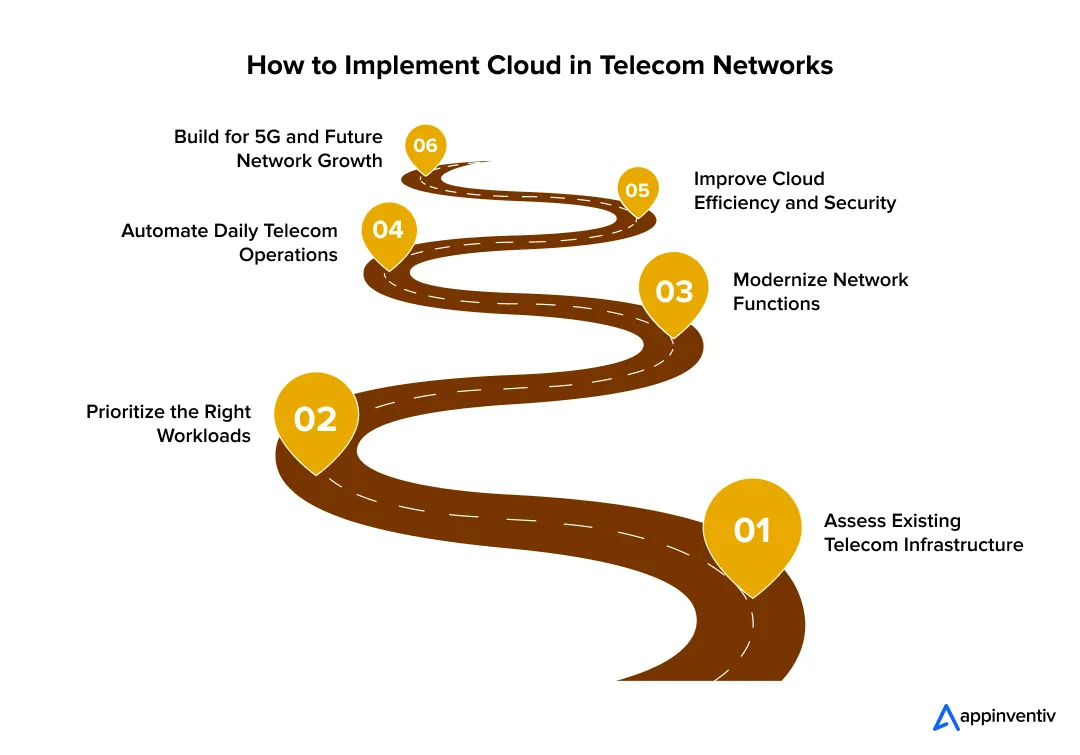
Step 1: Assess Existing Telecom Infrastructure
A vast majority of telecom operators rely on legacy OSS/BSS systems, siloed network environments, and hardware-centric infrastructure structures, which do not provide scalability and hinder service delivery. To make a positive move towards cloud adoption, telecom companies need to assess the current systems, network dependency, and bottlenecks. Cloud computing in telecom begins with understanding what can be modernized without disrupting ongoing services.
Cloud readiness assessments can be used to determine:
- Legacy applications that can be migrated to the cloud
- The network functions that need modernization
- Low-profitable infrastructure areas in terms of high operational costs
Step 2: Prioritize the Right Workloads
No single piece of software can handle all workloads. Focusing on high-impact systems can minimize operational disruptions and can provide increased business value. Strong telecom cloud computing strategies tend to be geared toward systems that enhance the agility and customer experience.
Common migration goals are:
- OSS/BSS and billing platforms
- Customer self-service applications
- Telecom analytics & reporting platforms
- Network monitoring and service management tools
Step 3: Modernize Network Functions
The traditional telecom network is largely dependent on hardware-centric infrastructure, which entails high maintenance costs and limited scalability. The role of cloud computing in telecom industry transformation is becoming more important as providers shift toward virtualized and software-driven networks.
The typical elements of an initiative to modernize are:
- Network Functions Virtualization (NFV)
- Containerized telecom applications
- Software-defined networking (SDN)
- Cloud native 5G core deployments
Step 4: Automate Daily Telecom Operations
Cloud environments enable telecom operators to implement automation for repetitive operational tasks across multiple systems, previously requiring manual effort. Cloud telecommunications infrastructure enhances efficiency through real-time monitoring and automated workflows.
Automation supports:
- Real-time network monitoring
- Automatic fault detection and ticket generation
- Dynamic resource allocation
- Predictive maintenance and alerts
Step 5: Improve Cloud Efficiency and Security
There are still many telecom providers using cloud resources at only partial capacity due to the complexity of migration and poor workload optimization. An effective cloud for telecom operators requires continuous monitoring, smarter resource planning, and stronger governance controls.
Optimization strategies include:
- Tracking the consumption of clouds
- Removing idle workloads and resources
- Improving the security of telecom clouds
- Installing compliance and access regulations
Step 6: Build for 5G and Future Network Growth
Scalable infrastructure is a critical component of expanding network services such as 5G, IoT, and edge computing by telecom companies. A strong telco cloud architecture enables distributed workloads, low-latency services, and accelerates the deployment of telecom services.
Scalability initiatives include:
- Enabling the growth of edge computing
- Supporting distributed telecom workloads
- Enhancing network flexibility and resilience
- Speeding up the provision of digital telecom services
Foundational Technologies in Telecom Cloud Computing
Telecom cloud environments are constructed from a mix of technologies that enable scalable, agile and software-driven network operations. These are essential technologies that enable telecom service providers to gain network flexibility, automate infrastructure management, and ensure high-quality digital services.
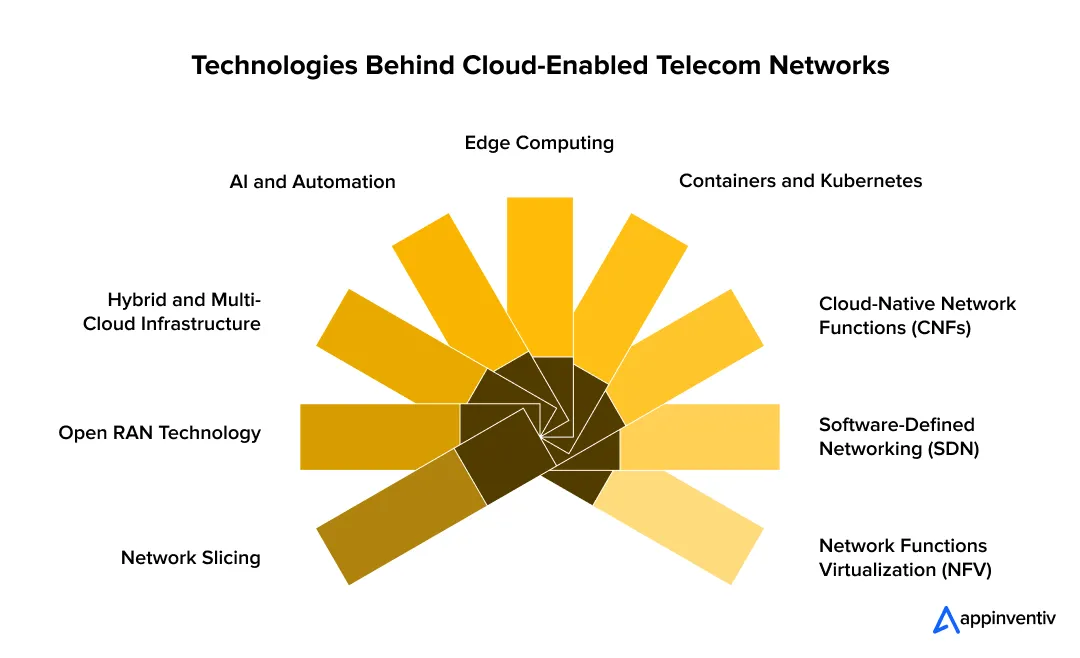
Network Functions Virtualization (NFV)
Virtualization of the telecom function by using virtual software on standard servers is called NFV. This not only lowers the infrastructure costs for telecom providers but also enables them to expand their services quickly.
Software-Defined Networking (SDN)
SDN provides operators with centralized control of the traffic and routing in the network. It enhances bandwidth usage, flexibility of the network, and optimisation of traffic in real-time.
Cloud-Native Network Functions (CNFs)
CNFs introduce microservices and container architectures to meet demands for enhanced scalability, rapid software updates, and reduced resource usage in telecom deployments.
Containers and Kubernetes
App deployments are made easy with Containers, and Kubernetes handles Workload orchestration and manages the infrastructure in large-scale telecom operations.
Edge Computing
Edge computing works by processing telecom data at the edge, rather than relying solely on cloud servers. This decreases latency for 5G, IoT and real-time applications.
AI and Automation
AI-powered telecom platforms enable automation of distributed telecom network monitoring, predictive maintenance, fault detection, and operational analytics.
Hybrid and Multi-Cloud Infrastructure
A hybrid cloud and multi-cloud approach enables telecom operators to optimize security, scalability and flexibility between public and private cloud deployments.
Open RAN Technology
Open RAN allows telecom companies to develop flexible and vendor-agnostic radio access networks, which will ultimately help to minimize dependency on existing infrastructure and deployment expenses.
Network Slicing
Network slicing enables telecom service providers to set up virtual network slices for specific applications, industries or enterprise workloads on a shared infrastructure.
Partner with our experts to accelerate telecom cloud transformation.

Key Challenges of Cloud Adoption in Telecom
While cloud adoption offers significant operational and scalability benefits, telecom providers still face several technical and infrastructure-related challenges during implementation. Let’s have a look at the key challenges of cloud adoption in telecom with solutions:
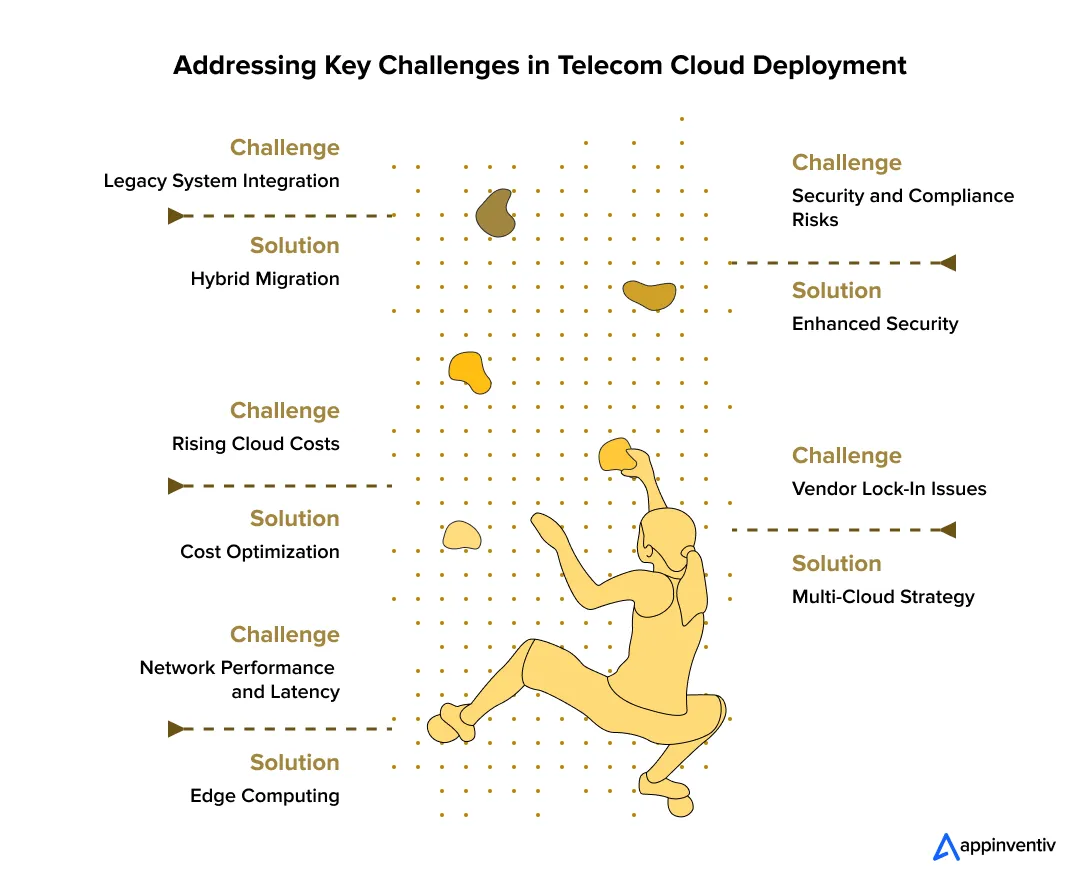
Legacy System Integration
There are still many telecom companies relying on aging OSS/BSS solutions and complex network architectures that are hard to migrate from. One of the challenges of cloud computing in telecom is when legacy programs don’t easily integrate with the modern cloud-based environment.
Solution: Through legacy modernization, telecom firms are turning to incremental upgrades and hybrid cloud architectures to keep systems up to date without hitting critical applications at once.
Security and Compliance Risks
Telecom networks carry critical customer information, financial details and vast operational information over geographically dispersed resources. Operators continue to be troubled by compliance with local laws and regulations as they secure cloud telecommunications infrastructure.
Solution: Providers are deploying this increased security to the cloud platform, including identity management, access control and ongoing compliance monitoring.
Rising Cloud Costs
Cloud utilization is an issue for many telecom vendors who commit to using cloud resources but don’t use them effectively, resulting in wasted operating costs. Managing infrastructure costs has become a growing challenge for cloud for telecom operators adopting large-scale cloud environments.
Solution: Continual workload monitoring, automated scaling and resource optimization for better utilization of cloud and lower wasted expenditure of telecom service providers.
Vendor Lock-In Issues
Such reliance on a single cloud vendor can limit flexibility and pose dependency risks in the long run. The challenge is becoming more apparent as public and hybrid clouds are being adopted as the foundation for expanding telecom cloud computing environments.
Solution: Telecom operators are increasingly taking multi-cloud and hybrid cloud approaches to balance workloads and control infrastructure.
Network Performance and Latency
Ultra-low latency and real-time processing are essential for cutting-edge telecom services like 5G, IoT, and edge applications. These performance needs may cause problems for traditional centralized cloud systems.
Solution: Telecom is rolling out edge computing environments and distributed cloud closer to the users, which helps to enhance responsiveness and service reliability.
The Future of Cloud Computing in Telecom
Cloud computing is expected to play a central role in the next phase of telecom transformation as operators continue modernizing networks and expanding digital services. Here are some of the key trends that highlight the impact of cloud computing on the telecom industry:
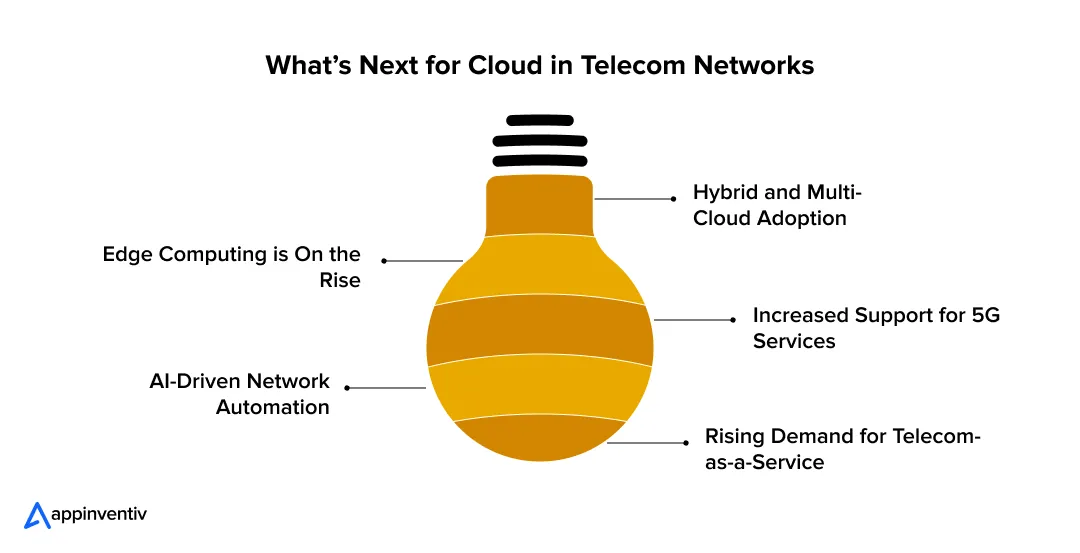
Hybrid and Multi-Cloud Adoption
The adoption of hybrid and multi-cloud models to achieve improved scalability and flexibility is gaining traction among telecom providers, with 27% already running network functions in public cloud. Despite its promise of interoperability, compatibility, vendor independence and stable business value, cloud native network development continues to pose challenges.
Edge Computing is On the Rise
Edge computing is playing an important role in lowering latency and enabling real-time applications like IoT and smart cities for telecom companies. The global edge computing in telecom market is expected to reach $155.0 billion by 2034 with a CAGR of 30.8% from 2026 to 2034.
Increased Support for 5G Services
The global deployment of 5G and scaling up service are being driven by cloud computing. By 2030, 57% of all mobile connections will be on 5G, and the total economic impact of the industry on the world will reach $11.3 trillion.
AI-Driven Network Automation
Telecom networks are becoming more automated and efficient with the help of AI. According to operators that have adopted AI-powered planning engines, they see 10%–20% reduction in the capex for greenfield deployments, 15%–35% reduction in capex for upgrades and a 20%–30% reallocation of capex to lower-ROI investments per annum.
Rising Demand for Telecom-as-a-Service
As service providers seek to offer scalable communication solutions at reduced infrastructure costs and with quicker deployment, the TaaS models are taking hold.
How Appinventiv Enables Telecom Cloud Transformation
The telecom sector is about to transition into a time of importance regarding network intelligence, scalability and real-time service delivery and its importance to long-term growth. With the emergence of new technologies like 5G, AI, edge computing and IoT, telecom operators are facing growing challenges to efficiently and rapidly manage complex digital ecosystems.
As a reliable telecommunication software development company, Appinventiv provide scalable cloud solutions to meet the needs of telecom businesses looking to upgrade their infrastructure. Our teams provide a range of solutions for telecoms to help build secure, future-ready ecosystems for sustainable digital growth, from cloud migration and network modernization to integrating AI and developing cloud-native applications.
Our industry-leading cloud consulting services offer professional cloud services and support businesses at every development stage. From cloud consulting services to transformation strategies and planning, cloud management and support, etc., we can streamline your business process for maximum scalability.
Whether your telecom business is just starting its cloud journey or needs a quick optimization in its existing cloud infrastructure, we are here to help. Talk to our cloud experts to get started.
FAQs
Q. How to implement the cloud in the telecom industry?
A. Here are the steps to implement cloud technology in your telecom business:
Step 1: Assess Existing Telecom Infrastructure
Evaluate current network architecture, applications, storage systems, and operational challenges to identify areas suitable for cloud migration.
Step 2: Establish your Cloud Strategy and Business Goals
Set goals for cloud adoption in telecom, whether it be scalability, cost of infrastructure, support for 5G services, or network performance.
Step 3: Select an Appropriate Cloud Model
Choose an appropriate deployment model (public, private, hybrid or multi-cloud).
Step 4: Adopt NFV and Cloud-Native Technologies
Modernize Telecom network functions and agility through the implementation of NFV, containerized applications and Cloud native platforms.
Step 5: Strengthen Security and Compliance
Implement robust security policies, encryption techniques, identity management systems, and compliance standards to safeguard telecom data and operations.
Step 6: Automate Network Management
Leverage AI-powered automation and orchestration to streamline network monitoring and traffic management, maintenance, and service deployment.
Step 7: Monitor, Optimize, and Scale
Monitor, optimize and scale cloud performance, workloads and infrastructure as per changing network requirements and customer needs.
Q. What is a telco cloud, and why is it important?
A. A telco cloud is a cloud-based telecom infrastructure offering virtualized and software-based networks, applications and services that operators can use to run their networks.
It’s crucial because it enhances scalability, cuts down on operational expenses, aids with the rollout of 5G, and permits telecom companies to offer more adaptable, automated, and efficient digital services in contemporary communication networks.
Q. Which cloud service is best for a telecom company?
A. Some of the best cloud computing services for telecom businesses are Amazon Web Services, Microsoft Azure, Google Cloud, IBM Cloud, Alibaba etc., popular for maintaining tele cloud networks and on-demand cloud platform solutions. However, if you require custom cloud solutions, it is suggested to seek technical guidance from a reliable cloud professional service provider.
Q. How does Cloud computing help in telecommunications?
A. Cloud computing in telecom offer modern businesses scalability, flexibility, security and operational efficiency at a low cost. You also get a varied range of user-friendly software solutions under one platform.


Fast 2-minute response, fully NDA-protected.

How to Build a DESC-Compliant Azure Architecture in the UAE Without Data Residency Risks
Key takeaways: Azure UAE data residency compliance is not just about choosing UAE North or Central; logs, backups, APIs, identity flows, and monitoring paths also need control. DESC-aligned Azure architecture should be planned before deployment or migration to avoid audit issues, delayed approvals, and expensive rework. Enterprises must map the full data journey across storage,…

How Cloud Services Accelerate Product Development for Businesses
Key takeaways: Cloud product development changes the speed, cost, and risk profile of modern software delivery. The cost of cloud product development ranges between $40,000 and $400,000 or more. Cloud platforms give you instant access to AI/ML, edge computing, and advanced analytics without dropping tons of money upfront. Appinventiv supports enterprise cloud product development through…

Green Cloud - How Cloud Adoption Helps Improve Sustainability/ESG Goals of Enterprises
Key takeaways: Adopting green cloud solutions lowers energy consumption, cuts emissions, and reduces operational costs. Companies like UEM Edgenta and Bharti Airtel have seen measurable improvements in sustainability and efficiency. AI Enhances Green Cloud Efficiency. AI optimizes energy use, predicts demand, and minimizes waste in cloud infrastructure. Your Green Cloud Roadmap. Start with an infrastructure…














