



































5G IoT Technology: Enterprise Applications, Architecture, Benefits, and Future Trends

 Share -


- 01Enterprise Applications of 5G-Advanced IoT Across Industries
- 02Business Outcomes of AI and Advance 5G IoT Integration
- 03Technologies Powering Next-Generation 5G IoT Deployments
- 04What Does a Modern Enterprise Advance 5G IoT Architecture Look Like?
- 05Private 5G Networks and the Future of Enterprise Connectivity
- 06Key Challenges Slowing Advance 5G IoT Adoption and Solutions
- 07How Can Enterprises Build a Successful Advance 5G IoT Strategy?
- 08Advance 5G IoT Security with Billions of Connected Devices
- 09How 5G-Advanced Redefines Enterprise IoT
- 10Satellite NTNs Expand Cellular Coverage
- 11Preparing for the 6G Era
- 12Signs Your Organization May Be Ready for Advance 5G IoT Transformation
- 13How Appinventiv Helps Firms Build Future-Ready 5G IoT Networks
- 14Frequently Asked Questions

Key takeaways:
- 5G-Advanced is shifting enterprise IoT from connectivity infrastructure to AI-driven, autonomous operational ecosystems.
- Private 5G, RedCap, and edge computing are making large-scale IoT deployments more secure and commercially viable.
- AI-powered IoT systems now support predictive maintenance, real-time decision-making, and self-managing enterprise operations.
- Satellite-enabled IoT and Non-Terrestrial Networks are extending enterprise connectivity beyond traditional network boundaries.
- Organizations investing in scalable 5G architectures today will be better positioned for the transition toward 6G-enabled intelligent enterprises.
The conversation about 5G IoT has changed. A few years ago, companies focused on network coverage. Today, 5G runs core corporate operations. It is everywhere. Manufacturers run production lines on private 5G networks. Hospitals stream patient data from thousands of medical devices. Logistics firms track fleets and inventory across global routes.
The real change involves intelligence rather than speed. Modern networks combine edge computing and artificial intelligence. This combination creates faster choices on the factory floor. Data no longer travels through long processing chains. Computers process data at the local source.
The 5G-Advanced standard accelerates this trend. The system builds artificial intelligence directly into the network. It improves data upload speeds and tracking tools. New tools like RedCap and satellite networks lower entry costs.
Corporate leaders now prepare for the future 6G standard. These investments will power the next wave of automated operations.
Industry forecasts indicate that the global 5G internet of things market will reach $479 billion by 2034, underscoring the scale of enterprise investment in connected technologies.
Let’s explore the technologies and enterprise applications driving the next phase of 5G and Internet of Things adoption.
Tomorrow’s leaders are building scalable IoT foundations today. Delaying modernization increases future migration costs.
Enterprise Applications of 5G-Advanced IoT Across Industries
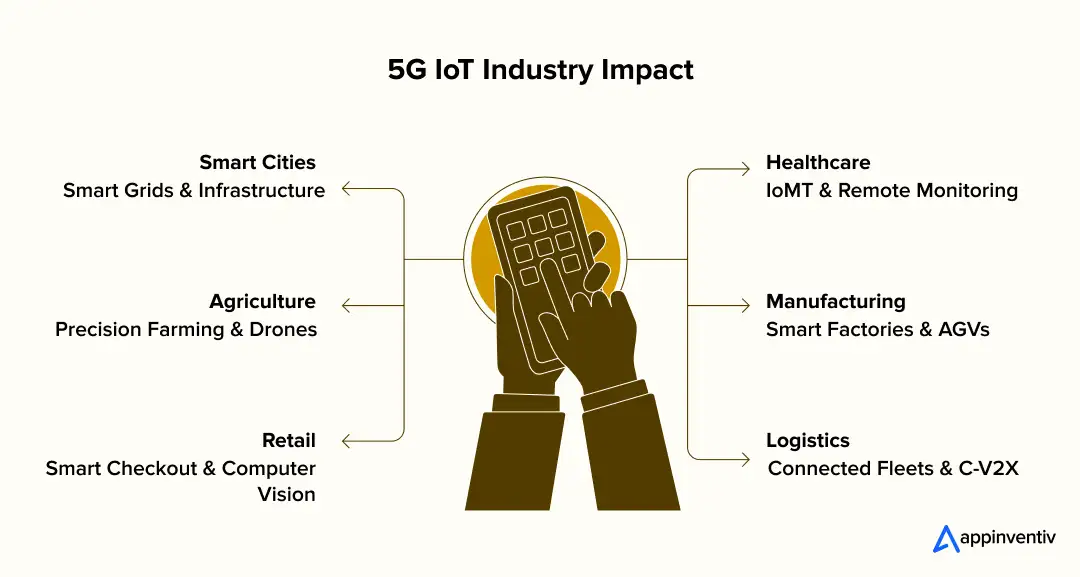
IoT in enterprise has moved well beyond small tests as firms across healthcare, manufacturing, transport, utilities, farming, and retail now deploy this hardware in live operations.
They provide executives with clear data and accelerate corporate decision-making. 5G networks are growing. Tools like Edge AI and RedCap are easy to buy. The list of practical 5G IoT use cases grows daily.
Healthcare and Connected Care
Overview
Clinics build connected spaces to upgrade medical data delivery. The widespread use of IoT in healthcare shows how modern hospitals update their medical networks.
How It Works
Teams establish connected medical clinics by deploying the IoMT technology in healthcare. Specialized medical machinery, active patient monitors, diagnostic gear, and hospital tools trade information instantly over a single unified network path.
Impact
The deployment of 5G in healthcare speeds up medical diagnostics. High-resolution MRI results, CT scans, and detailed clinical images travel instantly to off-site medical specialists to cut down delays during critical reviews. Remote patient monitoring serves as a primary setup type.
Connected wearables and wireless remote monitors stream baseline health metrics straight to central hospital databases without relying on local Wi-Fi networks. Medical staff views critical patient health data from any off-site location.
Example
The First Affiliated Hospital of Zhengzhou University deployed active 5G IoT sensors. These specific sensors track physical medical tools across several separate buildings. The live location data helps hospital staff find hardware fast and stops clinic workers from wasting valuable time on manual searches.
Also Read: Smart Technology in Healthcare
Manufacturing and Industrial IoT
Overview
Modern production factories represent a fully mature market for corporate 5G IoT setups. Industrial plants depend on thousands of linked tracking tools, machine vision systems, automated robots, and operational technology platforms.
How It Works
These complex machinery setups demand stable communication links with very low data latency. Private 5G networks are expanding rapidly inside heavy industrial spaces. The local installations run Automated Guided Vehicles, predictive maintenance schedules, detailed digital twins, and live production tracking without public cellular towers.
Impact
Assembly plant cameras send pictures over secure networks. Local artificial intelligence models analyze these images to detect structural assembly defects immediately. This automated monitoring setup maintains plant output and prevents defective items from leaving the factory floor.
Example
The Robert Bosch Elektronik factory located in Germany illustrates this automated trend. Teams from Bosch Rexroth and Qualcomm tested advanced 5G automation tools inside that facility to run self-driving mobile robots alongside automated AI quality checks.
Also Read: IoT in the Mining Industry
Transportation and Logistics
Overview
Global shipping operations generate massive data volumes across delivery trucks, storage warehouses, freight hubs, and distribution supply chains. New cellular links move this corporate information with minor data delays to form a tightly linked logistics network.
How It Works
Cellular Vehicle-to-Everything technology serves as the preferred system for corporate truck communications. This setup represents a core part of 5G in automotive systems, where delivery vehicles trade operational facts with roadside hardware units, central traffic management computers, and neighboring cars.
Impact
This continuous data sharing spreads critical safety updates across transit routes. Fleet operators use live truck telemetry, route software, and predictive maintenance programs to cut unexpected downtime and operational waste. Constant tracking of vehicle health and cargo status speeds up strategic logistics choices for corporate leaders.
Example
Freight firms across North America and Europe actively adopt these connected fleets. They combine vehicle sensors with cellular hardware to monitor transport assets across thousands of miles of open highway.
Smart Cities and Utilities
Overview
Modern IoT in smart cities projects connect and manage scattered physical assets. City traffic lights, security cameras, environmental air sensors, power grids, and emergency networks create constant data streams.
How It Works
Power companies deploy hardware to modernize large energy grids. Connected power substations, smart utility meters, and grid monitors give engineering teams clear data on power lines. Smart home automation principles extend directly into commercial buildings to link HVAC units, overhead lights, water valves, and security sensors to a central control network.
Impact
Variable traffic systems use this data to reduce urban congestion. Connected cameras and road sensors gather live traffic data so city workers can change light timing rules based on this incoming information. This step cuts gridlock on busy municipal roads. Inside managed facilities, building parts react instantly to shifting environmental conditions to save energy.
Example
Municipal operators combine road sensors and cellular links to manage downtown traffic. The automated grids adjust intersection delays in real time based on active vehicle counts.
Agriculture
Overview
Modern farming relies heavily on precise data. The expansion of IoT in agriculture changes how growers work. Farmers deploy connected tools to monitor soil moisture, local weather, crop status, and watering systems across massive acreage.
How It Works
Precision farming models demonstrate this clear operational shift. Connected physical sensors collect constant environmental metrics from fields while drones with high-definition cameras view growing fields from above. Remote locations combine standard 5G networks with low Earth orbit satellites.
Impact
The gathered data helps managers schedule exact watering times and fertilizer use. Aerial drone imagery lets workers spot crop diseases early. This combined satellite-cellular pairing brings continuous tracking tools to isolated rural regions that previously lacked traditional cellular towers.
Example
Large farming corporations plant wireless sensors throughout thousands of acres of land. The devices stream soil quality metrics to management software via hybrid satellite networks.
Retail
Overview
The corporate role of IoT in retail goes well beyond customer convenience. Large retailers use new cellular networks to cut stock waste and assist shoppers. Connected storefronts offer live updates regarding inventory levels, buyer habits, and floor operations.
How It Works
Smart checkout counters operate inside many modern stores. Automated stock software uses connected physical sensors and computer vision tools. AI theft prevention systems run on private 5G networks where connected cameras and sensors constantly monitor store aisles. Store owners also test advanced augmented reality features.
Impact
These tracking systems keep inventory counts completely exact to cut out manual clipboard logs. The security sensors alert store managers to suspicious behavior and scan errors immediately. The augmented reality tools combine customer phones, store hardware, and fast cellular links to engage active buyers.
Example
Retail brands deploy smart shelves equipped with weight sensors and cameras. The system updates the backend inventory database immediately when a customer removes an item.
Business Outcomes of AI and Advance 5G IoT Integration
Firms invest in 5G IoT to achieve specific financial and operational outcomes. The unified network connects hardware, live data, and artificial intelligence into self-managing systems. These systems analyze data and fix problems without human intervention.
From Simple Data Tracking to Autonomous Reasoning
Older IoT 5G systems gathered and sent basic data. Artificial intelligence adds reasoning to this step. Connected devices no longer just report facts. The tools spot patterns, predict outcomes, and suggest fixes immediately. This combination runs core business operations across factories, shipping firms, clinics, and power plants.
Large-Scale Predictive Maintenance and Higher Visibility
Unplanned downtime strains corporate profits. Connected sensors check machine heat, vibration, pressure, and power use constantly. AI software studies this data to find small faults.
This step stops sudden machine breakdowns and cuts repair costs. The network provides continuous monitoring across all corporate sites. Leaders get clear operational data to handle unexpected disruptions fast.
Edge AI and Immediate Decision-Making
Operational choices require fast action. Data cannot wait to travel to central cloud servers. Edge AI reduces this delay by making data analytics faster by processing data near the hardware. For instance, a factory camera checks parts on an assembly line.
It spots flaws instantly using local programs. Fast cellular networks reduce delays. This reduction remains a defining strength of 5G IoT applications. Managers can read about this setup in the article How Edge Computing Enhances IoT App Performance.
Also Read: How Edge Computing Enhances IoT App Performance
Workflow Automation and Asset Growth
The network handles complex workflows without human effort. Automated systems check operating conditions, trigger alerts, and fix backend processes. This automation cuts overhead costs. Real-time tracking also shows how teams deploy vehicles, inventory, and tools. Managers can redistribute corporate resources to maximize overall asset performance. Clean data streams power digital twins and advanced analytics pipelines.
Agentic IoT Systems
Firms now adopt Agentic IoT Systems. These setups combine connected hardware, artificial intelligence agents, and automated work steps. The tools work without human help to check operations and spot errors.
They start responses and manage connected corporate assets instantly. For example, a warehouse database redirects inventory during a sudden machine breakdown. This creates self-managing workspaces that adjust to new situations immediately.
Technologies Powering Next-Generation 5G IoT Deployments
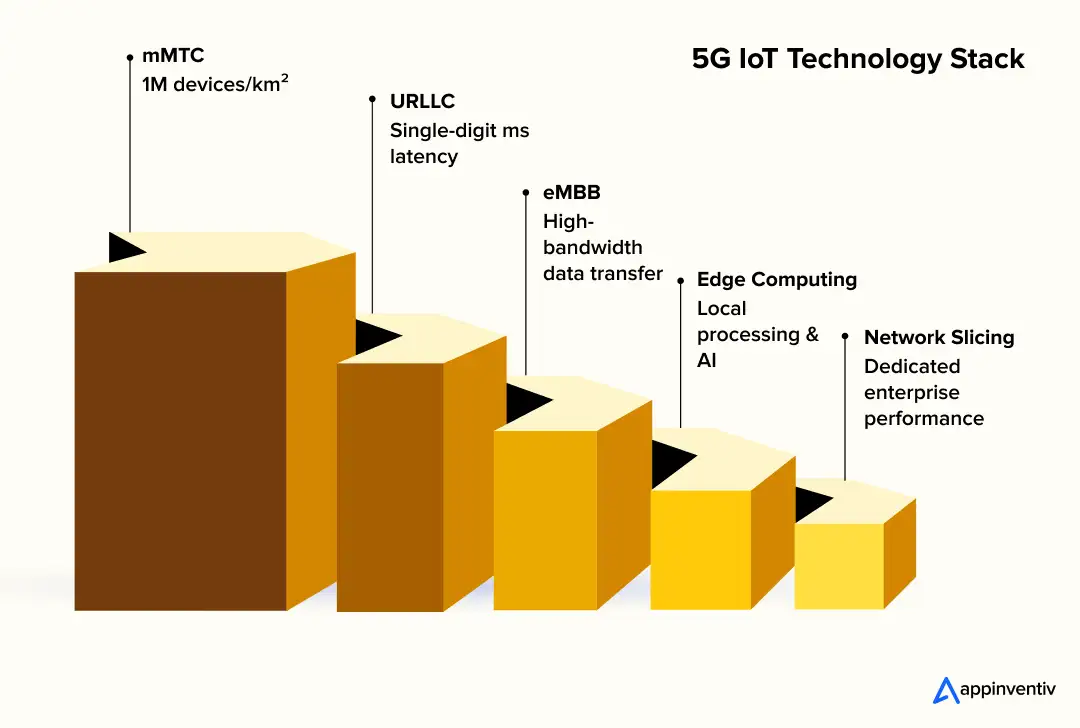
Modern networks require more than speed. They must run large device networks and process real-time data. IoT in telecom provides a clear competitive edge by helping firms automate workflows. This foundation scales 5G IoT operations across the company.
Massive Machine-Type Communications (mMTC)
Firms connect millions of meters and sensors. The mMTC standard links up to one million devices per square kilometer without network traffic jams. This tool gives leaders clear asset visibility. This scalability is becoming increasingly important as the IoT 5G device ecosystem worldwide is projected to reach 21.1 billion connected devices in 2025.
Ultra-Reliable Low-Latency Communications (URLLC)
Robots and self-driving vehicles need instant communication. URLLC cuts data delays to single-digit milliseconds. This feature supports automated assembly lines and predictive maintenance where delays risk worker safety.
Enhanced Mobile Broadband (eMBB)
Video tracking and digital twins create massive data workloads. The eMBB feature provides the high bandwidth required to transfer heavy data streams. It helps teams run complex programs across factories and clinics.
Edge Computing and Network Slicing
Sending all data to the central cloud computing for business networks increases lag. Edge computing in enterprise fixes this by processing data near the physical devices.
Network slicing builds separate virtual paths for distinct jobs. For example, managers can separate robotics data from other corporate traffic. These tools combine to create fast, scalable IoT and 5G networks.
What Does a Modern Enterprise Advance 5G IoT Architecture Look Like?
A corporate 5G IoT setup requires more than network coverage. Companies need an architecture to collect, process, and analyze massive files across operations. This 5G IoT architecture uses multiple layers to turn raw data into business results.
Device and Sensor Layer
This asset layer anchors the 5G IoT setup. It includes industrial sensors, smart meters, cameras, robots, and medical gear. These tools generate continuous data for automated tasks and real-time choices.
Connectivity Layer
This layer builds secure communication between devices and corporate systems. Firms use public 5G networks, private 5G infrastructure, network slicing, or satellite links. The system transmits data to support large device fleets and low-latency work.
IoT Platform and Data Management Layer
The platform serves as the operational control center. It handles device onboarding, authentication, monitoring, and firmware updates. It creates a central view to organize data across millions of connected assets.
AI and Analytics Layer
AI and machine learning models analyze operational data to find patterns and predict failures. They automate routine decisions and streamline workflows. Teams use this layer to run predictive maintenance and autonomous operations.
Enterprise Application and Integration Layer
This final layer links data with core business systems like ERP, CRM, and MES software. This connection updates corporate workflows to help leaders make fast choices. Combining these layers helps companies run automated systems and prepare for 5G-Advanced and 6G tools.
Private 5G Networks and the Future of Enterprise Connectivity
Public 5G and IoT networks support many corporate needs. Some firms require more control over network speed, safety, and data. This need drives corporate interest in private 5G networks. These dedicated cellular networks serve a single firm or facility.
Why Enterprises Deploy Private 5G
The IoT connectivity benefits become clearest when firms gain direct control over network assets and speed through private 5G. This matters for operations groups. Network reliability and low delays directly change corporate profits.
Main drivers include:
- Stable network speeds for critical business programs
- Dedicated bandwidth away from public data traffic jams
- Better control over network rules and setups
- Support for large IoT networks inside a defined site
Wi-Fi fails across big spaces. Private 5G maintains stable connections across large corporate campuses, factories, warehouses, ports, and power plants.
Security, Data Sovereignty, and Operational Control
Many companies face strict laws regarding data storage. Private 5G allows firms to keep sensitive operational data inside their own walls. The system does not route traffic through public networks.
This system supports:
- Stronger local data ownership rules
- Separate networks for factory machinery
- Lower exposure to public network threats
- Clear visibility into connected hardware and data paths
Some industries manage critical infrastructure or regulated data. For these firms, network ownership provides a clear business advantage. It is no longer just an IT choice.
Industry Adoption Patterns
Private 5G deployment is growing rapidly across sectors that depend on real-time operations and connected machinery.
| Industry | Common Private 5G Use Cases |
|---|---|
| Manufacturing | Robotics, AGVs, machine vision, predictive maintenance |
| Logistics | Truck coordination, warehouse automation, asset tracking |
| Healthcare | Connected medical gear, patient tracking and hospital operations |
| Energy | Power grid monitoring, remote asset management and field operations |
Real-World Private 5G Deployments
Current operations prove the value of private cellular hardware. For example, AT&T runs a private 5G AI grid project. This setup combines dedicated connections with AI management for critical infrastructure sites.
Globalstar operates the XCOM RAN platform. The system runs industrial automation and physical AI tools. These programs need reliable, low-latency communication.
Firms deploy more AI, automation, and connected tools. Private 5G serves as the base layer for corporate IoT sites. These operations cannot risk unstable networks.
Key Challenges Slowing Advance 5G IoT Adoption and Solutions
The benefits of 5G IoT are clear. Large deployments are rarely simple. Companies must fix technical, operational, and governance problems before they get full value from connected networks. Spotting these barriers early cuts deployment risks and improves long-term results.
Integrating with Legacy Infrastructure
Many firms face digital transformation challenges as they still rely on old factory technology, industrial control systems, and local hardware. Engineers never designed these tools for modern network needs. Linking old systems with 5G hardware requires protocol translation, middleware layers, API connections, and network updates. Poor planning lets old hardware slow down project timelines and increase setup costs.
Managing Large Device Networks
A standard corporate IoT network includes thousands or millions of connected endpoints. Every tool needs setup, authentication, monitoring, firmware management, and lifecycle tracking. Device counts grow. Teams must build central management systems that support specific tasks:
- Asset visibility
- Device onboarding
- Remote diagnostics
- Firmware updates
- Security rule enforcement
Without these tools, daily operational complexity becomes impossible to manage.
Data Governance and Regulatory Compliance
5G IoT setups create massive amounts of operational and customer data. Corporate leaders must decide where data resides, who can view it, and how teams protect it throughout its lifecycle. Compliance rules vary by industry and region, with frameworks like GDPR compliance covering:
- Data privacy
- Data residency
- Cybersecurity
- Critical infrastructure protection
Strong governance setups become more critical as connected sites expand.
Also Read: Data Analytics in Fintech
Skills and Operational Readiness
Successful rollouts require skills in networking, cloud hardware, cybersecurity, data engineering, AI, and IoT operations. Many firms struggle to find teams with experience across all these fields. Building internal skills and hiring tech partners can close knowledge gaps. This step speeds up rollout readiness.
Cost and Deployment Complexity
Corporate 5G IoT plans require network hardware, connected tools, edge computing resources, linking services, security controls, and constant management. Companies attempt massive setups without clear goals. They struggle to get measurable returns. Defining valuable use cases before setup aligns tech spending with business goals.
Recommended Strategies for Successful Deployment
Fixing 5G IoT connectivity issues requires a structured plan rather than a technology-first mindset. Organizations that achieve the strongest results typically:
- Start with high-impact 5G IoT use cases
- Build security and governance into deployment plans
- Modernize legacy systems in phases
- Establish centralized device management practices
- Align connectivity, AI, cloud, and edge plans from the outset
A step-by-step setup model lets firms confirm value early, cut deployment risks, and build a base for long-term growth.
How Can Enterprises Build a Successful Advance 5G IoT Strategy?
Many firms see the value of 5G IoT but struggle to move past pilot tests. The best rollouts focus on clear business goals rather than the technology alone. A structured roadmap reduces risk, controls costs, and speeds up returns.
Step 1 – Prioritize High-Impact Use Cases
Start by identifying operational problems where real-time data delivers clear value. Common starting points include predictive maintenance, asset tracking, and smart manufacturing.
Step 2 – Evaluate Current Infrastructure
Assess your current network, old hardware, cloud setups, and security needs before setup. This step flags integration bugs early and prevents costly equipment redesigns later.
Step 3 – Choose Your Connectivity Plan
Match your network architecture to your operational goals. Choose between public 5G, private 5G, or satellite links. Your choice depends on data lag, safety rules, and coverage needs.
Step 4 – Build a Scalable AI Foundation
Connected devices create massive data streams. Build a platform that handles edge computing, data governance, and AI analytics from day one. A strong foundation lets future projects expand without major network overhauls.
Step 5 – Build Security In Early
Embed security into every phase of the project. Do not treat defense as a final step. Use device verification, zero-trust rules, data encryption, and continuous monitoring to protect large hardware setups.
Step 6 – Start Small and Scale Up
Avoid company-wide changes right away. Launch targeted pilots that prove financial value first. Successful tests provide useful operational data, build executive confidence, and form a template for wider rollouts.
Treat 5G IoT as a long-term corporate plan rather than a basic network upgrade to get steady results. Aligning connectivity, AI, and business software from the start helps leaders build resilient systems that adapt as technology changes.
Unlock real-time visibility, predictive intelligence, and operational resilience across connected environments.
Advance 5G IoT Security with Billions of Connected Devices
Firms link more hardware, sensors, and factory platforms every day. This growth widens the corporate cyberattack surface. Every connected endpoint serves as a potential entry point for digital threats. This risk makes strong protection a central part of deploying 5G for IoT at a corporate scale.
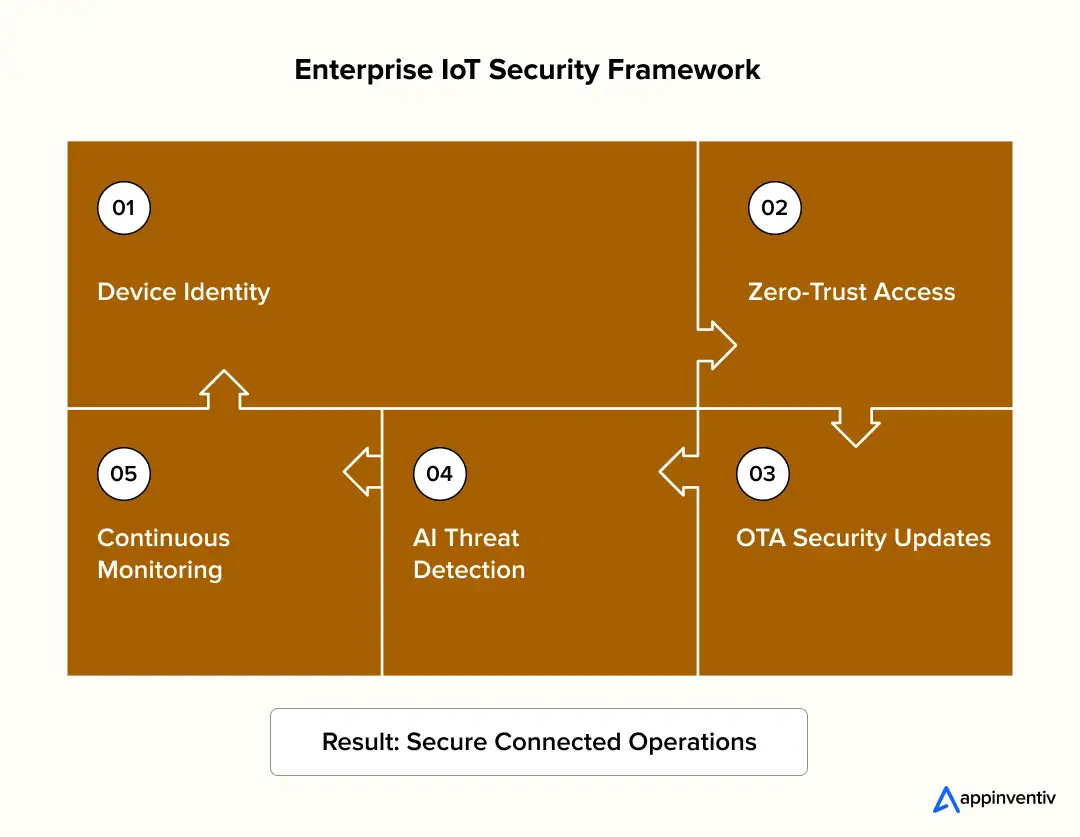
Why the IoT Attack Surface Swells
Modern corporate IoT networks connect thousands of tools across separate sites, networks, and operational groups. This growing hardware footprint raises threat exposure. It increases management difficulty.
Common Security Risks in Linked Networks
Common threats include botnet attacks, weak firmware, hardware hacks, and data theft during network transit. Poorly managed endpoints usually become the weakest link in the defense chain.
Zero-Trust Security for Corporate IoT
Zero-trust frameworks assume that no hardware or user deserves trust by default. The network must constantly verify every connection link, device identity, and data request to grant access.
Device Identity, OTA Updates, and Lifecycle Defense
Clear device identity management helps teams authenticate connected assets during their operational lifespan. Over-the-air (OTA) updates push safety patches and firmware upgrades quickly across large hardware fleets.
AI-Driven Threat Detection and Monitoring
AI-powered safety platforms check data traffic paths. They spot unusual behavior and stop cyber threats from halting factory output. Connected networks expand. Automated threat checks become critical to protect business continuity.
How 5G-Advanced Redefines Enterprise IoT
Many firms no longer see standard 5G setups as the final goal. Corporate focus now shifts toward 5G-Advanced. This update builds on the new 3GPP Release 18 rules. The system does not replace the hardware that companies own today. Instead, it adds better network intelligence, more automation, and broader device compatibility. These features help organizations expand their connected daily operations with much less waste.
| Feature | Traditional 5G | 5G-Advanced |
|---|---|---|
| Network Intelligence | Rule-based adjustments | AI-assisted adjustments |
| IoT Device Support | Standard 5G hardware | Broad support for RedCap hardware |
| Location Accuracy | Meter-level tracking | High-precision tracking and sensing |
| Uplink Performance | Standard data upload limits | Better upload throughput and speed |
| Network Operations | Manual and policy systems | High automation through AI |
Telecom companies started commercial rollouts in 2025. These deployments will expand through 2026. Operators continue to upgrade current local systems.
AI-Native Networks and AI-RAN
The creation of AI-RAN marks a major technical step forward. Software engineers build artificial intelligence directly into core network operations. Teams do not need to make manual tracking adjustments anymore. The AI-powered systems automatically distribute wireless resources and balance data traffic. The software predicts network congestion before it happens and cuts total energy use.
Corporate teams managing large groups of connected devices get immediate benefits. This setup provides more dependable network performance across facilities. It reduces daily maintenance expenses and builds better support for advanced software applications.
Why Enterprises Should Prepare for 5G-Advanced
The technology brings corporate value that goes far beyond raw network speed. 5G-Advanced builds a stronger base for independent corporate operations. Better physical sensing tools and sharper location tracking give managers exact asset data. Wider compatibility with RedCap hardware allows firms to build large, low-cost connected networks.
The impact of 5G on apps and enterprise systems is growing as corporate leaders continue to spend capital on automation, edge computing, and smart choice-making tools. 5G-Advanced will play a major role in these setups. The technology serves as the main architecture that powers future digital networks.
Satellite NTNs Expand Cellular Coverage
Ground towers limit traditional networks. Remote farms, offshore platforms, and pipelines suffer from signal loss. Non-Terrestrial Networks, or NTNs, fix this problem. The system builds satellite links directly into 5G infrastructure.
How Satellite Integration Works
NTNs combine low Earth orbit satellites with 5G core networks. This mix sends data without local cell towers. Space-based services leave the trial phase in 2026. Providers like Starlink build direct-to-device tools.
Corporate Use Cases
Farms connect rural soil sensors, and maritime firms track cargo ships. Energy teams monitor remote pipelines. Leaders can now deploy IoT and 5G devices anywhere.
Preparing for the 6G Era
Commercial 6G networks will arrive in the next decade. Forward-thinking firms now plan their corporate spending on AI, 5G and Internet of Things tools. Global connected devices will exceed 50 billion by 2035. Early planning prevents expensive equipment redesigns later.
How 6G Changes Operations
6G builds artificial intelligence directly into the network footprint. The system combines wireless links with radar-like physical sensing. Digital twins and automated machines will trade data instantly to sync physical and digital workspaces.
Actionable Steps for Leaders
Preparation does not require immediate hardware replacement. Instead, teams must invest in scalable edge computing hardware and flexible IoT platforms. These open setups accept new software standards easily. Early preparation secures a clear market advantage.
Build architectures that support 5G-Advanced, AI-RAN, satellite connectivity, and future 6G innovations.

Signs Your Organization May Be Ready for Advance 5G IoT Transformation
Some companies do not need a large 5G IoT deployment right now. Specific business problems show that your current network blocks corporate growth and new ideas. Your business will gain from a clear 5G IoT strategy if your teams face these specific operational issues:
- Your fleet of connected sensors grows constantly and becomes hard for teams to run across large sites.
- Managers lack immediate visibility regarding physical machinery, store inventory, tools, or scattered field operations.
- Constant machine breakdowns stop daily corporate output and lower overall factory performance.
- Separate information databases, trap files and stop artificial intelligence programs from delivering useful business results.
- Old wireless networks fail to process heavy data from smart machines and edge computing tasks.
- Active network modernization projects require safe, expandable communication networks with minimal data delays.
Firms expand artificial intelligence tools, machine automation, and linked devices across facilities. 5G IoT serves as the core technical baseline that helps these corporate systems grow to match business demand.
How Appinventiv Helps Firms Build Future-Ready 5G IoT Networks
Setting up 5G IoT across large organizations requires more than simple data links. Firms must connect old machinery, protect millions of devices, and manage data flows. They need to handle AI programs and prepare networks for future updates.
As a leading telecom software development company, Appinventiv addresses these problems through custom IoT engineering, AI deployments, edge computing, private 5G networks, and secure coding practices.
| Metric | Achievement |
|---|---|
| Connected IoT Platforms Delivered | 250+ |
| Industries Served | 35+ |
| Security Standards Compliance | 100% |
Our experience covers several operational fields:
- AI-powered IoT platforms and edge data management
- Private 5G networks and industrial IoT setups
- Connected medical clinics and IoMT networks
- Smart factories and advanced automation projects
- Smart power networks and utility updates
- Safe device tracking and network governance
Firms are now adopting 5G-Advanced features such as AI-RAN, new sensing tools, and RedCap devices. Appinventiv builds network designs that handle current factory needs and future network changes. Our teams create scalable systems that accept upcoming tools like space-linked IoT and 6G networks.
Firms want to update operations, multiply connected assets, or build self-running workspaces using AI and 5G. Appinventiv delivers the technical skills to turn complex 5G IoT projects into clear business results.
Let’s connect and build future-ready IoT ecosystems before market leaders pull ahead.
Frequently Asked Questions
Q. What is 5G-Advanced in IoT?
A. 5G-Advanced marks the next stage of 5G networks. The system is based on the 3GPP Release 18 rules. It builds artificial intelligence directly into the network architecture. The update improves data upload speeds and tracking accuracy. These tools help firms run large machine networks with less waste.
Q. What are the advantages of 5G and IoT?
A. The pairing of 5G and IoT easily handles dense device networks. It cuts data delays and opens up massive bandwidth. This combination runs live-tracking and predictive-repair programs. It powers factory automation and smart building tools. Corporate leaders gain clear data views and higher daily output.
Q. How does private 5G support enterprise IoT?
A. Private 5G gives companies a dedicated network for their own facilities. It grants total control over data safety and network speeds. The system eliminates lag and easily runs massive hardware setups. It powers critical programs across factories, hospitals, shipping hubs, and power plants.
Q. What is the difference between 5G and 6G for IoT?
A. 5G delivers steady connections, low lag, and support for large device fleets. 6G will expand these features through a native artificial intelligence network. It combines wireless signals with radar-like sensing tools. The network will run fully self-managing corporate workspaces.
Q. How does AI improve 5G IoT applications?
A. AI changes basic data networks into smart workspaces. AI programs study data from connected machinery. They spot trends, predict mechanical breakdowns, and make automated choices. This step cuts waste. When combined with 5G networks, AI performs self-directed business steps.
Q. What is the role of OSS/BSS in IoT management?
A. Operations Support Systems (OSS) and Business Support Systems (BSS) manage large-scale hardware networks. OSS handles network tracking, device setups, and daily maintenance. BSS runs customer bills, service subscriptions, and account management. Together, they turn connected products into profitable business models.
Q. What is driving the evolution of 5G capabilities in IoT?
A. The evolution of 5G IoT is driven by advances in network connectivity, computing power, capacity, and functionality. The transition from non-standalone (NSA) to standalone (SA) deployment enables higher speeds, higher bandwidth and greater reliability, expanding the scope of enterprise IoT applications.


Fast 2-minute response, fully NDA-protected.

The Growing Threat of Telecom Fraud and How to Safeguard Your Business
Key takeaways: Telecom fraud continues to surge, with global losses now exceeding $1.03 trillion. Scams such as SIM swapping, subscription fraud, and call termination fraud are becoming increasingly sophisticated by the day. Getting ahead of fraud with solid detection and prevention systems isn't optional anymore—it's absolutely critical. Companies need to invest in AI-powered fraud detection…
Why OSS Architecture is the Innovation Engine Behind Next-Gen Telecom?
In an era where 5G rollouts, network slicing, and edge computing are redefining connectivity, telecom operators are under increasing pressure to innovate fast and operate smarter. Behind the scenes of these headline-grabbing advancements lies a less glamorous, but critical, component of the telecom engine: Operational Support Systems (OSS). OSS architecture in telecom may not be…

Telecom Billing Software Development - Benefits, Features, Process, Costs
Key takeaways: Telecom fraud losses reached $41.82B in 2025, and most billing leakage starts in mediation and rating, not collections. Custom telecom billing software costs $45K–$350K+. Migration, compliance, and dual-running add hidden costs that most budgets miss. Build if billing sets you apart, buy if your pricing is standard, and modernise if your core works…